
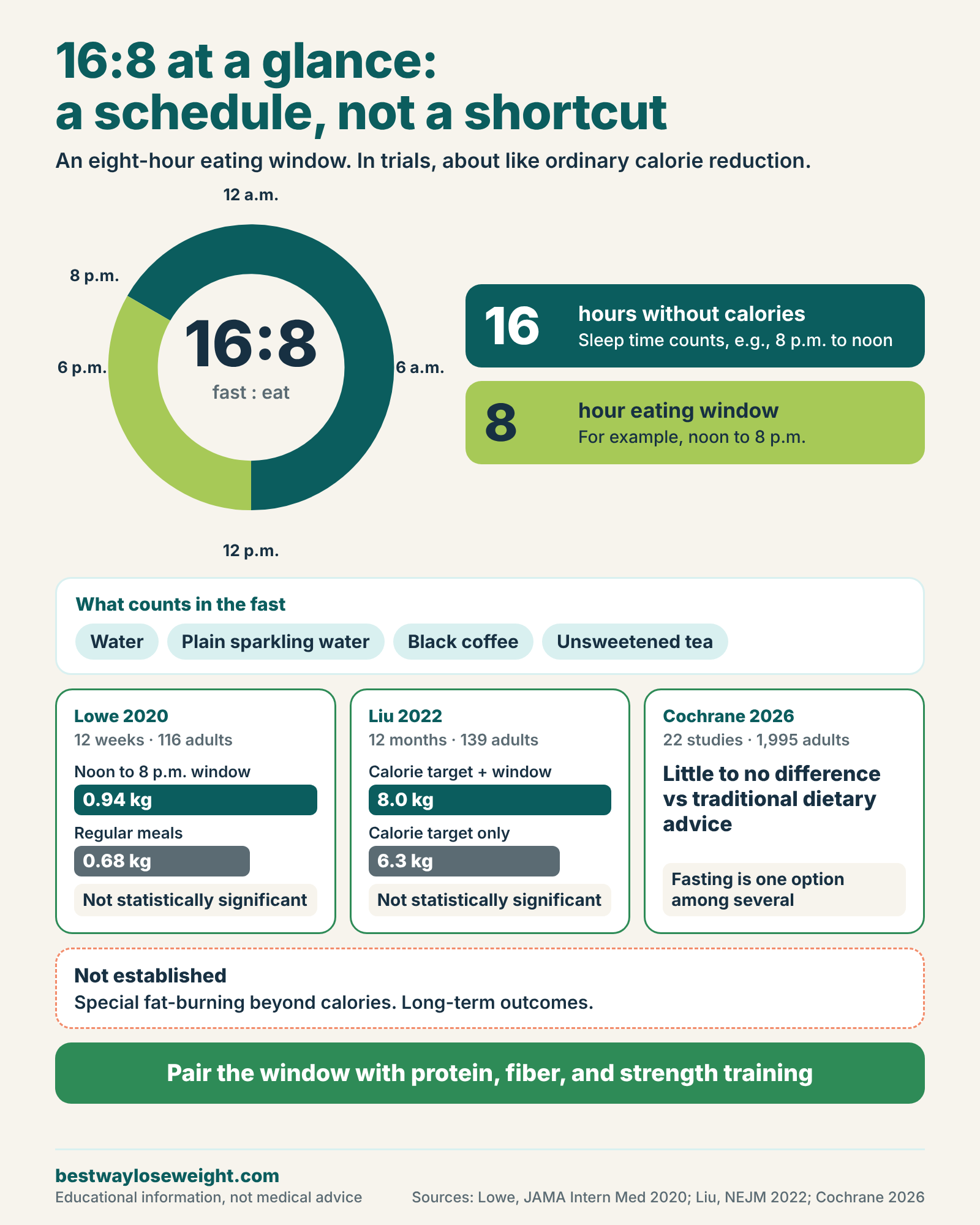
16:8 intermittent fasting means eating all of your food inside an eight-hour window and going 16 hours, including sleep, without calories. It is one of the simplest ways to structure a day, and for some people that simplicity makes it easier to eat a little less without counting everything. The research is more modest than the social media version: in head-to-head trials, 16:8 has generally not beaten ordinary calorie reduction, and results vary a lot from person to person.
This guide is written for adults who are curious about the pattern and want to try it sensibly. You will find what the best trials actually showed, a worked calorie example, a two-week start plan, sample days, workout and muscle guidance, troubleshooting for the problems people hit most often, and a clear list of who should talk to a clinician first. As of October 2026, that is the honest picture: 16:8 is a scheduling tool, not a metabolic shortcut.
Key Takeaways
The short version
What the evidence supports
- 16:8 can produce weight loss when it leads to a lower overall calorie intake. Several randomized trials found modest weight loss, and a 2026 Cochrane review of 22 trials found intermittent fasting did about as well as standard dietary advice.
- A fixed eating window can be easier to follow than counting calories for some people, particularly those who already skip breakfast or rarely snack late at night.
- Pairing the window with enough protein, fiber-rich foods, and resistance training is what protects muscle and fullness. The window alone does not.
- In one NIH-funded trial of 75 adults with type 2 diabetes, an eight-hour window led to more weight loss than usual eating over six months, but diabetes medicines make this a conversation to have with a clinician first.
What the evidence does not support
- That 16:8 beats a regular calorie deficit. In the 12-month NEJM trial that added an 8 a.m. to 4 p.m. window to calorie restriction, the extra weight loss was not statistically significant.
- That a 16-hour fast has special fat-burning powers beyond its effect on how much you eat. One expert commenting on a large 2025 meta-analysis put it plainly: there is nothing magical about intermittent fasting for weight loss beyond reducing overall calorie intake.
- That it is safe for everyone. Pregnancy, breastfeeding, a history of eating disorders, adolescence, and certain diabetes medicines are all reasons to get individual advice first.
- Long-term outcomes. Most trials last 12 weeks to 12 months, so what happens over years is still unknown.
Who this guide is for
Good candidates to consider 16:8
Healthy adults who want a simple structure, can eat balanced meals in a shorter window, do not take medicines that depend on food timing, and have no history of disordered eating. People who already eat their first meal late morning and find evening snacking is where most extra calories come from often find the transition easy.
People who should talk to a clinician first
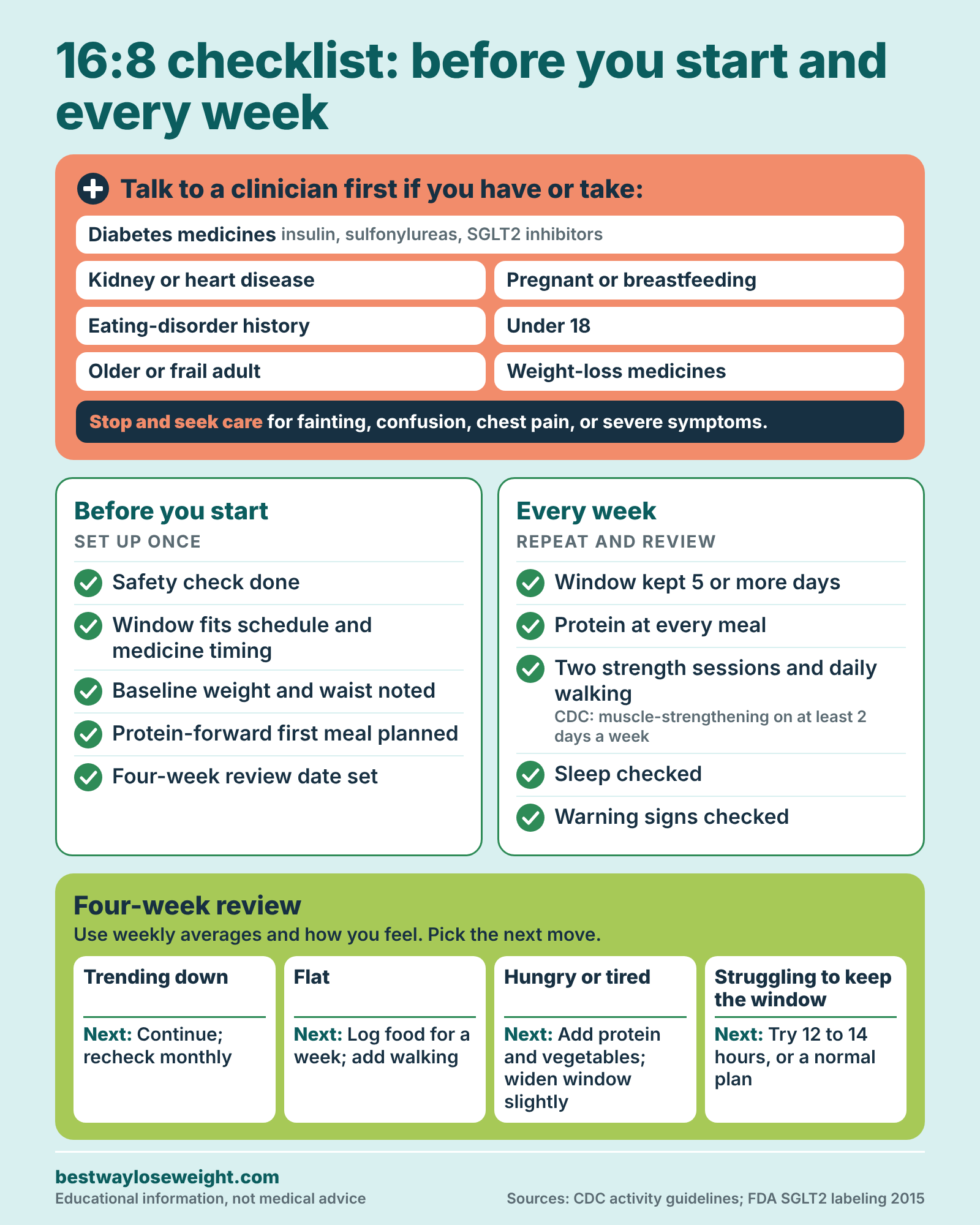
Anyone with diabetes or who takes insulin or other glucose-lowering medicines, anyone with kidney, heart, or digestive conditions, anyone who is pregnant, breastfeeding, or trying to conceive, anyone with a history of an eating disorder, anyone taking weight-management medicines, and anyone under 18, and older adults who are frail or losing weight without trying. The full reasoning is in the section on who should skip or adapt 16:8.
What 16:8 Intermittent Fasting Is (and What It Is Not)
The basic pattern: 16 hours off, 8 hours on
How the daily clock works
You pick an eight-hour block, eat all your meals and snacks inside it, and stay without calories for the other 16 hours. Harvard Health describes the pattern the same way: people eat during an eight-hour period, such as noon to 8 p.m., then fast for 16 hours, repeated daily. Because roughly seven or eight of those hours are sleep, a first-time faster usually only needs to move one meal, most often breakfast.
Researchers call this time-restricted eating (TRE) or time-restricted feeding. It is a rule about when, not about what or how much. That matters, because the rule says nothing about whether the eight hours include a balanced plate or a vending machine. Whatever quality or quantity pattern you already have will tend to follow you into the window.
What you can have during the fasting hours
The usual practice is water, plain sparkling water, black coffee, and unsweetened tea. These contain essentially no calories, so they are widely treated as compatible with the fast. The fine print, such as a splash of milk, a zero-calorie sweetener, or a bone broth cup, is covered in the drinks section. For most weight-management goals, the practical test is simple: if it adds meaningful calories, count it inside your window.
Where 16:8 sits among intermittent fasting methods
Time-restricted eating versus other schedules
Intermittent fasting is an umbrella term. The three main styles studied in trials are time-restricted eating (a daily window, like 16:8), whole-day fasting (such as 5:2, which means five regular days and two days of very low calories), and alternate-day fasting (reduced calories every other day). The evidence on each is different, and the broader comparison lives in our guide to intermittent fasting for weight loss and what the evidence says. This article stays on the daily window.
| Style | What it looks like | Main practical strength | Main practical challenge |
|---|---|---|---|
| 16:8 (time-restricted eating) | Eat within 8 hours daily, fast 16 hours | Same rhythm every day; no counting fasting days | Fits poorly with early training, family dinners, or shift work if the window is rigid |
| 5:2 | Two non-consecutive days of very low calories each week, normal eating the other five | Five “normal” days | Low-calorie days can feel hard; not suitable for people on glucose-lowering medicines without guidance |
| Alternate-day fasting | Very low calories every other day | A clear on-off rhythm that some people prefer | Hunger and fatigue on fasting days; the strictest to maintain |
| 12:12 or 14:10 | A longer overnight break without a strict window | Gentle starting point; easy socially | Less studied for weight loss as a stand-alone strategy |
Why 16:8 became the popular choice
It is the easiest to explain and the easiest to repeat. Nothing changes day to day, no special foods are required, and there is no “fasting day” to dread. A 2025 network meta-analysis reported by Harvard’s T.H. Chan School of Public Health pooled 99 trials with more than 6,500 participants; alternate-day fasting showed the largest edge over calorie restriction in that analysis, about 1.3 kg (roughly 3 pounds) more weight loss, while time-restricted eating performed similarly to calorie restriction. Similar performance with fewer rules is exactly why many people choose it.
What happens in your body during a 16-hour fast
The plain-English timeline
After a meal, your body spends several hours digesting and absorbing nutrients, and insulin (the hormone that moves sugar from your blood into cells) is elevated. Once that passes, insulin falls and your body draws more on stored energy: first glycogen (sugar stored in the liver and muscles), then more fat as the hours go by. At about 16 hours without food, most healthy adults are in a mild version of this state, with no dramatic shift. Ketone levels (fuel molecules the liver makes when carbohydrate is scarce) generally stay low after an overnight fast plus a skipped breakfast, and nothing special “switches on” at hour 16 that was not already trending since hour 8.
This is why online claims of precise hour-by-hour fat burning, autophagy (cell “clean-up” processes), and hormonal resets deserve skepticism. Much of the mechanism research comes from animals or from small, short human studies, and the weight data in people are what matter for this guide.
What is and is not well established
Plausible and commonly proposed: a shorter eating window can reduce calorie intake without people consciously trying to, because there are fewer chances to eat, although trials do not consistently show that it does. Reasonable but less certain: some people find hunger and appetite regulate more predictably with consistent meal times, and some trials show small improvements in blood sugar, particularly in people with type 2 diabetes. Not established: any benefit on body weight beyond what the calorie change explains, benefits for lean mass, or lower risk of heart disease or earlier death over the long run.
In short, the 16-hour fast is best seen as a container for eating, not a trigger for anything. The next section looks at how that container performed in randomized trials.
Does 16:8 Intermittent Fasting Work for Weight Loss? What the Research Shows
What randomized trials of 16:8 and similar windows found
The 12-week trial that tested 16:8 on its own (Lowe, 2020)
This is the clearest test of 16:8 as a stand-alone change. Researchers in San Francisco randomized 116 U.S. adults aged 18 to 64 with a BMI of 27 to 43 to either time-restricted eating or a comparison group told to eat three structured meals a day. The time-restricted group ate whatever they liked between noon and 8 p.m. and fasted from 8 p.m. until noon the next day, a 16:8 pattern. Over 12 weeks, the time-restricted group lost about 0.94 kg (roughly 2 pounds) and the comparison group lost about 0.68 kg. That 0.26 kg gap was not statistically significant. The authors concluded that time-restricted eating, in the absence of other interventions, was not more effective for weight loss than eating throughout the day. The trial also reported a statistically significant difference in appendicular lean mass index (a measure of arm and leg lean tissue relative to height) favoring the comparison group, which is one reason muscle protection gets its own section later in this guide. The details here come from the published JAMA Internal Medicine report as summarized by Consultant360.
Two points keep this in proportion. The trial was short and the time-restricted group was not told how much or what to eat, so it tells us what happens when people simply shrink their window and change nothing else. It also was not a diet trial, so it should not be read as a verdict on 16:8 combined with deliberate calorie goals.
The 12-month trial that added a window to calorie targets (Liu, 2022)
A larger, longer trial in China addressed that second question. It randomized 139 adults with obesity to a daily calorie target (1,500 to 1,800 calories for men, 1,200 to 1,500 for women) with or without an 8 a.m. to 4 p.m. eating window. After 12 months, the group with the window lost an average of 8.0 kg and the calorie-target-only group lost 6.3 kg. The difference of about 1.8 kg was not statistically significant, and adverse events were similar. The authors described the combination as a viable and sustainable option, and they reported that both approaches had similar effects on weight (trial summary from HCPLive; the NEJM abstract is indexed on PubMed).
A commentary published afterward argued that the authors leaned too heavily on a significance threshold: a 1.8 kg difference that did not clear the usual cutoff could still be a meaningful difference for some people, and a trial of this size cannot rule it in or out (commentary on PubMed Central). That is a fair point and a good reminder that “not significant” does not mean “no effect.” It also means we cannot call it a clear win. The participants were relatively young (average age about 32) and were in a structured program with regular contact.
A trial in adults with type 2 diabetes (Pavlou, 2023)
An NIH-funded trial randomized 75 adults with obesity and type 2 diabetes (average age 55; most were women, and many were Black or Hispanic) to an eight-hour window from noon to 8 p.m., a 25% calorie reduction, or a control group that kept usual habits. After six months, the window group lost about 3.6% of body weight, more than the control group, while the calorie-reduction group’s change was not significantly different from control. Both active groups improved HbA1c (a three-month measure of blood sugar) by a similar amount, and there were no differences in hypoglycemia between groups and no serious adverse events (Healio summary; NIH News in Health). The study is small, and it took place under research supervision. NIH’s own advice to people with diabetes considering this is to talk with a doctor first.
What larger reviews and meta-analyses conclude
The 2026 Cochrane review
Cochrane, an international organization that conducts systematic reviews, published a review of intermittent fasting for adults with overweight or obesity in February 2026. It included 22 studies with 1,995 adults, with evidence current to November 2024. Compared with traditional dietary advice, intermittent fasting may result in little to no difference in weight loss, and compared with no intervention it likely results in little to no difference as well. The review reported moderate certainty for weight loss against no treatment and low to very low certainty for quality of life and adverse events, citing small trials and inconsistent reporting. The authors said the evidence made a general recommendation hard to give and favored individualized decisions (Cochrane review page; Cochrane news release).
Read this review carefully. It pooled several types of fasting, not only 16:8, and “little to no difference” compared with traditional advice means intermittent fasting did not lose more weight than a standard calorie-reduction plan. It does not mean intermittent fasting is harmful or that it cannot work for the person who finds it easier to follow.
The 2025 network meta-analysis and other pooled analyses
The BMJ network meta-analysis mentioned earlier (99 trials, more than 6,500 participants, average BMI about 31) found that intermittent fasting and continuous calorie restriction performed similarly, and both outperformed unrestricted eating (Harvard T.H. Chan summary). Experts quoted by the Science Media Centre noted that in the studies running 24 weeks or longer, there was no difference between intermittent fasting and calorie restriction, that overall weight loss was moderate, and that muscle mass was not addressed (expert reaction).
A 2025 meta-analysis in Frontiers in Nutrition looked at 13 randomized trials with 612 women who had overweight or obesity. Time-restricted eating lowered body weight by an average of 1.93 kg compared with controls, with no significant change in fat mass or fat-free mass in the pooled data, and weight loss comparable to calorie restriction alone (abstract). The windows in that review ranged from 4 to 12 hours, so it is not a pure 16:8 result.
| Study | Who and how long | Comparison | Weight result | Practical takeaway |
|---|---|---|---|---|
| Lowe et al., JAMA Internal Medicine, 2020 | 116 adults, BMI 27 to 43; 12 weeks | Noon to 8 p.m. window versus three structured meals | About 0.94 kg versus 0.68 kg lost; difference not significant | A window alone, with no other changes, did not beat regular eating in 12 weeks |
| Liu et al., NEJM, 2022 | 139 adults with obesity; 12 months | Calorie target with versus without an 8 a.m. to 4 p.m. window | About 8.0 kg versus 6.3 kg; difference not significant | Window plus calorie goal worked; it was not clearly better than the calorie goal alone |
| Pavlou et al., JAMA Network Open, 2023 | 75 adults with type 2 diabetes and obesity; 6 months | Noon to 8 p.m. window versus 25% calorie reduction versus control | About 3.6% of body weight in the window group; more than control | Promising in a small group; medication review is essential |
| Cochrane review, 2026 | 22 studies, 1,995 adults | Intermittent fasting versus traditional advice or no treatment | Little to no difference versus traditional advice | Fasting is one option among several, not a clear upgrade |
| Frontiers in Nutrition meta-analysis, 2025 | 13 trials, 612 women | Time-restricted eating versus controls (windows 4 to 12 hours) | About 1.93 kg lower weight than controls | Modest effect; comparable to calorie restriction |
What the trials have in common
Across the studies, three themes repeat. The average effect is modest, usually a few pounds over a few months. Individual results vary, with some participants losing meaningfully more and others losing nothing. And the strategies work when they reduce the calories you actually eat, which is why the quality of the eight hours matters as much as the length of the fast.
How to read the evidence without overreading it
Association is not causation: the 2024 heart-death headline
In 2024, a conference abstract presented at an American Heart Association meeting reported that, among 20,078 U.S. adults in the NHANES survey, people whose eating was confined to an 8-hour window had a 91% higher risk of cardiovascular death over about eight years. The headlines were alarming. The analysis was observational, based on two days of recalled eating, and only 414 people (about 2%) were in the eight-hour group, with just 31 cardiovascular deaths among them. Critics also pointed to differences in the groups, including higher smoking rates and BMI, and noted it was not a peer-reviewed paper (TCTMD report). Such a study cannot show that a short eating window caused any deaths, and it is also not evidence of safety. A good summary: it is a flag for more research, not a reason to panic or a reason to dismiss. As of October 2026, we did not find a full peer-reviewed publication of the analysis.
The practical consequence is that people with existing heart disease, or those who are worried, should raise it with their clinician rather than rely on headlines either way.
Average results versus your result
A trial that says “no significant difference between groups” is describing averages. Inside each group, some people lost a lot and some did not. The question for you is not “does 16:8 beat everything,” but “will a daily window make it easier for me to eat in a way I can sustain?” You answer that with a trial of your own, using the four-week review framework later in this guide.
How 16:8 Changes Your Calorie Math
Why a shorter window can lower calories (and why it sometimes does not)
Fewer eating occasions, fewer chances to overeat
If your day usually includes a morning pastry, a mid-morning snack, lunch, an afternoon snack, dinner, and an hour of grazing in front of the TV, compressing that into an eight-hour window removes several of the easiest places for extra calories to enter. This is the most common explanation for weight loss in time-restricted trials, and it is a calorie mechanism, not a special metabolic one. Our primer on how a calorie deficit works covers the underlying math in more detail.
Compensation: when the window gets “all the calories”
The flip side is compensation. Some people arrive at the start of the window very hungry and eat a larger lunch, a bigger dinner, and a snack afterward that together match or exceed what they would have eaten across a longer day. That may be one reason trials like Lowe’s showed such small effects. If the scale is not moving after a few weeks, the most likely explanation is that the window is full of the same calories as before, not that the fasting is “broken.”
A worked example: setting a calorie target inside your window
Step 1: estimate daily energy needs
One widely used estimating formula is the Mifflin-St Jeor equation. For women, resting energy (BMR, the calories your body uses at rest) is about 10 × weight in kg + 6.25 × height in cm − 5 × age − 161. For men, replace the −161 with +5. Multiply by an activity factor to estimate total daily energy expenditure (TDEE): about 1.2 for mostly sitting, 1.375 for light activity, 1.55 for moderate activity. These are estimates with real error bars, typically plus or minus a couple of hundred calories, so treat the result as a starting hypothesis. The limits of these estimates are the reason to treat the result as an experiment.
Example A: a 45-year-old woman, 5 ft 5 in (165 cm), 180 lb (81.6 kg), lightly active.
- BMR = 10 × 81.6 + 6.25 × 165 − 5 × 45 − 161 = 816 + 1,031 − 225 − 161 = about 1,461 calories.
- TDEE = 1,461 × 1.375 = about 2,009 calories.
- A modest deficit of 400 to 500 calories gives roughly 1,500 to 1,600 calories per day, which stays above commonly cited floors (about 1,200 for women) and which she would eat across the eight-hour window.
Example B: a 38-year-old man, 5 ft 10 in (178 cm), 220 lb (99.8 kg), lightly active.
- BMR = 10 × 99.8 + 6.25 × 178 − 5 × 38 + 5 = 998 + 1,113 − 190 + 5 = about 1,926 calories.
- TDEE = 1,926 × 1.375 = about 2,648 calories.
- A 400 to 500 calorie deficit gives roughly 2,150 to 2,250 calories per day, comfortably above the usual floor (about 1,500 for men).
Step 2: split the target across the window
With a noon to 8 p.m. window, a practical split for two examples is a first meal at noon (about 30% of calories), a mid-afternoon snack (about 15%), and a larger dinner (about 40%), with 10 to 15% flexible. Example A would be roughly 480, 240, 640, and 190 calories. Eating the largest meal early in the window, rather than at the very end, helps some people avoid going to bed overly full, but the best arrangement is the one you can repeat.
| Item | Example A (woman, 45) | Example B (man, 38) |
|---|---|---|
| Estimated BMR (Mifflin-St Jeor) | About 1,461 calories | About 1,926 calories |
| Estimated TDEE (light activity, ×1.375) | About 2,009 calories | About 2,648 calories |
| Example deficit used | 400 to 500 calories | 400 to 500 calories |
| Starting daily intake to test | About 1,500 to 1,600 calories | About 2,150 to 2,250 calories |
| Example split (noon to 8 p.m.) | 480 / 240 / 640 / 190 | about 660 / 330 / 880 / 280 |
| What would change the plan | Higher activity, medication effects, perimenopause-related changes in appetite or sleep | Very high or very low steps, shift work, injury |
Step 3: treat the number as an experiment
Track intake honestly for two weeks, watch your weekly average weight, and adjust by about 100 to 200 calories if the trend is clearly off. Be cautious about aggressive targets: very-low-calorie approaches (generally under about 800 calories a day) belong under clinician supervision, and a bigger deficit is not automatically better. For people over 40, appetite, sleep, and muscle changes can shift the picture, so expect to adjust.
Why the first week on the scale can mislead you
Water and glycogen move first
When people eat less or change meal timing, glycogen stores shrink, and each gram of glycogen is stored with several grams of water. A quick drop of a few pounds in the first week can happen and does not mean the same amount of body fat disappeared. It also tends to partly return when you eat a larger meal, which is why the number can jump after a restaurant dinner.
How to interpret the early scale
Look at a weekly average rather than daily weights, and judge the plan after three to four weeks, not three days. If your weight has not changed at all across four weeks and you have followed your calorie target, that is useful information, and the troubleshooting section gives specific next steps. If it has dropped steadily, resist the urge to compress the window further.
Is 16:8 Right for You? Who Should Skip It or Get Advice First
Situations where talking to a clinician comes first
Diabetes and glucose-lowering medicines
If you have type 2 diabetes, prediabetes treated with medicine, or type 1 diabetes, a 16-hour gap between meals can change how your medicines behave. Some treatments, such as insulin and sulfonylureas (a class of pills that prompt the pancreas to release insulin), can cause low blood sugar if food intake drops or timing shifts. SGLT2 inhibitors (another class of diabetes pills) carry a label warning about ketoacidosis, a serious condition in which acids build up in the blood; when the FDA added that warning in 2015, it listed a low-carbohydrate diet or a reduction in overall calorie intake among possible triggers, and advised closer monitoring or stopping the drug during prolonged fasting for surgery or illness (Patient Care Online report on the FDA update). The point is not that these medicines are off-limits with fasting, but that any change to meal timing should be planned with the clinician who manages your diabetes, who may adjust your regimen or monitoring. Please do not adjust medicine yourself.
The NIH-funded trial in adults with type 2 diabetes found no differences in low or high blood sugar events between groups under research supervision, which is reassuring but not a license to improvise. NIH’s own coverage of the study advises people with diabetes to talk to their doctor first (NIH News in Health).
Kidney, heart, digestive, and other chronic conditions
MedlinePlus Magazine, from the National Library of Medicine, says intermittent fasting is not safe for everyone, particularly people with conditions such as diabetes, kidney disease, or heart problems, and that anyone considering it should consult their healthcare provider (MedlinePlus Magazine). Other situations that deserve individual advice include a history of gastric surgery, chronic digestive conditions where regular meals ease symptoms, low blood pressure that causes lightheadedness, and any condition in which you need a particular medicine taken with food. If you use weight-management medicines such as GLP-1 receptor agonists, which already reduce appetite, you and your prescriber should decide together whether a fasting window adds anything; questions about appetite, protein, and muscle are worth bringing to that conversation.
Groups that should generally skip 16:8 or adapt it with guidance
Pregnancy, breastfeeding, and trying to conceive
Pregnancy and lactation raise energy and nutrient needs, and fasting patterns have not been adequately studied in these groups. A commentary on intermittent fasting and disordered eating advises against it for pregnant or lactating women because of the lack of safety and efficacy research (Blumberg and colleagues, 2023), and an expert quoted on the BMJ meta-analysis likewise said it is not recommended during pregnancy. If you are pregnant, breastfeeding, or planning a pregnancy, a registered dietitian or obstetric clinician is the right person to guide your eating pattern.
Eating-disorder history, adolescents, and older or frail adults
The same commentary reports associations between intermittent fasting and disordered eating behaviors, with the strongest links in women and in adolescents and young adults, and notes that combining fasting with low-carbohydrate eating was linked with higher binge-eating risk. If you have ever had anorexia, bulimia, binge-eating disorder, or you find yourself preoccupied with food rules, a rigid eating window can reinforce the very pattern you are trying to leave behind. Adolescents are still growing and should not use fasting for weight management without pediatric guidance. For older adults, the concern is losing muscle, which matters for strength and independence; if you are over about 65, losing weight without trying, or frail, ask a clinician before narrowing your eating window and prioritize protein and strength training either way.
Warning signs that mean stop and reassess
Physical symptoms
Stop the fast and eat if you feel faint, confused, shaky with a racing heart, or have chest pain, severe headache, or vomiting. If you have diabetes and your glucose meter shows a low or high reading, follow your clinician’s plan. Seek urgent care for severe symptoms. Mild hunger, a light headache that resolves with water, and some irritability in the first days are common in the early transition and are covered in the troubleshooting section, but fainting, ongoing dizziness on standing, or palpitations are not things to push through.
Behavior and mood signs
A pattern that tips from structure into distress is just as important. Watch for bingeing after fasting hours, guilt or panic when you eat outside the window, avoiding social meals because of the rules, or a growing obsession with the clock. Any of these is a signal to loosen or drop the fasting rule and talk with a clinician or a registered dietitian experienced in disordered eating. Needing to quit a plan that is not working for you is not a personal failure.
| Situation | Why it matters | Reasonable next step |
|---|---|---|
| Taking insulin or sulfonylureas | Low blood sugar risk if meals shift or shrink | Plan timing and monitoring with the prescribing clinician before changing anything |
| Taking an SGLT2 inhibitor | Label warning for ketoacidosis; reduced food intake is a listed risk factor | Ask the clinician whether and how to adjust; do not change medicine on your own |
| Pregnant, breastfeeding, or trying to conceive | Higher nutrient and energy needs; fasting is not well studied | Skip 16:8; get individualized nutrition advice |
| History of an eating disorder or strong food preoccupation | Rigid rules can trigger relapse or bingeing | Avoid fasting rules; work with a clinician or dietitian experienced in disordered eating |
| Under 18 | Growth and development needs; limited research | Pediatric guidance only |
| Kidney, heart, or complex digestive disease | Hydration, electrolytes, medicine timing, and protein needs may differ | Review the plan with your treating clinician |
| Older, frail, or losing weight without trying | Muscle and nutrient reserves matter | Prioritize protein and strength training; check with a clinician before narrowing your window |
| Taking appetite-lowering or weight-loss medicines | Intake may already be low; muscle and nutrient adequacy matter | Decide with the prescriber whether a window adds value |
Choosing Your 16:8 Eating Window
Common windows compared
The popular choices and what each tends to feel like
There is no single “right” eight hours. The trials above used noon to 8 p.m. (Lowe, Pavlou) and 8 a.m. to 4 p.m. (Liu), and both approaches produced weight loss in a research setting. A 2025 Spanish randomized trial of 197 adults with overweight or obesity compared an early window (starting before 10 a.m.), a late window (starting after 1 p.m.), a self-selected window, and usual care for 12 weeks, and found no significant differences between the groups in sleep, mood, or quality of life (MIMS summary of the JAMA Network Open report; PubMed record). That supports a flexible, practical approach: pick the window you can actually keep.
| Window | Typically suits | Watch for |
|---|---|---|
| Noon to 8 p.m. | People who are not hungry in the morning; most social dinners fit inside | Morning workouts on an empty stomach; a very large last meal late at night |
| 11 a.m. to 7 p.m. | Those who want a slightly earlier dinner and a late-morning first meal | Hungry mornings if you sleep poorly; a long workday gap before lunch |
| 10 a.m. to 6 p.m. | Early risers, people who prefer an early dinner, those who feel better not eating late | Family dinners, evening gatherings, and late social events |
| 8 a.m. to 4 p.m. (early window) | People who like a real breakfast and are comfortable finishing eating by mid-afternoon | Evening hunger and difficulty with social or family dinners; hardest to sustain for many |
| 1 p.m. to 9 p.m. (late window) | Night owls and evening workers | Late heavy meals close to bedtime that may affect sleep for some people |
Early versus late: what we do and do not know
Some researchers think eating earlier in the day aligns better with body clocks, and that idea is still being tested. The trials directly comparing early and late windows in people with overweight are still limited, and the 2025 Spanish trial only reported secondary outcomes in the summaries we could access. For weight loss, we did not find evidence strong enough to say that one window is better for most people. The decision rule that holds up: choose the window that lets you eat enough protein, sleep well, and not dread the schedule.
Matching the window to your real life
Work schedules, family routines, and shift work
A window that collides with your day will not survive the first busy week. If you work nights, anchor the window to your waking period rather than the clock on the wall, for example first meal one hour after you wake and last meal four hours before your main sleep. If you have young children, a late-morning first meal and an early family dinner often fit better than a late window. If you travel across time zones, relax the rule for the trip and restart at home. A fixed 16:8 across a very irregular schedule can make eating more chaotic, not less.
Training, medicines, and social commitments
If you do your hardest workouts early, a late-morning first meal means training fasted, which some people tolerate and others do not; see the exercise section for options. If a medicine needs food, schedule it with a meal at the start or middle of your window rather than skipping it, and talk to your pharmacist or prescriber before moving any dose. For social commitments, choose a window with a built-in flex: a weekly “open” evening, for example, preserves your relationships and your consistency.
Flexible versus fixed: how strict does it need to be?
Five days a week is a legitimate plan
Many people do best with a fixed window Monday to Friday and a looser weekend. A rule you follow five days a week for six months beats a rule you follow perfectly for nine days and then abandon. The research is not detailed enough to say whether the extra two days contribute much, but a plan that survives birthdays and brunches is more useful than a stricter plan that does not.
Starting with 12:12 or 14:10
If a direct jump to 16 hours feels daunting, build up. A 12-hour overnight break (for example, 8 p.m. to 8 a.m.) is already how many people live, and extending it by an hour or two every few days is far gentler than a cold start. The ramp in the next section does exactly that.
Your First Two Weeks: A Step-by-Step 16:8 Start Plan
Before day one: set up for success
Get your baseline and make your decisions in advance
Take a starting weight and waist measurement, and write down the answers to three questions: why you are trying this, what your window will be, and what you will do if you wake up ravenous. If you have an appointment coming up with your doctor, mention you are planning it. Pick a trial length of four weeks so you have a clear point to evaluate, not an open-ended experiment.
Stock the kitchen for the first meal and the hunger point
Most people find the hardest moment is the hour before the window opens, and then the first meal itself. Prepare a protein-forward first meal (see the food section), keep water, unsweetened tea, and coffee on hand, and clear the obvious temptation foods from easy reach. Plan a short walk or a task for the hardest hour.
Week 1: ease in
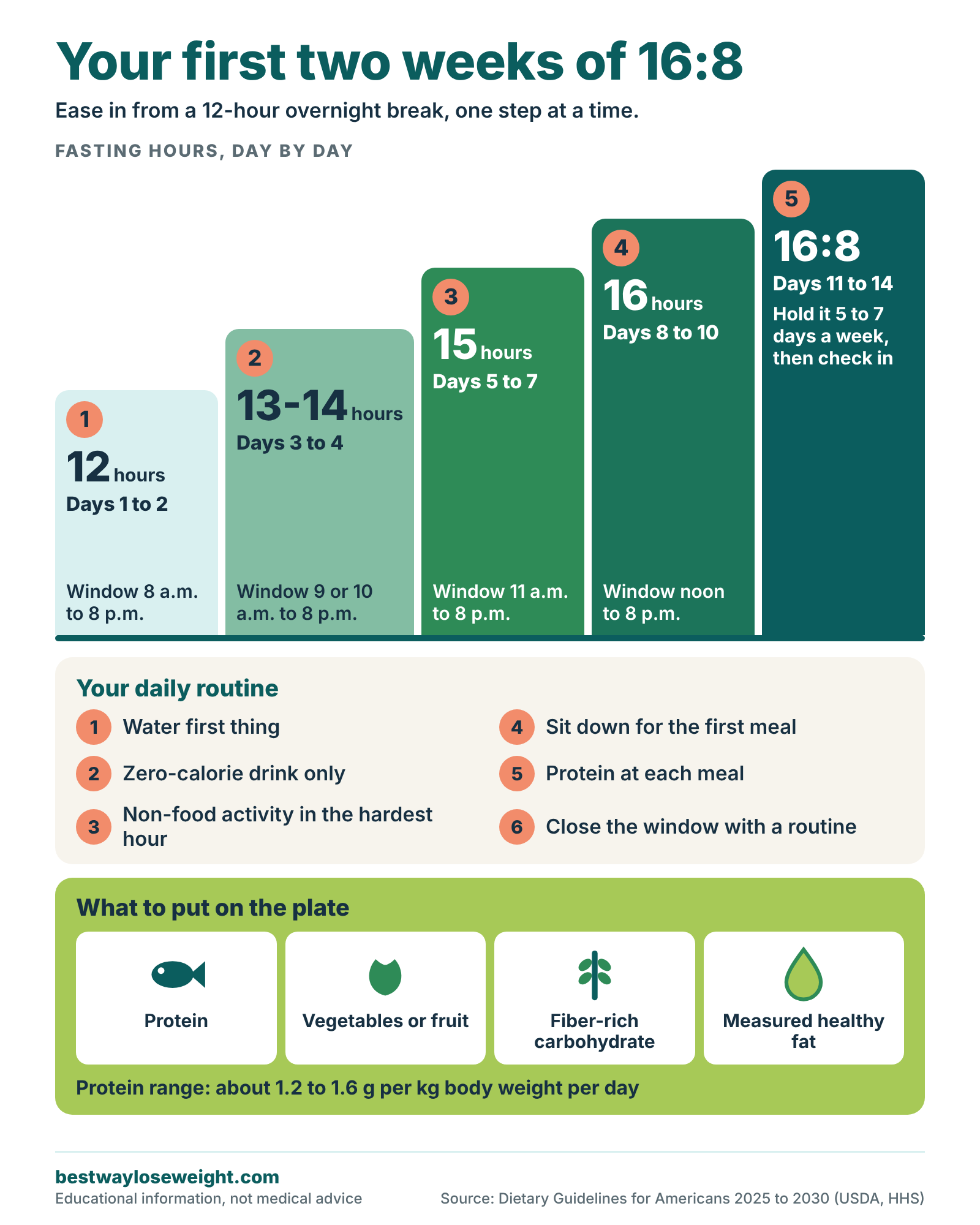
The ramp: 12 hours, then 14, then 16
Instead of jumping straight in, extend the overnight fast gradually. The table below is a template, not a rule; stay on any step longer if you need to.
| Days | Fasting hours | Eating window | Focus |
|---|---|---|---|
| 1 to 2 | 12 hours | 8 a.m. to 8 p.m. | Stop eating after dinner; notice when evening snacking happens |
| 3 to 4 | 13 to 14 hours | 9 or 10 a.m. to 8 p.m. | Move breakfast later; keep it protein-rich |
| 5 to 7 | 15 hours | 11 a.m. to 8 p.m. | Water, tea, or black coffee in the morning; notice the hardest hour |
| 8 to 10 | 16 hours | noon to 8 p.m. | Hold the window steady; start a food and hunger log |
| 11 to 14 | 16 hours (5 to 7 days a week) | noon to 8 p.m. | Evaluate: energy, sleep, hunger, and adherence |
Make the first meal count
Your first meal sets up the afternoon. Aim for a substantial dose of protein and fiber together, such as eggs with vegetables and beans, Greek yogurt with berries and nuts, or a salad with chicken and chickpeas. This helps avoid the pattern where a small, mostly refined first meal triggers a surge of hunger two hours later and a pile of snacks.
Week 2: stabilize and adjust
A short daily routine
- Wake up and drink a large glass of water.
- Have your usual morning drink if it has no calories, or plan a small splash of milk and decide up front whether you count it.
- Do something that is not eating during the hardest hour: walk, shower, tidy your workspace.
- Eat your first meal when the window opens, and sit down for it.
- Put the day’s protein in two or three meals, not one.
- Close the window at the planned time with a short routine: brush your teeth, make tea, or take an evening walk.
The end-of-week-two check-in
Ask five questions: Am I sleeping as well as before? Do I have steady energy in the morning? Am I eating enough protein and vegetables? Did I overeat after the window opened more than twice this week? And is this something I can see myself doing next month? If the answers are mostly yes, continue to the four-week mark. If not, adjust one thing at a time: the window length, the position of the window, or what you eat in it.
What to Eat in Your 8-Hour Window
Build meals for fullness, not just fewer hours
Protein: how much and how to spread it
The 2025 to 2030 Dietary Guidelines for Americans, released by USDA and HHS, call for roughly 1.2 to 1.6 grams of protein per kilogram of body weight per day (American Family Physician summary), and they steer people toward whole, minimally processed foods while limiting highly processed foods, added sugars, and refined carbohydrates (USDA Dietary Guidelines page). For a shorter window, protein matters more, not less: with fewer meals, each one has to carry more of the load.
Worked example, using the two adults from the calorie section: Example A weighs 81.6 kg, so 1.2 to 1.6 g/kg is about 98 to 131 grams a day. Across three eating occasions that is roughly 30 to 45 grams each. Example B weighs 99.8 kg, so the range is about 120 to 160 grams, or 40 to 55 grams per meal across three. People with kidney disease should follow their clinician’s guidance on protein rather than these general ranges. Our guide to how much protein you need to lose weight goes deeper on foods and distribution.
Fiber, volume, and food quality
Fiber and water-rich foods give you fullness for fewer calories, which is useful when you are trying to make a smaller calorie budget feel comfortable. Build each meal around a protein, a vegetable or fruit, and a fiber-rich carbohydrate like beans, lentils, oats, or intact whole grains, plus a measured portion of healthy fat. A list of practical options is in our guide to high-fiber foods for weight loss. If you increase fiber quickly, do it over a week or two and drink enough fluid to avoid bloating.
Sample 16:8 days you can adapt
A noon-to-8 p.m. day (about 1,600 calories)
This sample fits Example A’s target. Calories and protein are rounded estimates based on typical portion values, so adjust for your brands and check a nutrition database for precision.
| Time | Meal | Approx. calories | Approx. protein |
|---|---|---|---|
| 12:00 p.m. | Grilled chicken salad: 5 oz chicken, 2 cups greens, ½ cup chickpeas, mixed vegetables, 1 tablespoon olive-oil dressing | About 560 | About 52 g |
| 3:30 p.m. | Plain nonfat Greek yogurt (¾ cup) with 1 cup berries and 2 tablespoons walnuts | About 250 | About 19 g |
| 6:30 p.m. | 5 oz baked salmon, ¾ cup cooked brown rice, 2 cups roasted broccoli with 1 tablespoon olive oil | About 610 | About 38 g |
| 7:45 p.m. | Apple with 1 tablespoon peanut butter | About 190 | About 4 g |
A budget-friendly earlier window (10 a.m. to 6 p.m., about 1,500 calories)
Protein does not require expensive foods. Eggs, canned fish, beans, lentils, frozen vegetables, oats, and plain yogurt cover most of it.
| Time | Meal | Approx. calories | Approx. protein |
|---|---|---|---|
| 10:00 a.m. | ½ cup dry oats cooked with 1 cup 2% milk, a banana, and 1 tablespoon peanut butter | About 470 | About 18 g |
| 1:30 p.m. | Tuna sandwich: 1 can tuna, 2 slices whole-wheat bread, 1 tablespoon light mayonnaise, lettuce and tomato; carrot sticks and an orange | About 415 | About 36 g |
| 4:30 p.m. | ½ cup low-fat cottage cheese with ½ cup pineapple | About 130 | About 12 g |
| 5:30 p.m. | 1½ cups lentil-vegetable soup with 4 oz roasted skinless chicken thigh | About 460 | About 46 g |
Making the plan fit your own calories
If your target is higher or lower, scale portions of the starchy and fatty items first (rice, oil, nuts, peanut butter, bread) and keep the protein and vegetables steady. For a full seven-day rotation with a shopping list, see the 7-day weight loss meal plan, and use the same logic to shift meal times into your window.
What to drink and what “breaks” the fast
Water, coffee, tea, and the gray areas
Water, sparkling water, plain black coffee, and unsweetened tea are the standard choices. Drink enough water; thirst is often mistaken for hunger, and mild dehydration contributes to headaches. Adding a splash of milk or a teaspoon of sugar technically ends a strict fast, though it adds only a few dozen calories, which for most weight-management purposes is a small matter. The practical rule is to decide in advance, write it down, and count anything with calories toward your daily total.
Zero-calorie sweeteners, flavored sparkling water, and diet drinks are another gray area. Nobody has shown that they cancel the weight-management value of a 16:8 schedule, and nobody has shown that they are harmless for everyone. If they help you stay with the plan and you are not compensating with extra snacks, they are a reasonable tool; if sweet flavors trigger cravings for you, skip them.
Alcohol and the window
Alcohol carries calories (about 7 per gram), lowers inhibition around food, and has a stronger effect on an empty stomach. If you drink, keep it inside the eating window, have it with food, and count it. People with diabetes who take glucose-lowering medicines should ask about alcohol and low blood sugar specifically.
Exercise, Muscle, and Training Around a 16-Hour Fast
Protecting muscle while you lose weight
What the trials say about lean mass
When people lose weight by any method, some of that loss is lean tissue, and the goal is to keep that share small. In the 12-week Lowe trial, the time-restricted group had a statistically significant difference in appendicular lean mass index compared with the comparison group, which raised concern that a window without other support might not protect muscle. The 2025 meta-analysis in women found no significant change in fat-free mass in the pooled data. The two signals do not agree, trials usually measure lean mass with techniques that cannot cleanly separate muscle from water, and an expert commenting on the BMJ meta-analysis pointed out that muscle was not addressed. The sensible reading is that the evidence is mixed, so protect muscle on purpose.
The two tools that protect muscle: protein and resistance training
CDC’s adult guidelines recommend at least 150 minutes a week of moderate-intensity activity (or 75 minutes vigorous), plus muscle-strengthening activity on at least two days a week for all major muscle groups (CDC adult physical activity guidelines). Combine that with the protein targets above, spread across your meals. A beginner program of two or three full-body sessions a week is a good start, and the strength training guide for weight loss shows how to begin.
Timing workouts inside the cycle
Training fasted versus fed
A light walk, easy cycling, or gentle yoga before your first meal is fine for many people. Heavy lifting, long runs, or intense intervals on an empty stomach are another matter: some people feel strong, others feel shaky or perform worse. There is no single rule. If you try a hard morning session fasted and feel lightheaded or notice your performance dropping, move your window earlier or place the workout at the start of your eating window, so a meal follows right after it.
Practical arrangements that work
- Morning lifters: Shift the window to start at 9 or 10 a.m. and eat a protein-rich meal soon after the session.
- Evening exercisers: Put a meal one to three hours before training and a protein-rich dinner afterward, all inside the window.
- Daily walkers: Walk at any time; many people find a morning walk a good way to get through the first hungry hour. Even 10 to 20 minutes counts toward your weekly total.
- Very active people: If you train hard most days, a tight window can make it hard to eat enough, so consider a longer window, or skip fasting and get guidance from a sports dietitian.
Troubleshooting 16:8: Hunger, Energy, Sleep, and Social Life
Hunger and cravings
If you are very hungry before the window opens
Hunger tends to come in waves rather than climbing steadily; many people find that it rises around habitual meal times and then eases. A glass of water, tea, or black coffee often takes the edge off, and a short walk helps with distraction. If you are truly ravenous every day after the first week, check three things: how much protein and fiber you ate yesterday, how much you slept, and whether your window is too narrow for your life. Moving the start 30 to 60 minutes earlier is a legitimate adjustment, not a failure.
If you overeat when the window opens
This is the compensation problem. Break the first meal into two parts: eat a protein-rich plate, pause for 15 minutes, then decide whether you are still hungry. Keep your large snack foods out of view, and plan the later meals in advance so you are not making food decisions at your hungriest. If bingeing is a recurring problem, loosen the window or stop the schedule, because binge cycles are exactly what a rigid pattern can intensify.
Headaches, dizziness, fatigue, and digestive changes
Common early complaints and simple fixes
Reports of headaches, tiredness, irritability, and constipation are common in the early days of an eating change, although the Cochrane review noted that trials reported side effects inconsistently, so it is hard to put numbers on them. Usual culprits are not enough fluid, caffeine changes if you drop a morning coffee ritual, too few calories overall, and a sudden drop in fiber or sodium. Drinking water through the morning, keeping your coffee routine and including fiber-rich foods and vegetables at meals usually helps within a week.
When symptoms are not just adjustment
Ongoing dizziness when you stand, fainting, palpitations, a heavy sense of weakness, or any symptom that worries you should be addressed with a clinician, especially if you take blood pressure or diabetes medicines. Weight loss can lower the need for some medicines, and your prescriber is the one to adjust them.
Sleep, mood, and social situations
Sleep and mood: what 12 weeks of data suggests
In the Spanish trial, none of the eight-hour windows (early, late, or self-selected) showed significant differences in sleep duration, depression, anxiety, stress, or quality of life compared with usual care over 12 weeks. That is encouraging for adults without major sleep or mood problems, though 12 weeks is short. A late window can mean heavy meals close to bedtime, which some people find disrupts sleep, so watch how you feel and consider ending the window two to three hours before bed. Sleep and hunger are tightly linked; see our guide to sleep and weight loss.
Dinners out, holidays, and travel
Do not let the clock pick your friendships. A flexible week (five or six windows, one or two open evenings) usually works better than perfection. For restaurant meals, check the menu in advance, start with a protein dish and vegetables, and keep alcohol and bread to a decision, not a habit. On holidays or trips, run a 12:12 or 14:10 pattern, or simply pause the schedule and resume the next day without penalty.
| If this happens | Try this | Stop and ask a clinician if |
|---|---|---|
| Intense hunger in the late morning | Water or tea, a walk, a larger protein-rich first meal yesterday; move the window 30 to 60 minutes earlier | Hunger comes with shakiness, sweating, or confusion |
| Overeating in the first hour of the window | Split the first meal in two; plan meals ahead; add fiber and protein | You binge regularly or feel out of control |
| Headache | Drink more fluid; keep your usual coffee; eat on time | The headache is severe or unusual |
| Poor sleep | End the window two to three hours before bed; avoid heavy late meals | You have persistent insomnia or mood changes |
| Low energy in workouts | Move the workout inside the window; eat protein and carbohydrate beforehand | Fatigue persists for weeks or you feel faint |
| Scale not moving after four weeks | Review calories in the window, protein, steps, and sleep (see the review framework) | Weight is unexpectedly changing in either direction without reason |
| Dizziness on standing or palpitations | Stop fasting that day and eat and drink; do not train hard | Always, particularly if you take blood pressure or diabetes medicines |
Tracking Progress: How to Tell Whether 16:8 Is Working for You
What to measure and how often
Weekly average weight and waist, not the daily number
Body weight moves several pounds across a single week from water, salt, hormones, and digestion. To see the trend, weigh at the same time on three to five mornings a week, then average them. Example: if your readings this week were 181.4, 180.8, 181.9, and 180.6 pounds, the average is 181.2 pounds. Compare that with last week’s average, not with yesterday. Measure your waist once a week at the same spot, such as at the navel, after breathing out normally. A flat scale with a shrinking waist can mean you are losing fat and holding or gaining some lean tissue, particularly if you have started lifting.
Adherence, hunger, energy, and sleep
The scale is a lagging indicator of behavior. Add four quick ratings each day on a one-to-five scale: hunger, energy, sleep quality, and how well you stuck with the plan. After two weeks you will see patterns, such as low energy on days with late first meals or poor sleep after late dinners, that point to specific adjustments. A paper notebook or a phone note is enough.
A four-week review framework
Decide on evidence, not on one bad week
Give the plan four weeks at a consistent window before judging it, unless you have warning signs. At the review, sort your result into one of four groups and use the matching action.
| What you see after four weeks | Likely explanation | Next move |
|---|---|---|
| Weekly average weight trending down; energy and sleep steady; you can keep going | The window is helping you eat in a way that creates a modest deficit | Continue; keep protein and strength training in place; recheck monthly |
| Weight flat; you are following the window | Calories inside the window are close to maintenance; liquid calories or large snacks | Log food for one week; reduce portions of calorie-dense foods by 100 to 200 calories; increase walking |
| Weight down but hungry, tired, or cranky | Deficit is too large or protein and fiber too low | Add 100 to 200 calories, mostly protein and vegetables; widen the window slightly |
| Missing the window often; stressed about food | Plan does not fit your schedule or your relationship with food | Try a 12-hour or 14-hour overnight fast, or use a normal calorie-aware plan; talk to a dietitian if rules feel distressing |
How to use this when the scale stalls
A stall in the first month is common and often reflects water, hormones, or a few extra calories rather than a broken plan. Our guide to the weight loss plateau and what to do about it walks through the checks in a sensible order. The summary: confirm your portions and snacks, count liquid calories, recheck your step count and sleep, and wait through at least two to three weeks of data before changing more than one variable.
When to stop, modify, or switch
Adjust the window before abandoning the idea
Small changes keep the useful part of the plan. You can shift the window earlier or later, extend it to 10 hours, use it five days a week, or keep an overnight 12-hour fast as the baseline and use the stricter version only when you are busy or when you know you are prone to snacking. All of these are consistent with what the research suggests: structure helps when it reduces calories and does not create distress.
Signs that a different approach is a better fit
If you consistently overeat after the fast, feel preoccupied with food, sleep poorly, lose energy in workouts despite adjustments, or find the schedule disrupting your family and work, a regular three-meal pattern with a calorie target may suit you better. The research shows that approach performs about as well. If you have a medical condition, or if your weight does not respond despite honest effort, a clinician can assess whether another strategy, including medication, is appropriate.
Common 16:8 Mistakes and a Quick Checklist
Mistakes with food
Treating the window as a free-for-all
The most common mistake is believing the fast “earns” unlimited eating in the window. If you eat the same calories you did before, you should not expect a different result than the 12-week trial, where the time-restricted group lost less than a kilogram on average. Pay attention to portions and to calorie-dense extras like oils, nuts, sugary coffee drinks, and alcohol.
Under-eating protein and fiber
A common pattern is a small first meal followed by a pile of snacks. Aim for a real protein serving at each meal. Under-eating protein, especially while skipping meals, makes it harder to hold onto muscle and harder to feel full.
Mistakes with the plan
Jumping to 16 hours overnight, or moving to 18:6 or OMAD too fast
Narrower windows, such as 18:6 or one meal a day, make adequate protein and nutrient intake harder, and we did not find trial evidence that they produce better weight loss. If 16:8 is working, there is no evidence-based reason to tighten it. If it is not working, the fix is usually what you eat or how much, not a smaller window.
Treating a slip as a failure
Eating outside the window on a Saturday does not erase your progress. Treat a slip as data: what happened, what was the trigger, what could you try next time? “All-or-nothing” thinking is a bigger threat to long-term success than any single meal.
The pre-flight and weekly checklist
Before you start
- I checked that none of the situations in the safety section applies to me, or I have talked with a clinician.
- I picked a window that fits my schedule, and a plan for my medicines with food.
- I know my starting weight, waist, and daily calorie range.
- I have protein-forward options for my first meal.
- I planned a four-week review date.
Each week
- I kept my window at least five days.
- I ate a real protein serving at every meal.
- I did two strength sessions and some daily walking.
- I slept well, or I moved the window to help.
- I noticed any warning signs and acted on them.
16:8 Intermittent Fasting FAQ
Timing and schedule questions
Can my eating window change from day to day?
Yes, within reason. A consistent window makes the habit easier to automate, but shifting your start by an hour or two to fit a workout, a late meeting, or a family dinner is not a problem for most healthy adults. What matters for weight is what and how much you eat across the day. If your schedule changes wildly, use a simple anchor rule, such as “first meal at least 14 hours after the last one,” and move the clock times as needed.
Do I need to fast for exactly 16 hours for it to count?
No. There is nothing magical about the 16-hour mark. The trials used eating windows that started at different times of day, and the Cochrane review pooled many fasting styles. If you manage 14 or 15 hours on most days and the arrangement feels good, you are still using the same tool. Treat 16:8 as a target pattern, not a pass or fail test.
How long can I stay on 16:8?
The longest randomized trial discussed here ran 12 months, and the Cochrane review notes limited long-term data, so no one can say what multi-year use does to health, positive or negative. A practical approach is to review every three months: is the pattern still helping, still comfortable, and still compatible with your health and medicines? If you reach your goal, many people move to a maintenance version, such as a 12-hour or 14-hour overnight break, rather than stopping abruptly or intensifying the fast.
What if I wake up very hungry in the early morning?
Check yesterday’s dinner for protein and fiber, how late you ate, and how much alcohol you had. A glass of water and a few minutes of light activity often help. If you are waking hungry most nights, a longer window or an earlier first meal may suit you better. Waking because of hunger with sweating or shakiness, especially if you take diabetes medicines, needs a call to your clinician.
Food and drink questions
Do I need to count calories on 16:8?
You do not have to, and some people choose 16:8 precisely so they can avoid counting. The trade-off is that you will not know whether your window is full of the same calories as before. A reasonable compromise is to log your food for one or two weeks to calibrate portions, then rely on weekly weight, hunger, and energy trends. If you are not losing weight and want to understand why, go back to logging for a week. The basics are explained in our guide to how a calorie deficit works.
Can I take vitamins, supplements, or medicines during the fasting hours?
Many supplements are best taken with food, and some cause nausea on an empty stomach, so schedule them with a meal inside your window. Medicines are different: never skip or move a prescribed medicine just to protect a fast. Ask your pharmacist or prescriber whether the timing is flexible, particularly for diabetes, thyroid, blood pressure, or pain medicines that come with specific instructions about food.
Is it okay to combine 16:8 with a low-carb or keto diet?
It is possible, but it narrows your food choices and your schedule at the same time, which makes the plan harder to sustain and easier to misjudge. The disordered-eating commentary cited in this guide reported that combining intermittent fasting with low-carbohydrate diets was associated with a higher risk of binge eating, and the FDA’s SGLT2 inhibitor warning names low-carbohydrate eating as a ketoacidosis risk factor for people on those drugs. If either applies to you, talk to a clinician first. If neither does, change one thing at a time.
Is skipping breakfast bad for me?
There is no single answer. Some observational research has linked skipping breakfast with worse health outcomes, but those studies are observational and mix up many other habits. In randomized trials like Lowe’s, people who delayed their first meal did not do worse than those who ate throughout the day, though their weight benefit was small. What counts is the total quality and quantity of food and how you feel. If you notice you are irritable, unfocused, or snacking heavily in the morning, move the window earlier.
Health and special-situation questions
Will 16:8 slow my metabolism or put me in “starvation mode”?
As you lose weight by any method, your body needs somewhat fewer calories because there is less of you to fuel. That is a feature of weight loss, not of fasting. we did not find trial evidence that a daily 16-hour fast uniquely lowers metabolic rate in healthy adults, and the idea of a sudden “starvation mode” switch in a typical diet is not supported. Eating too little, losing muscle, and sleeping poorly are the more realistic reasons that progress slows. Our guide to the weight loss plateau covers this in detail.
Can I do 16:8 with PCOS, fatty liver, or a thyroid condition?
The research here is still developing. MedlinePlus Magazine notes that NIH is studying intermittent fasting in fatty liver disease and polycystic ovary syndrome (PCOS), which means the answers are not yet in. These conditions often come with medicines, blood sugar issues, or hormonal changes, so individual guidance from your clinician or a registered dietitian is the sensible route. Some thyroid medicines have specific timing rules around food; follow your prescriber’s instructions.
Can I use 16:8 while taking a GLP-1 medicine?
Appetite is often reduced on these medicines, so a rigid window may push total intake and protein too low. This is a decision for you and the prescriber, who can weigh your goals, side effects, and nutrition. If you do try a window, most of the same points apply: protein at each meal, strength training, and checking in about any symptoms such as dizziness or nausea.
What happens to my weight if I stop 16:8?
If the window was helping you eat less, going back to old patterns can bring the calories, and often the weight, back, which is true of most weight-management approaches. The Cochrane review stresses that long-term data are limited. Plan your exit: shift to a gentler overnight break, keep the protein and strength habits, and keep weighing weekly so any drift is caught early.
Bottom Line
What to take away from this guide
If you decide to try 16:8
Use it as a simple scheduling structure for eating, not as a metabolic trick. Check the safety list first, ease in over one to two weeks, and anchor the window to your real life. Build each meal around protein and fiber, keep two strength sessions a week, and review progress at four weeks using weekly averages and how you feel. Expect modest results that vary by person, and treat a good fit with your life as the main sign it is working. For the bigger picture of safe, sustainable weight management, start with our complete evidence-based guide to losing weight safely.
If 16:8 is not for you
That is a perfectly good outcome. Randomized trials and a 2026 Cochrane review suggest intermittent fasting performs about as well as ordinary calorie reduction, which means a regular meal pattern with sensible portions, protein, fiber, activity, and sleep can get you to the same place. If you want to compare the other fasting styles, read our overview of intermittent fasting for weight loss.
Editorial and medical-review note
Scope and sourcing
This article is educational and does not replace individual medical advice. It was fact-checked against the sources listed below as of October 2026. Several trial details were taken from summaries and secondary reports because some journal pages could not be opened, and the 2024 AHA abstract on eight-hour eating was reported as a conference presentation without a full peer-reviewed paper at the time of writing.
Review status
The article is flagged for qualified clinical review before publication, with particular attention to the sections on diabetes medicines, pregnancy, eating-disorder history, and older adults. No individual reviewer is named here, and this note should be updated once review is complete.
Sources
Primary sources (government and clinical guidelines)
U.S. government and public-health sources
- USDA and HHS, Dietary Guidelines for Americans, 2025 to 2030 (USDA page updated April 2026), and the American Family Physician practice guidelines summary (2026) for the protein range.
- CDC, Adult Physical Activity Guidelines (current).
- NIH News in Health, Intermittent Fasting and Type 2 Diabetes (2024).
- National Library of Medicine, MedlinePlus Magazine, 5 Questions About Intermittent Fasting (2020).
Safety and medication-labeling sources
- Patient Care Online, FDA adds new warnings to SGLT2 inhibitors (December 2015), reporting the FDA label update on ketoacidosis. The FDA page itself could not be opened.
Research and supporting literature
Systematic reviews and meta-analyses
- Cochrane, Intermittent fasting for adults with overweight or obesity (CD015610) (2026), and the Cochrane news release (2026).
- Harvard T.H. Chan School of Public Health, Intermittent fasting may be effective for weight loss, cardiometabolic health (2025), summarizing the BMJ network meta-analysis, and Science Media Centre, expert reaction (2025).
- Frontiers in Nutrition, meta-analysis of time-restricted eating in women with overweight or obesity (2025).
Randomized trials, commentary, and secondary reporting
- Lowe et al., Effects of time-restricted eating on weight loss and other metabolic parameters, JAMA Internal Medicine (2020); details from Consultant360.
- Liu et al., Calorie restriction with or without time-restricted eating in weight loss, New England Journal of Medicine (2022); HCPLive summary and a published commentary (2024).
- Pavlou et al., time-restricted eating in adults with type 2 diabetes, JAMA Network Open (2023); Healio summary.
- Time-restricted eating and sleep, mood, and quality of life, secondary analysis of a randomized trial, JAMA Network Open (2025); PubMed record and MIMS summary.
- TCTMD, Intermittent fasting study sparks debate over increases in CV mortality (2024).
- Harvard Health Publishing, Should you try fasting? (2020, updated 2023), for the description of the 16/8 pattern.
- Blumberg, Hahn, and Bakke, Intermittent fasting and risks of disordered eating, Clinical Diabetes and Endocrinology (2023).

