

How long does a weight loss plateau last? There isn’t an official number, and anyone who gives you one without asking what’s causing the stall is guessing. What the research and everyday experience do support is a range that depends on the cause: a few days to about two weeks for ordinary scale noise, several weeks to a few months for a real stall that has a fixable cause, and open-ended when your weight has simply settled at the level your current eating and activity support. This guide gives you a plain way to tell which of those you’re in, a timeline you can follow week by week, the math behind why progress slows, and honest notes about where the evidence runs thin.
This article is educational. It isn’t medical advice, and it doesn’t replace care from your own clinician, who knows your health history. If you want the broader “why it happens and what to do” guide, start with our companion article on the weight loss plateau. This page is about the clock: how long to wait, when to act, and what to expect afterward.
Key Takeaways
The short answer
Typical lengths by cause
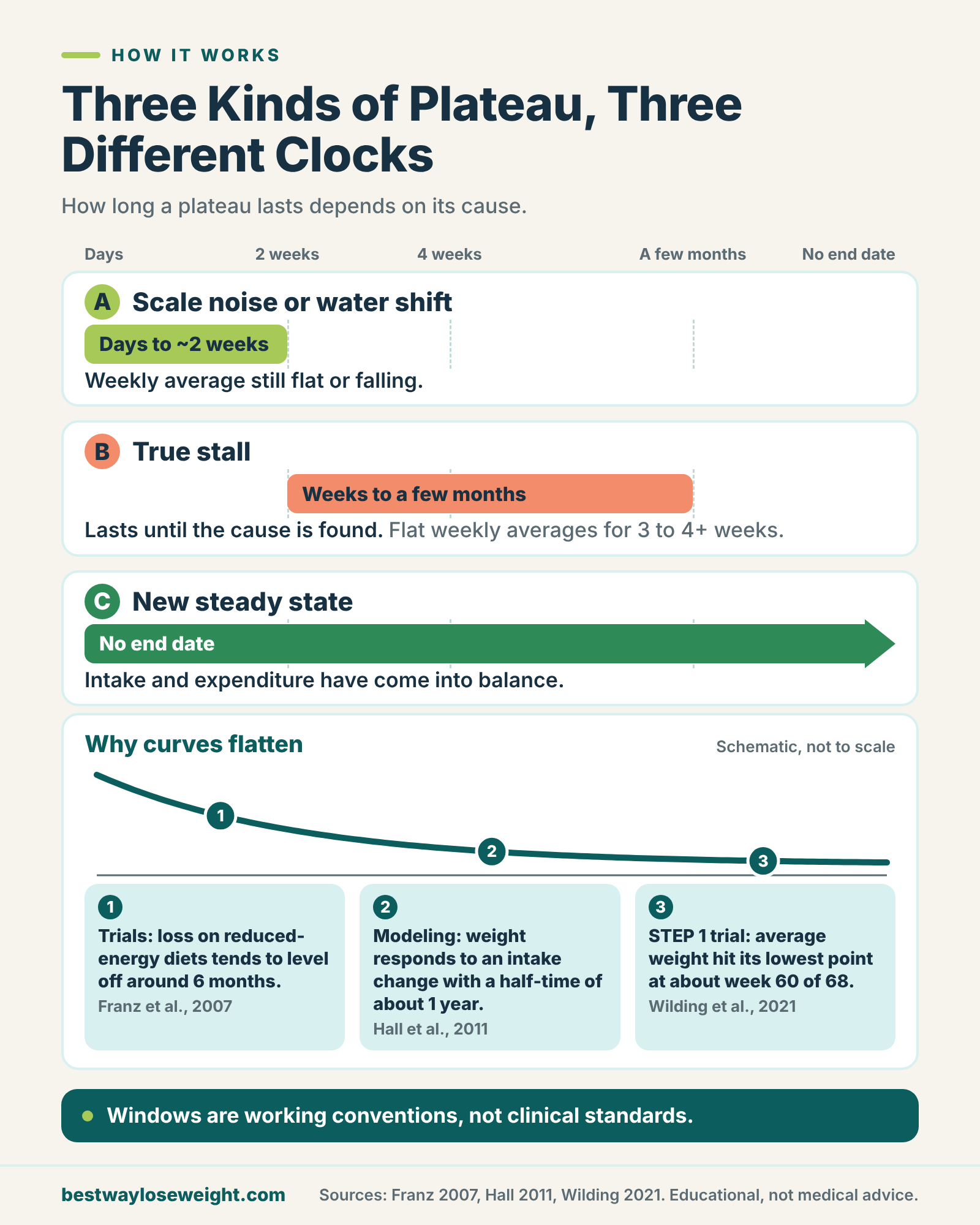
Think of three different situations that all get called a plateau. Ordinary scale noise, driven by water, food volume and hormonal shifts, usually resolves within days to about two weeks. A true stall, where weekly averages stay flat for several weeks because intake crept up, activity drifted down or your body now needs fewer calories, lasts until the underlying gap is closed, and in practice that often means weeks and sometimes a few months. A new steady state, where your weight has leveled off because your habits now match what your body burns, has no end date at all unless you change something.
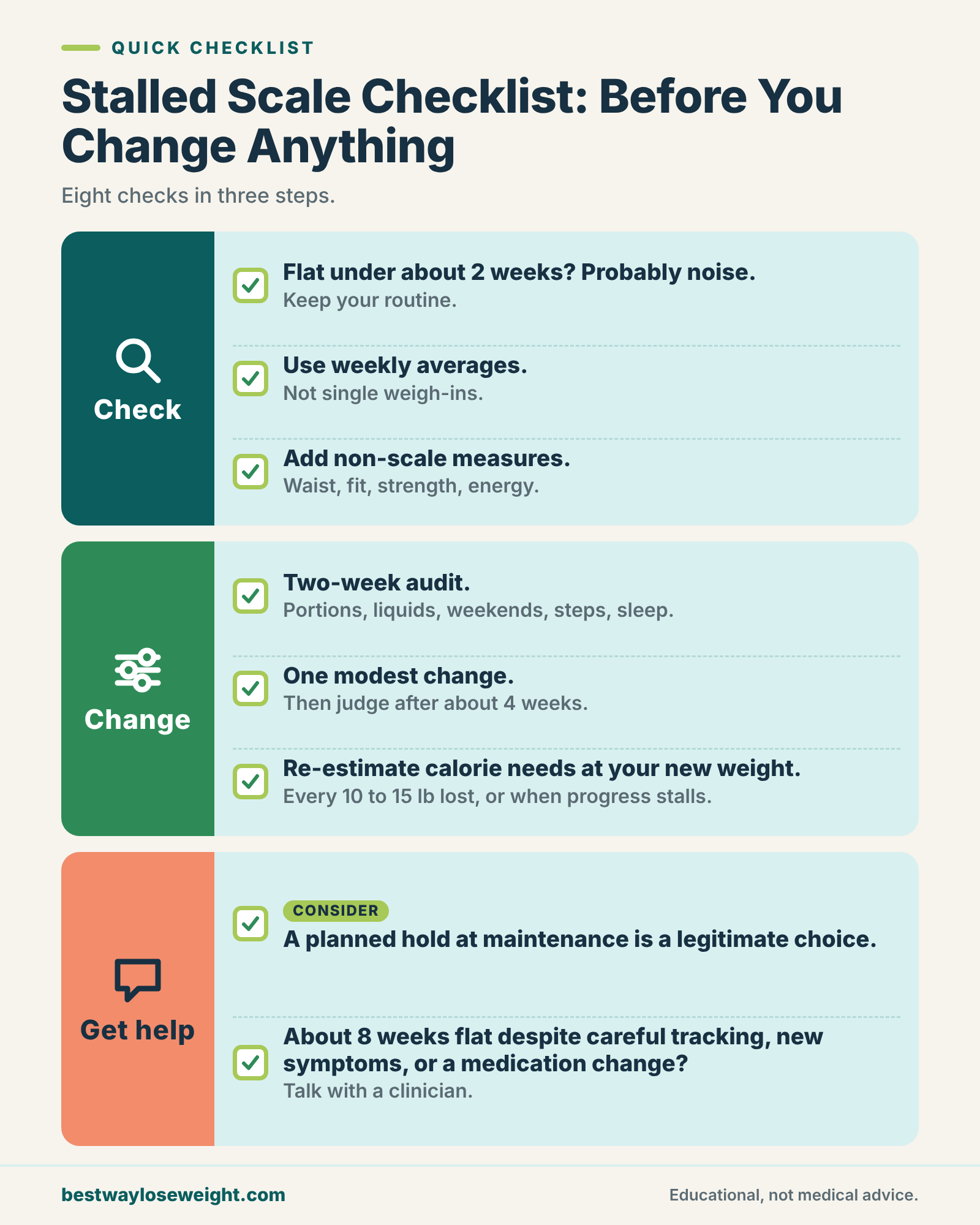
- Under about two weeks of flat readings: usually noise, not a plateau.
- Three to four weeks of flat weekly averages with consistent habits: a real plateau worth troubleshooting.
- About eight weeks with careful tracking and no change: reasonable time to involve a clinician or dietitian.
Those windows are working conventions, not clinical standards. We use them because they give you a decision rule, and we’ll say so each time they appear.
Why the plateau has no fixed clock
Body weight responds slowly and unevenly to a change in calories. In a published modeling study, Hall and colleagues estimated that the weight response to a change in energy intake has a half-time of about one year, and that people with more body fat take longer to reach a new steady weight. That means a flattening curve is a normal feature of long-term weight loss, not always a sign that something broke. Whether a flat stretch lasts two weeks or six months depends mostly on what is behind it and how quickly you find and change that cause.
Using the clock
A working timeline
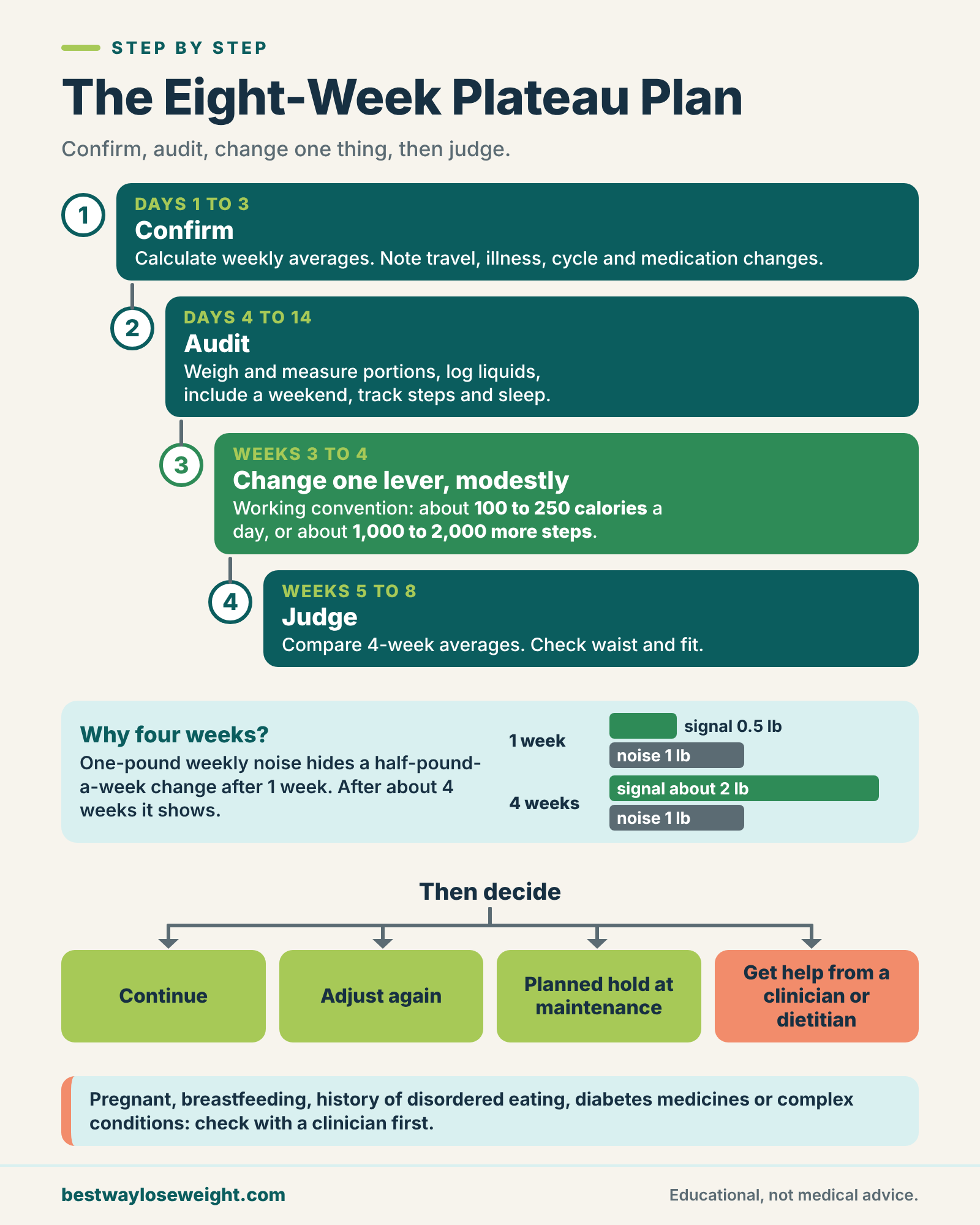
If you only remember one sequence, make it this one. Weeks one and two: confirm the stall with weekly averages and run a measurement audit. Weeks three and four: change one thing, in a modest way. Weeks five to eight: judge the result and decide whether to adjust again, hold steady on purpose, or ask for help. Later sections turn that into a table and a checklist.
When to get help
See a clinician if you’ve followed a sensible plan for about two months with careful tracking and your weight and measurements haven’t moved, if you gained weight quickly or notice swelling, if you feel unusually tired or cold, or if you started or changed a medication around the time progress stopped. Never stop or change a prescription on your own. Pregnancy, breastfeeding, a history of disordered eating, diabetes, kidney or heart disease, and adolescence all call for individualized guidance rather than a general article.
How Long a Weight Loss Plateau Typically Lasts, by Cause
The most honest answer to “how long” is a question back: a plateau of what? The same flat number on the scale can come from three very different processes, and each has its own natural length. Sorting yours into the right bucket is the single most useful thing you can do, because it tells you whether to wait, to audit, or to accept that you’ve arrived.
What the Research Says About Timing
No major health agency page reviewed for this article gives a standard duration for a plateau. The CDC’s weight loss guidance, for example, emphasizes a gradual pace of about 1 to 2 pounds a week and a lifestyle built on healthy eating, regular activity, enough sleep and stress management, and it doesn’t define a plateau length. The Mayo Clinic’s patient guide on getting past a plateau explains why a stall happens and what to review, and it likewise doesn’t say how many weeks one lasts. What the research does offer is a picture of how weight trajectories behave over months and years.
There is no clinical standard length
Because no guideline sets a threshold, every “a plateau lasts X weeks” claim you read online is a convention or an opinion. Conventions can still be useful. A rule such as “three to four weeks of flat weekly averages” works well precisely because it’s long enough to average out water shifts and short enough that you don’t spend a quarter of the year waiting. Just keep in mind that it’s a tool for making decisions, not a measured property of human biology.
What trials show: loss tends to level off around six months
A 2007 systematic review and meta-analysis by Franz and colleagues pooled 80 weight loss trials with at least one year of follow-up (26,455 people enrolled, 18,199 completers). Weight loss happened mainly in the first six months of programs that reduced energy intake, then flattened. In the diet-alone arms, average loss was about 4.9 kg (5% of body weight) at six months and about 4.6 kg at twelve months. In the diet-plus-exercise arms it was about 7.9 kg (8.5%) at six months, with about 3.9 kg (4%) still off at 36 to 48 months. Those are group averages from structured programs, and they blend real physiology with changes in how closely people could keep following the plan. They tell you that a leveling-off around the half-year mark is common, not that your own plateau will start or end at a particular week.
Newer medication trials show a similar shape. In the 68-week STEP 1 trial of once-weekly semaglutide 2.4 mg, which enrolled adults with overweight or obesity, the report describes average weight reaching its lowest point at about week 60, with a 14.9% mean reduction from baseline at week 68 versus 2.4% with placebo. Even with a powerful treatment, the average curve bends and flattens. We come back to this in the medication section and in our guide to GLP-1 medications for weight loss.
Duration by Type of Stall
Here’s the practical breakdown. Each type has a different typical length, a different tell, and a different first move. The ranges are working estimates drawn from how these processes behave, not trial-measured durations, so treat them as starting points.
Scale noise and water shifts: days to about two weeks
Your scale weight includes everything inside you: food and fluid in your gut, water held alongside stored carbohydrate (glycogen), and fluid shifts tied to sodium, hard training days and, for many women, the menstrual cycle. These swing the number by a pound or two, occasionally more, without any change in body fat. They are also the reason a week can look flat even when fat loss is continuing. A water-masked stall typically clears within days to about two weeks once the trigger passes. Your first move is to keep your routine steady and keep weighing, because changing the plan in response to a few flat days is how people accidentally turn noise into a real problem.
A true stall: weeks to months, until the cause is found
When weekly averages hold within a narrow band for three to four weeks or more while you’ve been following your plan, something has shifted in the balance between what you take in and what you use. The usual suspects are gradual portion drift, less everyday movement than you realize, tracking error, a smaller body that now burns fewer calories, poor sleep or high stress, or a new medication. There’s no fixed length for this kind of plateau. It lasts as long as the cause is unaddressed, which is why a short, structured audit usually beats waiting it out. Our companion guide on the causes of a weight loss plateau goes deeper on the causes; this page focuses on timing.
A new steady state: no end date, and sometimes the goal
If you’ve been losing for many months and your weight has leveled off at a weight you’re happy with, the plateau is arguably the finish line. Your body now needs about as many calories as you eat. That plateau lasts as long as your habits stay the same, and the skill that matters from here is maintenance, which has its own research base and its own pitfalls. If you aren’t at a weight that’s right for you, the same level-off tells you that it’s time to adjust the plan or reconsider the goal.
| What you’re seeing | Typical window | How to tell | First move |
|---|---|---|---|
| Scale noise or water shift | Days to about 2 weeks | Daily readings jump up and down; weekly average still trends flat or down | Keep the routine; weigh under the same conditions; wait |
| Slowing loss (still losing) | Ongoing; not a true plateau | Weekly averages falling, but more slowly than at the start | Expect it; re-estimate calorie needs for your new weight |
| True stall from intake or activity drift | Weeks to a few months, until the gap is closed | Weekly averages flat for 3 to 4 weeks despite the same plan on paper | Two-week measurement audit, then one modest change |
| Stall with sleep, stress or medication context | Varies; no reliable estimate | Flat weight plus poor sleep, high stress, a new prescription or new symptoms | Address sleep and stress; talk with a clinician about medications |
| New steady state at your goal | No end date | Weight stable for months at a weight you’re comfortable with | Shift from losing to maintaining |
| Flattening on a weight loss medication | Varies; trials describe a leveling-off in the average curve | Loss slows after many months on treatment | Review with the prescribing clinician; do not change doses yourself |
How to Tell a Plateau From Noise: The Time Windows That Matter
You can’t judge how long a plateau lasts until you know whether you’re in one. Most “plateaus” reported after a week or ten days are not plateaus at all. They’re the ordinary wobble of a body that holds a few pounds of water, food and waste at any moment. This section gives you the time windows that separate noise from a real stall, with a worked example so you can see the difference in actual numbers.
Why the Scale Moves Without Changing Body Fat
Scale weight is the sum of bone, muscle, organs, fat, and everything passing through you. Only one of those, fat, is the thing most people mean when they say they want to lose weight, and it changes slowly. The rest can swing by pounds in a day.
Daily swings and the weekly rhythm
Several everyday factors move the number without touching body fat. A saltier-than-usual dinner can lead to more fluid retention for a day or two. Stored carbohydrate (glycogen) is held in the body with water, so a run of higher-carbohydrate days can raise the scale and a run of lower-carbohydrate days can lower it, without a matching change in fat. A hard training session can cause temporary fluid retention while muscles repair. For many women, the menstrual cycle brings a predictable rise and fall of a pound or more across the month. And there’s a weekly rhythm: Orsama and colleagues, writing in Obesity Facts in 2014, reported that weight tends to rise over weekends and fall during weekdays among people who weighed themselves daily. If your weekend meals and your weekday meals differ, your Monday reading and your Friday reading will too.
Weekly averages beat single readings
The fix for noise is to stop treating any one reading as information. Weigh at the same time of day under similar conditions, ideally first thing in the morning after using the bathroom and before eating, and then add up a week of readings and divide by the number you took. That weekly average is the number to compare with the previous week’s average. A noisy week and a quiet week can have the same average, and the average is what tracks the trend.
A Routine That Makes the Windows Work
The time windows below only help if your measurements are consistent. A few habits make the data far easier to read.
How often to weigh
NIDDK’s guidance on keeping weight off includes monitoring your weight at least once a week. A 2015 systematic review and meta-analysis by Madigan and colleagues looked at self-weighing as a tool for weight loss. It found that when self-weighing was added to behavioral programs, people lost about 1.7 kg more than comparison groups, and in multicomponent programs the difference versus minimal control was about 3.4 kg. The authors found no significant difference between daily and weekly weighing, and they noted that only one study tested self-weighing alone, so the evidence is mostly about weighing as part of a larger program. For plateau purposes, that points to a simple conclusion: weigh as often as you find useful, as long as you read averages, not single days. If daily weighing makes you anxious or preoccupied, weekly weighing is a reasonable choice and the evidence reviewed here doesn’t suggest it’s worse.
Adding measures that don’t depend on the scale
Waist circumference measured at the same spot, how your clothes fit, strength and endurance in workouts, and energy and sleep quality all give information the scale can’t. They matter most when you’ve recently started strength training or when water shifts are large. A stable weight with a shrinking waist is a very different situation from a stable weight with a stable waist, and only the second one is a plateau in the sense of “nothing is changing.” If you have a history of disordered eating, check with your clinician before adopting frequent weighing or measuring, because for some people those habits aren’t helpful.
Two Six-Week Examples You Can Compare
The examples below are illustrative. They aren’t real people or study data. They show what the same “I haven’t lost anything” feeling looks like in two different situations, using weekly average weights in pounds.
Example A: slow loss that feels like a stall
Series A starts at 182.4 lb and drifts down through 181.9, 181.7, 181.0, 181.2 and 180.6. Week 5 ticked up, which is the kind of reading that makes people say they’ve hit a wall. Fit a straight line through all six points and the trend is about 0.34 lb lower each week, which is about 1.4 lb a month. That’s slow, and it may be slower than the person hoped, but it isn’t a plateau. The right response is patience and perhaps a re-estimate of calorie needs, not a drastic cut.
Example B: a real plateau
Series B reads 178.2, 178.4, 177.9, 178.3, 178.1 and 178.2. The six-week trend line is almost flat, about 0.01 lb per week, and the average sits at about 178.2 lb. If the person has been following the plan, this is a real plateau at around six weeks. The right response is to stop waiting and run an audit: measure portions, check liquid calories and weekends, and look at activity. The table below sets the two series side by side.
| Week | Series A (slow loss) | Series B (flat) |
|---|---|---|
| 1 | 182.4 | 178.2 |
| 2 | 181.9 | 178.4 |
| 3 | 181.7 | 177.9 |
| 4 | 181.0 | 178.3 |
| 5 | 181.2 | 178.1 |
| 6 | 180.6 | 178.2 |
| Trend per week (straight-line fit) | About -0.34 lb | About -0.01 lb |
| Verdict | Slow but real loss; no plateau | Plateau at six weeks |
One more point from these examples: you can’t tell the two series apart by looking at one or two weeks. In the first three weeks of Series A the weights go 182.4, 181.9, 181.7, and in Series B they go 178.2, 178.4, 177.9. Each looks like it could be anything. That’s the whole reason time windows exist.
| Flat for about | What you can conclude | Reasonable action |
|---|---|---|
| 1 to 3 days | Almost certainly water, food volume or timing | Nothing; keep your routine |
| 1 week | Can’t tell; one week of averages is still noisy | Keep logging; check for a salty or high-carbohydrate stretch, a new workout, or cycle timing |
| 2 weeks | Possible early stall, or water masking fat loss | Start a measurement audit quietly; don’t change the plan yet |
| 3 to 4 weeks | Likely a real plateau if habits were consistent | Finish the audit, then change one lever modestly |
| 6 to 8 weeks | Established plateau or a new steady state | Re-evaluate; consider a planned hold, or a dietitian or clinician visit |
| About 12 weeks or more | Persistent; the plan or the goal likely needs a rethink | Involve a clinician, especially if you have symptoms or take medications |
Why Plateaus Take as Long as They Do: The Energy-Balance Clock
If a plateau were only about scale noise, it would be over in days. The reason some last for months is that your body and your habits are in a conversation that keeps changing. Every pound you lose changes the energy balance that produced it. Understanding that conversation explains why progress slows, why a plateau can be a sign of success, and why the timing of your next adjustment matters.
Your Calorie Needs Fall as You Lose Weight
A smaller body needs fewer calories. That’s a plain fact about physics and physiology, and it’s the first and largest reason a deficit shrinks over time. Our guide to the calorie deficit covers the basics; here we focus on the timing.
The formula and its assumptions
Total daily energy expenditure (TDEE) is the number of calories you burn in a day. A common way to estimate it is to calculate resting energy expenditure with the Mifflin-St Jeor equation and then multiply by an activity factor. For a woman, resting energy is about 10 x weight in kg + 6.25 x height in cm – 5 x age in years – 161. A typical activity factor for light daily activity is about 1.375, and it’s an assumption, not a measurement. Treat the result as an estimate that can easily be off by a couple hundred calories either way. Our TDEE calculator guide explains how to refine it.
Worked example: what a 25-pound loss does to maintenance
Take a hypothetical 41-year-old woman who is 5 ft 6 in (168 cm) and weighs 190 lb (86.2 kg). Her resting energy is about 10 x 86.2 + 6.25 x 168 – 5 x 41 – 161 = 1,546 calories. Multiplied by 1.375, her estimated maintenance is about 2,126 calories a day. Now suppose she loses 25 lb and weighs 165 lb (74.8 kg). The same formula gives about 1,432 resting calories and about 1,970 for maintenance. The difference is about 156 calories a day, which works out to roughly 6 calories per day for every pound lost. If she started with a 500-calorie daily deficit, eating about 1,626 calories, her deficit at 165 lb is now about 344 calories (1,970 – 1,626), even though she hasn’t changed a thing. Add 150 to 350 calories of gradual portion drift, a figure chosen purely for illustration, and the deficit approaches zero. This simple formula doesn’t include any extra drop in expenditure from metabolic adaptation, so it understates the shrinkage for many people. To run your own numbers, use our guide to the calorie deficit calculator.
The One-Year Half-Time and What It Means
The slowdown in that example isn’t a one-time event. It’s continuous, and that gives weight loss its characteristic curve: fast at first, then slower, then flat. Hall and colleagues put numbers on this in a 2011 Lancet paper. Their mathematical model of adult metabolism found that the weight response to a change of energy intake is slow, with half times of about one year, and that people with more body fat take longer to reach their new steady weight.
A worked table: how much of the eventual change has happened by when
“Half-time” means the time it takes to cover half of the remaining distance to the new steady state. If we use a half-time of exactly one year as a simplified assumption, the share of the eventual change achieved is 1 minus 0.5 raised to the number of years. Let’s apply that to the woman above. If she permanently ate 300 calories a day below her original maintenance of 2,126 (about 1,826), the simple model says her weight would eventually settle where maintenance equals 1,826, which is about 142 lb, a 48-pound change. The table shows how that would unfold. It’s an arithmetic illustration of the idea, not a prediction for any individual.
| Time since the change | Share of eventual change | Approximate loss so far |
|---|---|---|
| 3 months | About 16% | About 8 lb |
| 6 months | About 29% | About 14 lb |
| 12 months | 50% | About 24 lb |
| 24 months | 75% | About 36 lb |
| 36 months | About 88% | About 42 lb |
What it means for the length of a plateau
Two things follow. First, on a constant plan the loss each month gets smaller, so the weekly average slows without any change in behavior. That’s why a plan that produced a pound a week in month one produces much less in month eight, and why “I’m still doing the same thing” and “I’m barely losing” can both be true. Second, there’s no moment when the curve suddenly stops. It approaches the new steady state gradually, which makes the line between “slow loss” and “plateau” blurry, and it’s the reason a time window and weekly averages are more useful than a single cutoff. Real life also doesn’t follow a smooth curve, because adherence changes, early loss includes water, and each person’s physiology differs. The model is a way to see why an unchanged plan eventually looks like a plateau, not a forecast.
Beyond the Simple Model: Adaptation and Appetite
The formulas above assume that your expenditure changes only because your body is smaller. Research suggests that may not be the whole story, and the details matter for how patient to be.
Metabolic adaptation: real but variable
Metabolic adaptation, also called adaptive thermogenesis, refers to a drop in energy expenditure beyond what the loss of body mass would predict. The most dramatic evidence comes from Fothergill and colleagues’ 2016 follow-up of contestants from The Biggest Loser television competition, which found persistent metabolic adaptation six years later, with resting energy expenditure lower than predicted by roughly 500 calories a day on average among those studied. That group lost very large amounts of weight very rapidly, so it’s an extreme case. A 2022 systematic review by Nunes and colleagues of adults after weight loss looked at 33 studies and found adaptive thermogenesis reported in most of them, but noted that well-designed studies reported lower or non-significant values, and that the effect seems to be attenuated or absent after a period of weight stabilization. The takeaway is that the evidence is mixed, depends heavily on how it’s measured, and may ease once weight is stable. The practical reading is that a modest extra drop in needs is plausible for many people and large for a few, which is another reason a plateau can last longer than the arithmetic alone would predict.
Hunger hormones don’t reset right away
Sumithran and colleagues reported in the New England Journal of Medicine in 2011 that, in people who lost weight on a very low-calorie diet, several hormones that influence appetite remained changed a year later, in a direction that favors regaining. Their findings help explain why a plateau can feel like more than a number: appetite can rise as weight falls, and holding a deficit takes more effort over time. That’s physiology at work, not a character flaw, and it’s one reason this site avoids “willpower” framing. It also means that if a plateau is accompanied by growing hunger, a small planned increase in calories for a few weeks may be a better strategy than gritting your teeth through a harder deficit.
A Plateau Timeline: What to Expect From Month One Through Year Two
Plateaus aren’t evenly distributed across a weight loss journey. They show up at predictable points for predictable reasons, and knowing the usual pattern helps you decide whether your own stall is early, on schedule or unusually long. The stages below describe common patterns from the research and from how energy balance works. They aren’t promises about when your progress will start or stop, and individual paths vary widely.
The First Month: Fast Drops and Early Stalls
Most people who start a reduced-calorie plan see the scale move quickly in the first couple of weeks and then notice it slow. That early speed is real on the scale, but only part of it is fat.
Why early loss runs ahead of fat loss
When calories and often carbohydrates drop, the body draws down its stored carbohydrate (glycogen), and the water held with it leaves too. The contents of your digestive tract may also shrink if you’ve changed what you eat, especially if you’ve cut back on fiber-rich or very high-volume foods. Together those changes can account for a few pounds of quick scale loss that has little to do with fat. This is why dramatic first-week numbers shouldn’t set your expectations for the weeks that follow. If you have a pace in mind from week one, you’ll likely feel as if you’ve failed by week four when you haven’t.
The first stall is usually fluid
The mirror image happens when the early water loss is finished and fat loss, which is slower, becomes the main driver. At that point a week or two of no change is common. Add a salty meal, a hard workout, a poor night’s sleep or the premenstrual phase, and the scale can hold still or even rise while fat loss continues. A stall in the first four to six weeks that clears within days to about two weeks is usually this kind. It rarely calls for any change to the plan, and the best response is the boring one: log consistently, wait, and look at weekly averages.
Months Two Through Six: The Steadier Stretch
For many people, the period after the first month is the most predictable. NIDDK’s guidance on choosing a safe and successful weight loss program suggests an initial goal of 5% to 10% of starting weight within six months, which for a 200-pound person means roughly 10 to 20 pounds. That aligns with the group averages in the Franz meta-analysis, where diet-only programs averaged about 5% loss at six months. Within that window, the loss isn’t linear, and it isn’t assured.
What steady progress looks like
Steady progress usually looks like a downward trend with ordinary bumps. Weekly averages might fall by half a pound to a pound or so a week early on, then slower, with some weeks flat or slightly up. Over any four-week stretch, though, the average should still be a bit lower than the stretch before. That’s the signature of the “slowing loss” row in the first table: you’re still losing, and you’re still on track for the pace the energy-balance math predicts. If this is you, your best move is usually to stay the course and, at some point, re-estimate your calorie needs for your new body size.
When the first real plateau tends to show up
The first genuine plateau for many people comes somewhere in the second to the fifth month, when three things tend to overlap. The early water loss is long gone. The calorie deficit has shrunk because the body is smaller. And the first enthusiasm for tracking and meal prep has worn off, which lets portions drift. Any one of those can produce a stall. Together they often do. That’s why this is the time for a structured audit rather than a dramatic change: the cause is often a combination of small things, and the audit is how you find out which ones. Our guide to how much weight you can safely lose in a month can help you set a realistic pace for this period.
Six Months and Beyond: The Curve Flattens
The most reliable pattern in the research is that weight loss slows and levels off after about six months on a typical program. After that, the main question changes from “how do I lose faster” to “how do I decide what my target is, and how do I hold it.”
Why the half-year mark matters
In the Franz review, losses during the first six months of reduced-energy interventions were followed by a plateau around the six-month mark. Part of the reason is physiological, as the half-time model explains: the deficit shrinks as the body shrinks. Part is behavioral: sustaining a plan for six months takes effort, and adherence tends to loosen for many people. Part is context: holidays, work seasons, injuries and family demands pile up over half a year. A plateau at the six-month mark often reflects all three at once, which means that the fix may need to address both the numbers and the routine. A plan that works at month two might not be the plan that works at month eight, and that’s not a failure of the plan.
Maintenance becomes the main job
If you’ve lost a meaningful amount, the plateau may be the point where the work shifts. The National Weight Control Registry, a research registry that tracks people who have lost significant weight and kept it off, reports on its site that it follows over 10,000 people who have maintained at least a 30-pound loss for a year or longer, and the researchers have published descriptions of the eating, activity and behavior patterns of those people. NIDDK’s maintenance advice emphasizes an eating plan suited to your new weight, 150 to 300 minutes or more of physical activity a week, and checking your weight at least once a week. In other words, the plateau at the end isn’t the end of the work, but it’s a different job from the one that got you there.
| Stage | What usually happens | Plateau risk | What’s most useful |
|---|---|---|---|
| Weeks 1 to 4 | Quick early drop, much of it fluid, then a slowdown | Short water-related stalls | Consistent logging; weekly averages; patience |
| Months 2 to 5 | Steadier, slower fat loss | First real stall as deficit shrinks and routine loosens | Two-week audit; one modest change; re-estimate needs |
| Months 5 to 8 | Curve flattens in many trials | Higher; physiology and adherence both contribute | Decide: continue, adjust or hold; add strength work and sleep protection |
| Months 8 to 24 | Slow change or stable weight | Plateau becomes the default state | Define the target; treat stability as maintenance if you’re at your goal |
| Beyond 2 years | Approach to a new steady state | Regain risk becomes the main concern | Weekly weighing, regular activity, a plan for lapses |
What Makes a Plateau Last Longer or End Sooner
Two people can hit the same flat number at the same week and have plateaus of completely different lengths. One is back on a downward trend in three weeks. The other stays flat for four months. The difference is rarely willpower. It’s usually what’s driving the stall and how fast that driver can be found and changed. The factors below are sorted by how quickly they respond to action.
Behavior Factors You Can Change Quickly
These are the causes that a good audit most often finds, and they tend to be the shortest plateaus because they respond to a change in routine within a few weeks.
Calorie creep and portion drift
Over months, portions grow, cooking oil gets a little heavier, a few bites here and there go uncounted, and weekends loosen. None of it feels like a decision. A modest creep of 100 to 300 calories a day, which is easy to reach with one extra tablespoon of oil, a handful of nuts and a sweetened coffee drink, can cancel a deficit that was only a few hundred calories to begin with. People also tend to log less carefully as time passes. A small study published in the New England Journal of Medicine in 1992 by Lichtman and colleagues found that people who described themselves as unable to lose weight on very little food underreported their intake and overreported their physical activity when compared with measured values. It was a small, specific group, so it doesn’t prove that everyone’s log is wrong. It does show that honest, careful people can be off by a lot, and that’s why the first fix for a stall is measuring, not cutting.
Everyday movement and exercise compensation
Everyday movement that isn’t formal exercise, such as walking around the house, standing, fidgeting and carrying things, often falls as people get busy or tired, and it can fall without anyone noticing. Some people also compensate after workouts by sitting more or eating a bit more, which can eat into the calories the exercise burned. Evidence on how much compensation happens is mixed, so we won’t put a number on it. A step counter or the activity tracker on your phone can show whether your daily steps have drifted down since the early weeks, and our guide on how many steps a day to lose weight can help you set a realistic target.
Biology and Life Context: Slower to Change
Some drivers take longer to address or can’t be changed directly. They’re the reason a plateau sometimes lasts for months even when your effort is good.
Adaptation, appetite and body size
As covered above, a smaller body needs fewer calories, appetite signals may push toward eating more, and some people see an extra drop in expenditure beyond what body size alone predicts. These aren’t things you can audit away. What you can do is adjust your plan to your current size, include strength training and enough protein to help preserve lean mass, and plan for the possibility that holding a loss is a different challenge from achieving it. If you want more detail on those levers, see our guides to how much protein you need to lose weight and strength training for weight loss.
Sleep, stress, medications and health conditions
Short sleep can undercut a diet. In a small crossover trial by Nedeltcheva and colleagues, published in Annals of Internal Medicine in 2010, dieters who slept 5.5 hours a night lost less of their weight as fat, and more as lean mass, than when they slept 8.5 hours, while following the same calorie restriction. It was a small, short study, but it fits with other work on how sleep affects appetite and behavior, which our guide to sleep and weight loss covers. High stress can change eating patterns and activity. Some prescription medications are associated with weight gain or with difficulty losing weight, and several health conditions, such as an underactive thyroid, can make weight loss harder. This is an area to raise with a clinician. Please don’t stop or change any medication on your own, since that can cause real harm.
| Driver | How it lengthens a plateau | Typical time to address | Where to start |
|---|---|---|---|
| Portion and calorie creep | Quietly erases the deficit | 2 to 4 weeks once found | Two-week weighed and measured audit |
| Drop in everyday movement | Lowers daily expenditure without notice | 2 to 4 weeks to rebuild | Check step trend; add short walks |
| Smaller body, same plan | Shrinks the deficit with every pound lost | Immediate recalculation; effect shows over weeks | Re-estimate calorie needs at current weight |
| Adaptation and appetite changes | Lowers expenditure and raises hunger beyond body size effects | Not directly fixable; managed over months | Protein, fiber, strength work, realistic expectations |
| Short sleep, high stress | Can affect appetite, activity and what is lost as fat versus lean mass | Weeks to months | Protect sleep time; add stress-management habits |
| Medications and health conditions | May promote weight gain or blunt loss | Depends on the clinician’s plan | Talk with the prescriber; do not stop medicines yourself |
A Week-by-Week Plan for the First Eight Weeks of a Plateau
Knowing how long a plateau might last is only useful if it changes what you do on a given day. The plan below gives each stretch of time a job. Its time windows are conventions that we chose because they balance patience with action, and they aren’t from a guideline. If you’re pregnant, breastfeeding, have a history of disordered eating, take medication for diabetes, or have a complex health condition, check with a clinician before changing your calories or activity.
Weeks 0 to 2: Confirm the Stall and Audit
The first two weeks are about information. You aren’t changing the plan yet. You’re finding out whether a plateau exists and what might be behind it.
Days 1 to 3: use the data you already have
Pull together the last four to six weeks of weigh-ins and calculate weekly averages. If you haven’t been logging, start now, and for the first few days simply record what you’re already doing. Check the calendar for context: travel, illness, a new training block, the menstrual cycle, a change in medication, or a stretch of poor sleep. Decide whether the flat period is long enough to count by the windows in the earlier table. If it’s under about two weeks, the plan for now is to wait and keep logging. If it’s closer to three or four weeks, go ahead with the audit.
Days 4 to 14: the measurement audit
For about two weeks, weigh or measure the foods you eat, especially calorie-dense ones such as oils, nut butters, cheese, dressings, grains and snacks. Log liquid calories, including coffee drinks, juice, alcohol and sweetened beverages. Include at least one full weekend, because weekend eating is where drift often lives. Record your daily step count, or a rough estimate if you don’t wear a tracker, and note your typical sleep hours. At the end of two weeks, compare your logged average intake with what you believe you eat and with your estimated maintenance calories. The gap between your estimated maintenance and your measured intake is often smaller than your plan assumed, and finding that out is the point of the audit. Don’t judge the numbers harshly. They’re data, and nothing about them says anything about your character.
Weeks 3 to 4: Make One Modest Change
Changing several things at once makes it impossible to know what worked, and it raises the odds that you’ll burn out by week six. So pick one lever and test it.
Choose the lever that fits your audit
If the audit found drift, fix the drift first, by going back to measuring the few foods that creep up. That alone may restore the deficit you thought you had. If intake is accurate and steps have fallen, rebuild everyday movement first. If both are in order and weight still hasn’t moved, consider a small reduction in calories or a modest increase in planned activity, and check whether your calorie target still matches your current body size. If sleep has been poor or stress has been high, putting effort into those may be the higher-yield move, because they can influence appetite, activity and how much of your weight loss comes from fat rather than lean mass.
How big should the change be?
There’s no guideline number, but a small change is easier to keep and less likely to trigger rebound hunger. A commonly used convention is a reduction of about 100 to 250 calories a day, or an increase of about 1,000 to 2,000 steps a day, or about 15 to 20 minutes of added walking. Neither number is a rule, and neither guarantees a result. The reasoning is that a change large enough to matter over a month but small enough to sustain beats a dramatic change you abandon in ten days. Avoid dropping to extremely low calorie intakes. Very-low-calorie diets belong under clinician supervision, and Mayo Clinic’s plateau guidance cites 1,200 calories a day as a lower limit when reducing intake, though that figure isn’t right for everyone, and many people need more.
Weeks 5 to 8: Judge the Result, Then Decide
By the fifth week, you’ve had four weeks of one change. It’s time to read the data.
Reading the result: why four weeks and not one
Here’s the logic of the four-week window in plain numbers. Suppose your change creates a real loss of about half a pound a week, which is a good result. Your weekly average has its own noise, perhaps a pound up or down from week to week. After one week, a half-pound signal is swamped by a one-pound noise. After four weeks, the signal has grown to about two pounds, which is larger than the noise and visible in the average. That’s why judging a change after a week or ten days almost always leads to the wrong conclusion. Look at the average of weeks 5 to 8 in comparison with weeks 1 to 4, and also check your waist measurement and your clothes.
The decision: continue, adjust again, hold or get help
If the average has turned downward, even slowly, continue and keep logging. If it’s still flat and the change was modest, you can add a second small change and test it for another three to four weeks. If you’ve done this carefully and nothing moves by about week eight, there are two reasonable branches. One is a planned hold at your current weight, which we cover later and which makes sense if you’ve already lost a meaningful amount or if the effort has become hard to sustain. The other is a conversation with a clinician or a registered dietitian, particularly if you have symptoms, take medications, or have a health condition that could be involved.
| Weeks | Main task | What you decide at the end |
|---|---|---|
| Days 1 to 3 | Calculate weekly averages; note travel, illness, cycle and medication changes | Is this noise (under about 2 weeks) or a possible plateau (3 to 4 weeks or more)? |
| Days 4 to 14 | Weigh and measure portions, log liquids, include a weekend, record steps and sleep | Does measured intake match the plan? Has movement dropped? |
| Weeks 3 and 4 | Change one lever modestly | None yet; hold the plan steady |
| Weeks 5 and 6 | Compare 4-week averages; check waist and fit | Is the trend turning down? |
| Weeks 7 and 8 | Continue, or add a second small change | Continue, adjust, hold or seek help |
Choosing How to Break a Plateau: Intake, Activity and Recalculation
Once the audit has told you what’s happening, the next question is which lever to pull. There’s no universally best option, and the right one depends on your audit, your schedule and your preferences. The three groups below cover the main choices.
Intake Levers
Food changes are the most direct lever on energy balance, and also the one most prone to overcorrection. Moderate beats extreme.
Close the gap before you widen it
If your measured intake is higher than the plan, you don’t need a bigger cut. You need to return to the plan, which is a smaller change and an easier one. Look at the usual culprits: cooking fats, dressings and sauces, snacking between meals, drinks with calories, and larger servings of calorie-dense staples. Often two or three adjustments recover most of the drift. If measured intake already matches the plan and you’re still flat, then a small deliberate reduction is reasonable, with the size limits mentioned earlier.
Protein and fiber for fullness
If hunger is the reason portions have drifted, changing the makeup of meals can help more than tightening the rules. Protein-rich foods and fiber-rich foods like vegetables, beans, fruit and whole grains tend to be more filling per calorie, and adequate protein helps preserve muscle during weight loss. How much protein is right depends on your body size, age, kidney health and activity, which is why our guide to how much protein you need to lose weight gives ranges and a worked example, and why anyone with kidney disease should check with their clinician before increasing protein.
Activity Levers
Activity supports weight loss, and it matters even more for keeping weight off. The Physical Activity Guidelines for Americans (2nd edition) say that people who want to lose a substantial amount of weight, more than 5% of body weight, may need to do more than 300 minutes of moderate-intensity activity a week, and that people trying to keep a significant amount of weight off may need the same. They also note that combining calorie reduction with physical activity tends to be more beneficial than either alone.
Walk more before you train harder
For most people, adding walking is the easiest activity lever to sustain. It needs no equipment, it’s gentle on most people’s joints compared with high-impact exercise, and it’s easy to scale up gradually. If your steps have dropped from your early weeks, bringing them back is often the best first move. Break it into pieces if you need to: a 10-minute walk after each of two meals, a call taken on foot, parking farther away. Our guide to walking for weight loss goes deeper on structure.
Keep or add strength training
The same guidelines note that muscle-strengthening activities can help maintain lean body mass during weight loss. Strength training doesn’t burn the most calories during the session, but over time it supports muscle, function and long-term maintenance, and it may make the body-composition picture look better than the scale suggests. If your weight is flat but your waist is shrinking and your lifts are going up, that’s a different story from a flat scale with no other change. If you have joint problems, heart conditions or have been inactive for a long time, ask a clinician or a qualified trainer about a safe starting point.
Recalculating Instead of Guessing
One of the most useful, least used tools for a long plateau is simply redoing the math at your current weight. The plan you wrote at 190 lb may be outdated at 165 lb.
Re-estimate maintenance at your current weight
Use the same formula as before, but with your new weight. In our hypothetical example, the woman’s estimated maintenance fell from about 2,126 calories at 190 lb to about 1,970 at 165 lb. If she kept eating the 1,626 calories that made sense at 190, her deficit at 165 lb would be about 344 calories, which is still a deficit, and the plateau must come from somewhere else, such as drift or lower movement. If instead she’d been aiming for the same size deficit as before, she would need to recompute the target. The point is that the number on your plan should reflect your current body, and the right moment to check is every 10 to 15 pounds of loss, or whenever progress stalls. The calorie deficit calculator guide has a step-by-step version.
A worked adjustment with real trade-offs
Suppose the audit finds that the same woman, now at 165 lb, has been averaging about 1,876 calories a day instead of the planned 1,626, because of portion drift. Against an estimated maintenance of about 1,970, her real deficit is only about 94 calories a day, which is far too small to see in the scale’s noise. She has three broad options. She could return to the 1,626-calorie plan, restoring a deficit of about 344. She could split the difference by trimming about 150 calories and adding a daily 20-minute walk, which may burn roughly 80 to 100 calories at an easy pace for a person her size (an approximation that varies with speed and body weight). Or she could decide that the plan is too hard and shift to a planned hold. Each choice is legitimate. The first is fastest but strictest, the second spreads the effort, and the third trades speed for sustainability. Whichever she picks, the evaluation window is the same: four weeks of weekly averages, not four days.
Hold, Diet Break or Keep Pushing: When Stopping the Deficit Is the Plan
Many articles about plateaus only offer ways to push harder. But when a plateau lasts, a sensible response is sometimes to stop pushing for a while, on purpose and with a plan. That is different from drifting or giving up. It’s a decision to eat at roughly maintenance for a defined period, and it can be a good fit in a few situations. The evidence for it is thinner than the evidence for basic energy-balance math, so we flag where the research ends.
A Planned Hold at Maintenance
A hold means eating at or near your estimated maintenance calories for a set period while keeping your other habits. It differs from a diet break in purpose: the goal is stability and recovery, with no assumption that it will restart weight loss.
When a hold makes sense
A hold can make sense when you’ve lost a meaningful amount and want to consolidate it, when life has become unusually demanding, when hunger and fatigue have built up, when you’ve been dieting for many months without a pause, or when your audit found that your current intake is already near maintenance and further cutting would be hard to sustain. It’s also a reasonable choice when you’re close to a healthy weight and the remaining gap is small. Maintaining your weight for a stretch is a skill that most people who lose weight eventually need anyway, and practicing it deliberately beats discovering it by accident.
How to run a four-to-eight-week hold
The length is a convention, not a guideline: long enough to feel what maintenance is like and for your weekly averages to settle, short enough that you don’t lose the thread. Raise your intake to your estimated maintenance, which for most people means adding back a few hundred calories a day over the course of a week or two, not all at once. Keep your protein, your activity and your sleep habits. Weigh weekly and expect the average to stay within a pound or two of where it started, and expect some early rise as glycogen and water return if you’re eating more carbohydrate. Don’t treat that early bump as fat gain. At the end, review how you feel, and then decide whether to resume a modest deficit, extend the hold, or call this your new weight.
Diet Breaks and Intermittent Energy Restriction
A diet break is a short planned stretch of eating at maintenance, often one to two weeks, inside a longer dieting period. The idea is that periodic breaks may blunt some of the body’s responses to a long deficit. The research is interesting, but it’s still modest.
What the MATADOR study reported
The MATADOR study, led by Byrne and published in the International Journal of Obesity in 2018, randomized 51 men with obesity to a 16-week continuous diet or to an intermittent diet that alternated two-week blocks of dieting with two-week blocks of eating at energy balance. Both groups spent 16 weeks in a deficit in total, but the intermittent group’s program stretched over 30 weeks. Among the 36 men who completed the study per protocol, the intermittent group lost more weight (14.1 versus 9.1 kg) and more fat mass (12.3 versus 8.0 kg), the loss of fat-free mass was similar, and resting energy expenditure, adjusted for body composition, fell less in the intermittent group. Those are encouraging results for building breaks into a diet, and they’re among the better-known pieces of evidence for the idea.
One detail matters for plateau timing: the intermittent route took nearly twice as long on the calendar. It may produce a better result per week of dieting, but it doesn’t make the overall process faster.
Limits of the evidence
MATADOR was a small study of men only, with attrition and no resting-energy measurements during the energy-balance blocks, using one particular schedule of breaks, and the results don’t automatically carry over to women, to other schedules or to long-term maintenance. A single trial can’t tell you that breaks would shorten your plateau. Other research on intermittent approaches has produced mixed results. A reasonable summary is that diet breaks are a plausible tool that may help some people sustain a deficit psychologically and possibly physiologically, with evidence that doesn’t yet justify strong promises. If you try one, treat it as a practical strategy to test, not as a proven way to restart loss. And if you have diabetes or take medications that affect blood sugar, ask your clinician before changing how you eat.
When the Plateau Is the Goal
Not every plateau is a problem to solve. At some point your weight levels off because you got where your habits take you, and that can be the result you wanted.
Recognizing arrival at a new steady state
Signs that your plateau may be a destination rather than an obstacle: your weight has been stable for several months at a level you’re satisfied with, your waist and fitness are where you wanted them, your habits feel sustainable, and your energy and mood are good. The half-time math from earlier explains why this happens: with a constant plan, weight approaches a new steady state and then stops, which makes the flat line the expected finish, not a malfunction. If you aren’t sure whether your current weight is right for you, a clinician can help you set a range that reflects your health, not just a number.
Skills that hold a steady state
NIDDK’s advice for keeping weight off centers on an eating plan appropriate for your new weight, 150 to 300 minutes or more of physical activity a week, and checking your weight at least once a week. The Physical Activity Guidelines add that people trying to keep a significant amount of weight off may need more than 300 minutes of moderate-intensity activity a week. In practice, that means planning for the long term: a flexible eating pattern, regular movement, a weekly weigh-in with a pre-agreed response (such as a short tightening of habits if your weekly average rises a few pounds), and some support. You’ll also want a plan for lapses, because they happen to everyone and are far more manageable when you’ve decided in advance what you’ll do.
| Option | Best when | What the evidence supports | Main downside |
|---|---|---|---|
| Keep the plan and wait | Weekly averages are still trending down slowly | Slowing loss is expected from energy-balance modeling | Impatience; the urge to over-correct |
| Audit, then one modest change | Flat for 3 to 4 weeks or more with steady habits | Logging and self-weighing within programs are associated with more loss | Takes effort; results aren’t assured |
| Planned hold at maintenance | You’ve lost a meaningful amount, or effort feels unsustainable | Limited direct evidence for restarting loss | No scale progress during the hold |
| Diet breaks | Long dieting stretch; you want a structured pause | One small trial (MATADOR) in men with encouraging results; evidence is limited | More complex; uncertain benefit for you |
Plateaus on Weight Loss Medications: What the Curve Shows
Many people who use prescription weight loss medications also reach a point where the scale stops moving. This section isn’t medical advice and doesn’t tell anyone what to take or how. It describes what trials report about the shape of the curve and suggests what to ask the clinician who prescribes the treatment. As of October 2026, the numbers below come from the published STEP 1 trial report; if you’re considering or taking one of these medications, current labeling and your prescriber are the authorities.
The Flattening Curve in a Major Trial
A level-off isn’t unique to diet and exercise. It appears in medication trials too, though the curve is steeper and longer.
What STEP 1 reported about timing
In STEP 1, published in the New England Journal of Medicine in 2021 by Wilding and colleagues, adults with overweight or obesity took once-weekly semaglutide 2.4 mg or a placebo, alongside lifestyle intervention, for 68 weeks. The report describes weight loss beginning from the first assessment at week 4 and reaching its lowest average point at week 60, with a mean reduction of 14.9% from baseline at week 68 versus 2.4% with placebo. In other words, even in a trial with large average effects, the average curve bent and flattened after about a year. The trial reports that among participants with data at week 68, 86.4% had lost at least 5% of body weight, 69.1% at least 10%, and 50.5% at least 15%, which also tells you that individual results varied.
What an average curve hides
An average line is the average of many different paths. Some people in a trial lose quickly and then plateau early, some lose steadily for a year, and some lose little. Trial participants are also selected and supported, and the results apply to people like them over the length of the trial. So when your own progress slows on a medication, it can mean you’re following a normal curve, or it can mean something else, such as side effects that reduce your eating, a dose or supply issue, or an unrelated change in your health. Only your prescriber can tell the difference, which is why the next steps belong with them. For the broader picture, see our guide to GLP-1 medications for weight loss.
Questions to Take to Your Prescriber
If you’re on a weight loss medication and your progress has leveled off, you don’t need to guess. A short list of questions makes the visit more productive.
Questions about expectations and timing
Ask what pattern of weight change your prescriber expects at this point in treatment, whether your plateau fits that pattern, and what time frame they’d use to decide whether the treatment is working for you. Ask what other health measures they’d track besides weight, such as blood pressure, blood sugar, cholesterol or waist circumference, because benefits don’t always track the scale. And ask what the plan is if the weight levels off at a weight that’s still above your goal, and what the plan is for maintenance.
Questions about nutrition, muscle and safety
Ask whether your protein intake and strength training are adequate to help preserve muscle while you’re losing weight, whether your reduced appetite means you should check your nutrition, and which symptoms mean you should call right away. Report any new or severe symptoms, such as persistent vomiting, severe abdominal pain, or signs of dehydration, promptly. Do not stop, skip or adjust doses of a prescription on your own. If you’re pregnant, planning pregnancy, or breastfeeding, discuss that with your clinician before using any weight loss medication.
Special Situations That Change the Timeline
The general rules in this guide hold for most adults, but a few situations change how long a plateau tends to feel, or what a flat scale means. None of these should replace individualized advice from a clinician, and several are areas where the research is still developing.
Midlife, Menopause and Age
Many people notice that weight loss gets harder in their forties, fifties and beyond. Several things tend to change together, which makes it hard to pin a plateau on any single one.
Why plateaus can feel longer in midlife
Muscle mass tends to decline with age unless it’s trained, and less muscle means a lower daily energy need. Sleep often becomes more disrupted, especially around the menopause transition, and sleep affects appetite and activity. Work, family and caregiving demands can crowd out exercise and meal planning, and some medications that become more common with age can affect weight. None of this means that weight loss is impossible. It means that the same plan may deliver slower results than it did at 30, and that strength training, protein, sleep and realistic expectations matter more.
What helps in practice
Treat resistance training as a core habit, not an add-on, keep protein adequate, protect your sleep, and give each change the full four-week window before judging it. If your cycles have become irregular or you have symptoms such as hot flashes, severe fatigue or sleep disruption, it’s worth discussing them with a clinician, because treating the underlying problem may help your overall well-being whatever it does for the scale. Our site has separate guides for weight loss after 40 and after 50 that cover this in depth.
The Last Stretch and Lower Starting Weights
A plateau near the end of a weight loss journey feels different, and often lasts longer, for reasons that are mostly arithmetic.
Smaller deficits, slower curves
Hall and colleagues’ modeling found that people with greater adiposity have a larger expected weight loss for the same change in energy intake, and take longer to reach their steady weight. The flip side is that someone who starts closer to their goal will see a smaller total change from the same calorie adjustment. A person who wants to lose 10 pounds needs a smaller energy gap than a person who wants to lose 50, but the gap is also harder to create and harder to measure, because a few hundred calories of logging error is a large share of it. That’s why the last 10 pounds can feel disproportionately stubborn, and why precise tracking often matters more at that stage.
Rethinking the target
Body weight guidelines and charts describe ranges, not single numbers, and your best weight is the one you can hold with habits you can keep. If you’ve lost a meaningful amount and your health markers, energy and mobility have improved, a plateau short of an arbitrary goal weight may be a reasonable place to stop and consolidate. A clinician can help you decide whether further loss would benefit your health or whether stability is the better goal.
Changes in Training: New Strength Work and Body Recomposition
Starting or changing a training program can disguise progress, and that can make a plateau seem longer than it is.
Water retention after new training
A new or harder workout routine often causes temporary fluid retention while muscles repair and adapt, and the scale can hold flat or rise for a couple of weeks even when you’re losing fat. This usually settles within a few weeks of the routine becoming familiar. If you started a new program just before the plateau began, hold your plan steady and judge it after a full four weeks of averages, combined with waist measurements and how your clothes fit.
Recomposition: when the scale understates change
Body recomposition means losing fat while gaining or keeping muscle, which can leave scale weight nearly unchanged while the body changes. It’s most plausible for people who are newer to strength training, who eat enough protein and who have some fat to lose, and it’s harder to achieve and slower for people with more training experience. Because it’s hard to see on a scale, measurements, photos taken under consistent lighting if you find them useful and not stressful, and strength numbers are more informative than weight alone. A flat scale plus a shrinking waist and rising strength isn’t a plateau in the sense that matters.
Common Mistakes That Make a Plateau Last Longer
Most prolonged plateaus aren’t caused by a single dramatic error. They’re stretched by a handful of understandable reactions to frustration. Spotting these is useful because every one of them is fixable and none is a moral failing.
Overcorrecting
The urge to “do something big” when progress stalls is strong, and it usually backfires within a few weeks.
Cutting calories too far, too fast
A steep cut can produce a quick bump on the scale, but it’s also more likely to increase hunger, reduce energy and make the plan hard to follow, and the extra hunger can lead to rebound eating that ends up costing more time than the cut saved. Very-low-calorie approaches are intended for supervised use. If you find yourself eating well below the amounts your plan was built on and still not losing, that’s a signal to get the numbers checked, not to cut further.
Adding a lot of hard exercise at once
Jumping from a few workouts a week to daily intense sessions raises injury risk, can leave you too tired to move during the rest of the day, and may increase appetite. A gradual increase in walking and a steady strength routine are less dramatic and more likely to last. If you’ve been inactive for a long time or have a medical condition, check with a clinician before ramping up.
Misreading the Signals
The other group of mistakes is about interpretation. The data you have is real, but it’s noisy and slow, and the mind prefers a quick story.
Changing the plan every few days
If you switch strategies each time the scale disappoints, you never get a clean test. A different diet on Monday, extra cardio on Thursday and a new restrictive diet on Sunday can’t be evaluated against each other, and each reset costs you the weeks you needed to see an effect. Pick one change, hold it for three to four weeks, and let the weekly average speak.
Ignoring non-scale data and the calendar
Waist measurements, fitness, energy and the calendar all carry information. Many apparent plateaus include a menstrual cycle, a trip, a holiday or a hard training block that explains the flat stretch, and many real plateaus come with a shrinking waistline that the scale can’t show. Before you decide that nothing is changing, check all the evidence, not just one number. The opposite error is waiting indefinitely: if a careful audit and a single modest change over about eight weeks have produced nothing, further waiting is not a plan, and a conversation with a professional is a better use of the next month. For the big picture of safe, steady habits, see our complete guide on how to lose weight safely.
When a Long Plateau Deserves a Conversation With a Professional
Most plateaus are ordinary, but some are worth a professional look. The goal isn’t to alarm you. It’s to give you a clear threshold so you don’t spend months troubleshooting something a clinician could quickly sort out.
Signs Worth Raising
These signs shift the question from “how do I break through” to “is something else going on.”
Weight changes and symptoms
Raise it with a clinician if your weight has stayed flat for about eight weeks or longer despite careful tracking, if you’ve gained weight quickly without a change in habits, or if you have new swelling, unusual fatigue, feeling cold much of the time, hair or skin changes, constipation, irregular periods or other new symptoms. Also raise it if the effort of staying on plan has become consuming, if you’re skipping meals or exercising compulsively, or if thinking about food and weight is causing distress. Those are reasons to reach out for support regardless of what the scale says.
Medications and health conditions
If your plateau began around the time you started, stopped or changed a medication, mention it, but don’t change any prescription on your own. If you have diabetes, especially if you take insulin or a sulfonylurea, changes in food and activity can affect blood sugar and may call for medication adjustments by your clinician. People with kidney disease, heart disease, or a history of an eating disorder, and anyone who’s pregnant or breastfeeding, need individualized guidance for any change in eating or activity.
What to Bring and Whom to Ask
A visit goes better when you bring data. The extra preparation turns a vague “I’m stuck” into something a professional can work with.
What to bring
Bring your weekly average weights for the past two or three months, your two-week audit log or a typical day of eating, your usual step count and workouts, a list of every medication and supplement you take, a note on your sleep and stress, and a short timeline of when the plateau began and what else changed. Write down your goals and what you’ve already tried, so you don’t need to retell it from memory.
Who can help
A primary care clinician is a good first stop, especially for symptoms and medications. A registered dietitian can review your eating pattern and calorie estimates in detail. Clinicians who specialize in obesity medicine can discuss the full range of treatment options, including medications, when they’re appropriate. A qualified trainer or physical therapist can help with a safe activity plan if you have injuries or limits. Ask whichever professional you see what they’d expect to be a reasonable timeline for you, because a general article can’t answer that.
Frequently Asked Questions About Plateau Length
Questions About Timing
Is a three-week plateau normal?
Yes. Three flat weeks is common, especially after the first couple of months, and many such stalls come from water shifts, a recent routine change or gradual drift in intake or movement. It’s also exactly the point where the audit starts to be worthwhile. Three weeks isn’t an emergency, and it’s not a reason for a drastic change. It’s a reason to check your numbers.
Can a plateau really last for months?
It can. Plateaus last as long as the balance between intake and expenditure stays the same, and if nothing in your routine changes, there’s no reason for the balance to shift. Months-long plateaus often reflect an unrecognized drift, an actual steady state, or a body adjusting to a lower weight. If yours has run for eight weeks despite a careful audit, a professional conversation is a sensible next step.
How long should I wait before changing my plan?
A practical convention is to wait until weekly averages have been flat for three to four weeks, use up to two of those weeks for an audit, and then change one thing. After the change, give it three to four weeks. That sounds slow, but it’s the shortest time that reliably separates a real trend from noise.
Questions About Causes
Does a plateau mean my metabolism is broken?
No. A plateau usually means your energy intake and expenditure have come into balance at your current weight. Your needs are lower than they were at a higher weight, and some people also see an additional drop in expenditure, though the research on that is mixed and seems to ease after weight stabilizes. That’s an adjustment, not damage, and it’s a reason to recalculate rather than a reason to despair.
Why is my weight flat while my waist is shrinking?
Several things can explain it. You may be gaining some muscle while losing fat, especially if you’re newer to strength training. You may be holding extra water after a hard workout or because of your cycle. Or both could be true at once. Keep measuring your waist and tracking strength and fit alongside weight, and look at four-week trends rather than individual weeks.
Can stress or poor sleep cause a plateau?
They can contribute. Poor sleep and high stress can influence appetite, food choices and activity, and a small crossover trial found that dieters sleeping 5.5 hours lost less fat than when they slept 8.5 hours. They’re unlikely to be the sole cause of a long plateau, but they’re worth addressing because the cost is low and the benefits extend beyond weight.
Questions About What to Try
Should I cut calories further?
Not as a first move. Confirm the plateau, audit what you’re actually eating, and check whether drift or lower activity explains it. If intake and movement are accurate, a small reduction or increase in activity is reasonable, and a larger cut belongs under a clinician’s guidance.
Will a higher-calorie day or refeed day break a plateau?
There’s no strong evidence that a single high-calorie day restarts weight loss in people on long-term calorie restriction. Structured diet breaks of one to two weeks have some early research behind them, but the evidence is limited. A one-off higher-calorie day also doesn’t undo your progress. Treat food flexibly and judge the result by weekly averages.
Is it okay to stop trying to lose weight and just maintain?
Yes. A planned hold at maintenance is a legitimate choice, and for many people it’s the right one after a meaningful loss. It lets you consolidate habits, rest from the deficit and decide later whether to start again. Weigh weekly, stay active, and write down what you’ll do if your average starts climbing.
Questions About Medications and Special Situations
Do plateaus happen on weight loss medications?
Yes. In the STEP 1 trial, for example, the average weight on semaglutide reached its lowest point around week 60 of a 68-week study. Individual experiences differ. Talk with the prescriber about what to expect and don’t change your treatment on your own.
Does a plateau last longer in midlife or after menopause?
It may feel that way. Declining muscle mass, disrupted sleep and busier schedules can all slow progress, and there’s no reliable published figure for how much longer plateaus last. The best response is to prioritize strength training, protein and sleep, and to use the same four-week test windows.
When is a plateau a medical concern?
When it comes with new symptoms such as swelling, marked fatigue, feeling cold, irregular periods or unexplained rapid weight gain, or when it follows a change in medication. A flat scale alone, without symptoms, is rarely an emergency, but a plateau that lasts about two months despite careful tracking is worth discussing with a clinician.
Bottom Line
How Long a Plateau Lasts, in Short
What to remember
There is no official length for a weight loss plateau. Scale noise usually passes within days to about two weeks. A true stall lasts until the cause is found and addressed, which in practice often means weeks and sometimes a few months. A plateau that follows a long period of loss can also be a new steady state, which has no end unless your habits change. In the research, weight loss on typical programs tends to level off around six months, and modeling suggests that the body takes a year or more to move even halfway to a new steady weight. The patient move is to read weekly averages, not single days.
What to do this week
If you suspect a plateau, calculate your weekly averages, check the calendar for explanations, and start a two-week audit of what you measure, drink, move and sleep. Then change one thing modestly for about four weeks. If nothing has moved after about eight careful weeks, or if you have symptoms or take medications that might be involved, talk with a clinician or registered dietitian. For the full framework behind these steps, see our guide to losing weight safely.
Editorial and Medical-Review Note
Purpose and scope
This article is educational and does not replace individualized medical advice, diagnosis or treatment. It doesn’t give medication doses or recommend starting, stopping or changing any prescription. Worked examples use hypothetical people and are illustrations of arithmetic, not predictions or study data. The time windows described, such as three to four weeks and eight weeks, are practical conventions, and the text says so wherever they appear.
Fact-check and review status
The statistics and study descriptions in this article were checked against the sources listed below as of October 7, 2026. The article is flagged for review by a qualified clinician before publication, and fast-moving facts, particularly anything about medications, should be re-verified against current labeling at the time of publication. No reviewer is named here, and none should be implied.
Sources
All sources were consulted in October 2026. Study details are described only as far as the source material we reviewed supports them.
Primary Sources (Government and Clinical Guidelines)
Public health and government pages
- CDC. Losing Weight. Page last reviewed December 28, 2023. https://www.cdc.gov/healthy-weight-growth/losing-weight/index.html
- NIDDK, National Institutes of Health. Choosing a Safe and Successful Weight-Loss Program. Reviewed February 2024. https://www.niddk.nih.gov/health-information/weight-management/choosing-a-safe-successful-weight-loss-program
- U.S. Department of Health and Human Services. Physical Activity Guidelines for Americans, 2nd edition. 2018. https://odphp.health.gov/sites/default/files/2019-09/Physical_Activity_Guidelines_2nd_edition.pdf
Clinical and registry resources
- Mayo Clinic Staff. Getting past a weight-loss plateau. April 9, 2024. https://www.mayoclinic.org/healthy-lifestyle/weight-loss/in-depth/weight-loss-plateau/art-20044615
- National Weight Control Registry. Home page (registry size and eligibility criteria). https://www.nwcr.ws/
Research and Supporting Literature
Energy balance, trajectories and adaptation
- Hall KD, Sacks G, Chandramohan D, et al. Quantification of the effect of energy imbalance on bodyweight. The Lancet. 2011. https://pubmed.ncbi.nlm.nih.gov/21872751/
- Franz MJ, VanWormer JJ, Crain AL, et al. Weight-loss outcomes: a systematic review and meta-analysis of weight-loss clinical trials with a minimum 1-year follow-up. Journal of the American Dietetic Association. 2007. https://www.cdrnet.org/vault/2459/web/files/Franz.pdf
- Fothergill E, Guo J, Howard L, et al. Persistent metabolic adaptation 6 years after “The Biggest Loser” competition. Obesity. 2016. https://pmc.ncbi.nlm.nih.gov/articles/PMC4989512
- Nunes CL, Casanova N, Francisco R, et al. Does adaptive thermogenesis occur after weight loss in adults? A systematic review. British Journal of Nutrition. 2022. https://eprints.whiterose.ac.uk/id/eprint/172561/
- Sumithran P, Prendergast LA, Delbridge E, et al. Long-term persistence of hormonal adaptations to weight loss. New England Journal of Medicine. 2011. https://pubmed.ncbi.nlm.nih.gov/22029981/
Behavior, monitoring and treatment trials
- Orsama AL, Mattila E, Ermes M, et al. Weight rhythms: weight increases during weekends and decreases during weekdays. Obesity Facts. 2014. https://pubmed.ncbi.nlm.nih.gov/24504358/
- Madigan CD, Daley AJ, Lewis AL, et al. Is self-weighing an effective tool for weight loss: a systematic literature review and meta-analysis. International Journal of Behavioral Nutrition and Physical Activity. 2015. https://doi.org/10.1186/s12966-015-0267-4
- Lichtman SW, Pisarska K, Berman ER, et al. Discrepancy between self-reported and actual caloric intake and exercise in obese subjects. New England Journal of Medicine. 1992. https://pubmed.ncbi.nlm.nih.gov/1454084/
- Nedeltcheva AV, Kilkus JM, Imperial J, et al. Insufficient sleep undermines dietary efforts to reduce adiposity. Annals of Internal Medicine. 2010. https://pubmed.ncbi.nlm.nih.gov/20921542/
- Byrne NM, Sainsbury A, King NA, Hills AP, Wood RE. Intermittent energy restriction improves weight loss efficiency in obese men: the MATADOR study. International Journal of Obesity. 2018. https://pmc.ncbi.nlm.nih.gov/articles/PMC5803575
- Wilding JPH, Batterham RL, Calanna S, et al. Once-weekly semaglutide in adults with overweight or obesity (STEP 1). New England Journal of Medicine. 2021. https://pubmed.ncbi.nlm.nih.gov/33567185/

