
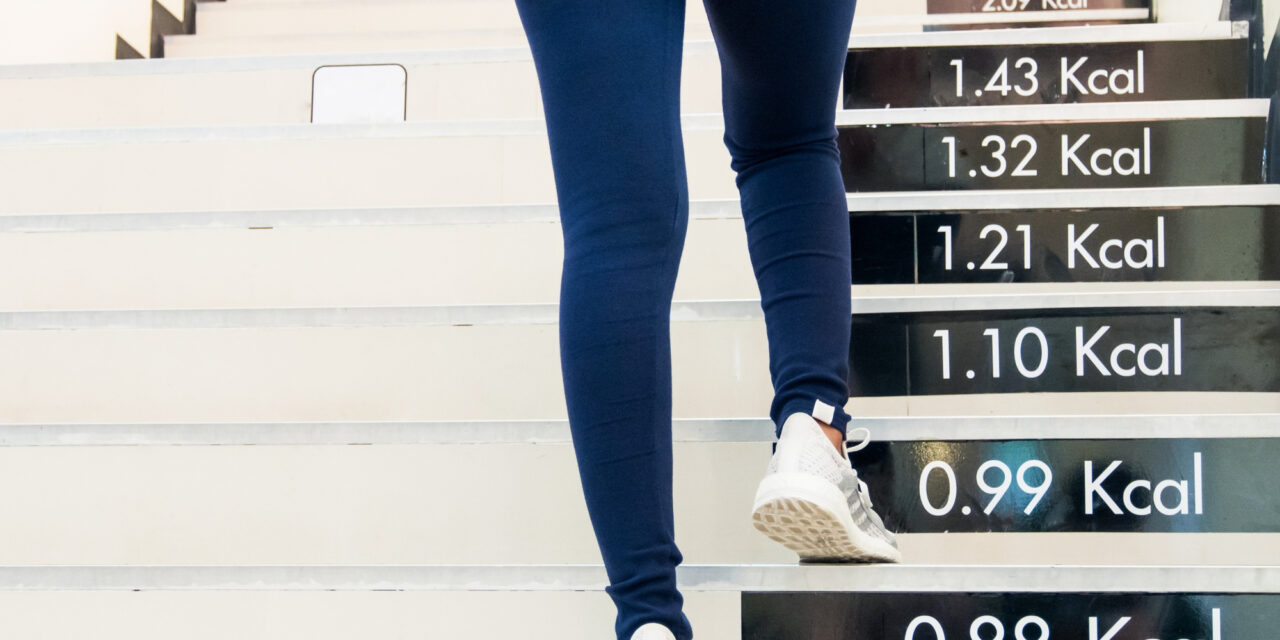
There isn’t one magic number. For most adults, the number of steps a day to lose weight that works in the real world is the number you can add to your current routine and repeat for months. A practical starting point is to measure your average for a week, add about 1,000 to 2,000 steps a day, and build toward a range somewhere between roughly 7,000 and 10,000 steps, depending on your age, health, schedule and joints.
Here’s the part many step guides skip. Steps are no magic bullet. They’re excellent for health and for keeping weight off, but eating less than you burn usually does more of the work on the scale in the first months. This guide explains what the research does and doesn’t show, how to turn steps into calorie estimates, how to build a ladder you can actually climb, and what to do when your step count rises and your weight doesn’t. It’s educational, not personal medical advice. If you have a heart condition, diabetes, joint problems, or you’re pregnant, check with your clinician before you ramp up.
It pairs well with our broader guides on how to lose weight safely and walking for weight loss. This page zooms in on one question: what the step counter number means, and how to use it.
Key Takeaways
The short answer in plain terms
What the evidence supports
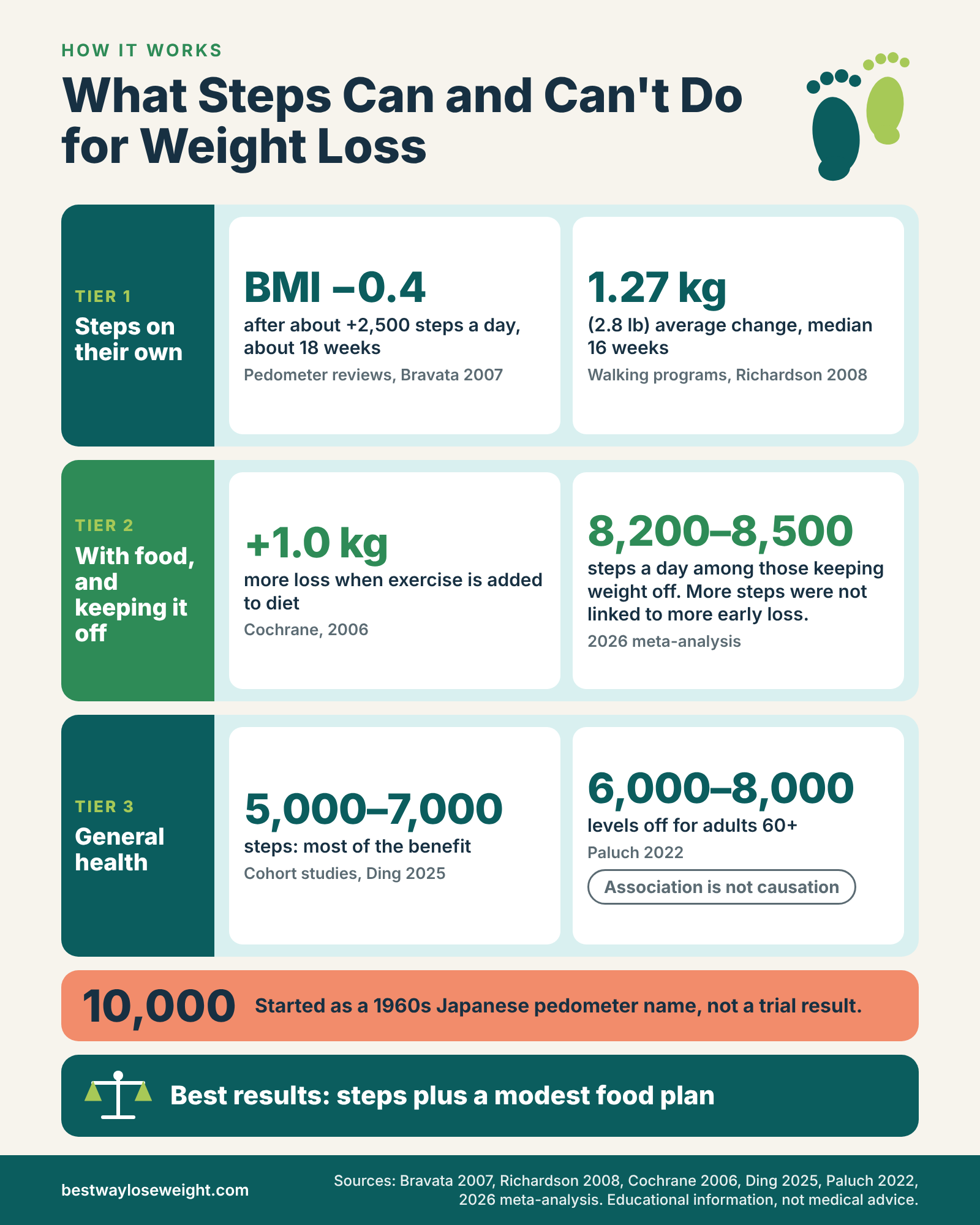
Pedometer-based programs in trials produced modest weight change on average, and the step goal itself seemed to help people stay motivated. Large observational studies link more daily steps with lower risk of dying and of several diseases, with much of the benefit showing up by about 5,000 to 7,000 steps a day in the most recent pooled analysis. A 2026 meta-analysis of randomized trials found that people who kept weight off after a lifestyle program averaged about 8,200 to 8,500 steps a day. Steps support health, and they appear to help with keeping weight off.
What it does not support
No study cited here shows that 10,000 steps is a threshold for weight loss, and none shows that any step count delivers a set amount of weight loss. The 2026 review also reported that walking more wasn’t linked to greater weight loss during the initial dieting phase. Observational studies can’t prove steps cause better health, because people who are healthier tend to walk more. Your results depend on food intake, body size, sleep, medications and a dozen other things.
What to do this week
Measure first, then add
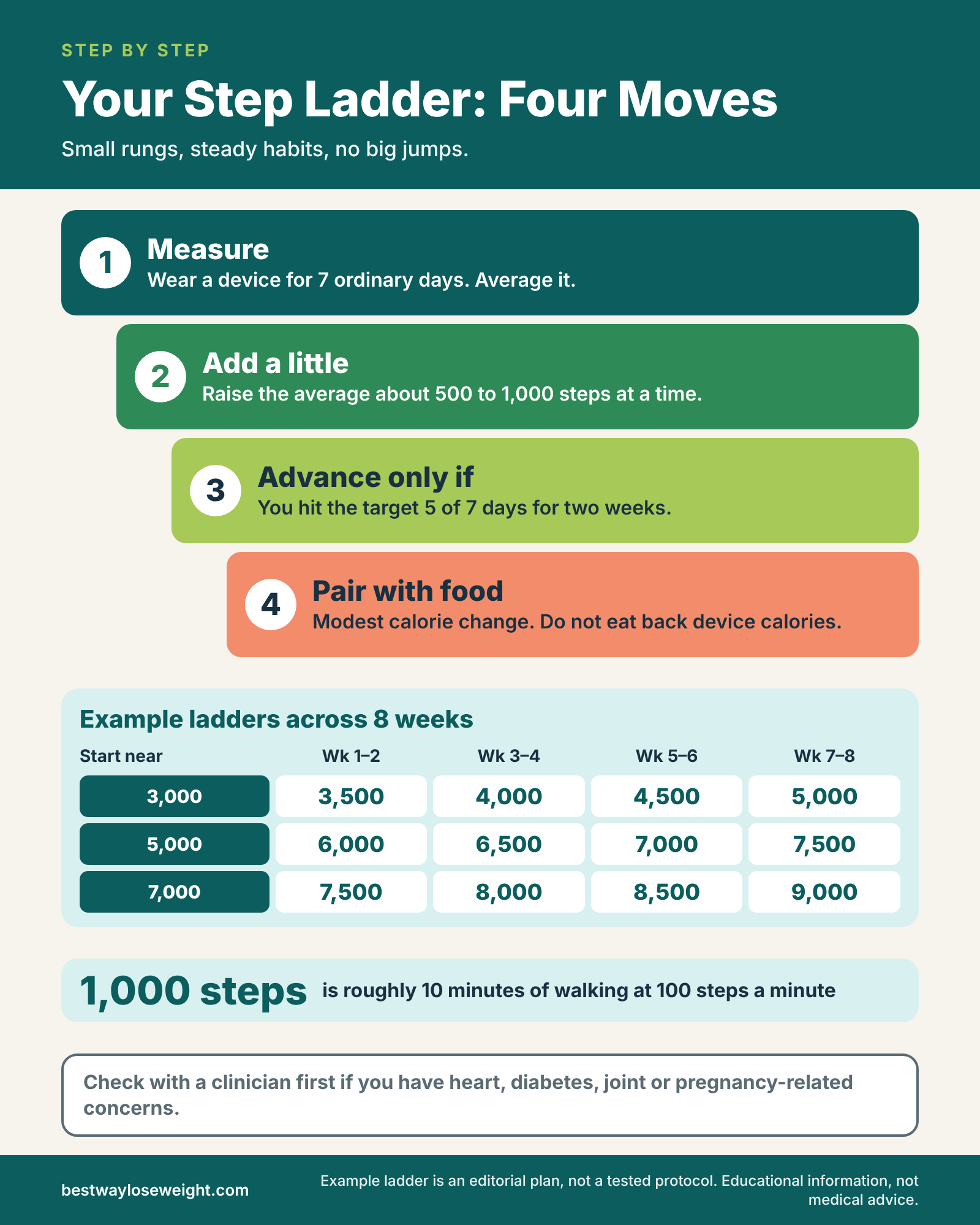
Wear your phone or tracker for seven ordinary days and average the total. That’s your baseline. Then raise your daily average by about 10 to 20 percent, or 500 to 1,500 steps, for two weeks before you raise it again. Small, repeatable jumps beat heroic Saturdays followed by sore Sundays. The planning tables below show starting points for different baselines.
Pair steps with eating
If your goal is weight loss, set a modest calorie gap through food and use steps to widen it a little, protect your health and make the result easier to keep. Our guides on how a calorie deficit works and the calorie deficit calculation walk through that side. Steps alone, at a realistic volume, rarely close a big gap.
Steps a Day to Lose Weight: What the Research Actually Shows
Three kinds of evidence get blended together in headlines: trials that tried to change step counts and watched weight, big cohort studies that followed people with step counters and tracked who got sick or died, and a more recent set of reviews about keeping weight off. They answer different questions, so it helps to pull them apart.
What trials of step-based programs found
Pedometer reviews: Bravata 2007 and Richardson 2008
A 2007 systematic review in JAMA pooled 26 studies with 2,767 participants, mostly women with an average age near 49 who were overweight and sedentary at baseline. People given a pedometer increased their activity by roughly 2,500 steps a day in the randomized trials, body mass index (BMI, a weight-for-height index) fell by about 0.4 units, and systolic blood pressure fell by about 3.8 mm Hg. The reviewers noted that having a specific step goal, such as 10,000, was linked to bigger increases. The average program lasted only about 18 weeks, and few men took part (news summary of Bravata et al.; PubMed record).
A 2008 review of nine walking-and-pedometer studies with 307 people found an average weight change of about 1.27 kg (roughly 2.8 pounds) over a median of 16 weeks, or about 0.05 kg a week. Longer programs were associated with greater change, and the authors couldn’t rule out that some participants changed their eating on their own (Richardson et al., Annals of Family Medicine). Taken together, that’s a real but modest signal. It’s a nudge, not a transformation.
Exercise alone vs. exercise plus diet: Cochrane
The Cochrane review of exercise for overweight and obesity pooled 43 randomized trials with 3,476 participants. Exercise alone produced small weight losses compared with no treatment, while adding exercise to a diet produced about 1.0 kg more loss than diet alone. Higher-intensity exercise produced about 1.5 kg more loss than lower-intensity exercise. The same review stressed that exercise improved cardiovascular risk markers even when people didn’t lose weight (Cochrane summary, Shaw et al., 2006). It’s an older review, so treat the exact figures as a rough guide rather than current gospel.
The 2026 review of steps and keeping weight off
A systematic review and meta-analysis presented at the European Congress on Obesity in May 2026 looked at randomized trials of lifestyle programs that tracked steps. The final analysis covered 14 trials and 3,758 adults (average age about 53, average BMI about 31). During the weight-loss phase, which averaged about 7.9 months, the intervention groups lost an average of 4.39 percent of body weight and averaged about 8,450 steps a day. During the maintenance phase, which averaged about 10.3 months, they kept off about 3.28 percent and averaged about 8,240 steps a day. The authors linked higher step counts with less regain, but also reported that walking more wasn’t associated with greater weight loss during the initial dieting phase (ScienceDaily summary of the ECO 2026 presentation; paper: International Journal of Environmental Research and Public Health, 2026).
That’s useful in two ways, and it’s a solid starting point for setting expectations. It suggests steps matter most for the “keeping it off” chapter. And it reminds us that these are averages across programs that also changed eating, so we can’t isolate what steps alone did.
What the big observational studies add (and don’t)
Mortality and disease cohorts
The best-known step data come from cohort studies, where researchers measure steps once and follow people for years. A 2022 meta-analysis of 15 cohorts (47,471 adults, 3,013 deaths over a median of about 7 years) found that risk of death fell with more steps, leveling off around 6,000 to 8,000 steps a day for adults 60 and older and 8,000 to 10,000 for younger adults (Paluch et al., Lancet Public Health 2022). A study of 16,741 older women (average age 72) found that those averaging about 4,400 steps a day had a 41 percent lower risk of death over roughly four years than those averaging about 2,700, with benefit leveling off near 7,500 (Lee et al., JAMA Internal Medicine 2019, via ScienceDaily).
A 2023 meta-analysis of 17 studies and 226,889 participants estimated a 15 percent lower risk of dying from any cause for every additional 1,000 steps a day (Banach et al., via ScienceDaily). The newest large synthesis, in The Lancet Public Health in 2025, pooled 57 studies from 35 cohorts. Compared with about 2,000 steps a day, around 7,000 steps was linked to roughly 47 percent lower all-cause mortality (hazard ratio 0.53), 25 percent lower cardiovascular disease incidence, 37 percent lower cancer mortality, 38 percent lower dementia risk and 22 percent fewer depressive symptoms. Most of the benefit showed up by about 5,000 to 7,000 steps (summary of Ding et al. 2025; PubMed record).
Why association is not causation here
None of those outcomes was weight. They tell us that people who walk more tend to live longer and develop fewer diseases, not that walking more will change your weight by a given amount. The Lee study’s authors acknowledged they couldn’t fully separate whether more steps lower mortality or whether women in better health simply step more. The 2025 authors listed limited age-specific data and residual confounding, meaning other differences between walkers and non-walkers that the analysis couldn’t fully remove. Cohort participants were also mostly from higher-income countries.
The practical consequence: use these studies to set a health-supportive range, not to forecast pounds. A step count that gets you into the 6,000 to 8,000 zone has solid support for general health, particularly if you’re starting low.
Where the 10,000 number came from
A marketing name, not a trial result
The 10,000-step figure traces back to Japanese pedometers sold in the 1960s under a name that translates roughly to “10,000 steps meter.” Catrine Tudor-Locke, a researcher who has studied walking for decades, has said the idea resonated with Japanese walking groups and spread from there. She has also noted that the CDC’s 150 minutes of moderate activity a week works out to roughly 7,000 to 8,000 steps a day, and that “more is better” beyond that (NBC News interview). In other words, 10,000 started as a round, memorable number.
Why 10,000 can still be a fine target
Round numbers can still be useful goals. A 2011 review by Tudor-Locke and colleagues concluded that 10,000 steps a day is a reasonable target for healthy adults, while describing a typical range of 4,000 to 18,000 steps a day and an estimated range of about 7,100 to 11,000 steps for meeting moderate-to-vigorous activity targets. It also pointed out that intervention studies commonly achieve increases of 2,000 to 2,500 steps (Tudor-Locke et al., 2011 abstract). If 10,000 motivates you and your body tolerates it, go for it. If it feels out of reach, a 7,000-step target is not a consolation prize. It sits near the middle of that evidence-based range.
How Steps Turn Into Calories: The Math
A step counter measures movement, not energy. To see what your steps might be worth on the scale, you need three conversions: steps to distance, distance to time, and time to calories. None is exact, but the arithmetic gives you a sensible ballpark and, just as usefully, shows you why steps alone rarely close a big calorie gap.
Steps, miles and minutes
Steps per mile depends on stride length
A mile is 5,280 feet, so steps per mile is 5,280 divided by your step length in feet. Taller people and faster walkers take longer steps and need fewer of them. The table below shows the spread. Most adults at a comfortable pace land somewhere around 2,000 to 2,500 steps per mile, which is why 10,000 steps usually works out to roughly four to five miles of total movement. Short, slow steps around the house cover less ground, so your all-day average may be a bit lower.
| Average step length | Steps per mile | Miles in 5,000 steps | Miles in 10,000 steps |
|---|---|---|---|
| 2.0 ft (shorter stride, slow stroll) | 2,640 | 1.9 | 3.8 |
| 2.2 ft (typical for many adults) | 2,400 | 2.1 | 4.2 |
| 2.5 ft (longer stride) | 2,112 | 2.4 | 4.7 |
| 2.8 ft (long stride, brisk walk) | 1,886 | 2.7 | 5.3 |
Stride changes how far 1,000 steps carries you, and therefore how many calories they cost. How long 1,000 steps takes depends on cadence (steps per minute) instead, which the next section covers.
The time cost of a step goal
At a cadence of 100 steps a minute, 1,000 steps takes 10 minutes of walking. That makes 2,000 extra steps about 20 minutes and 3,000 extra steps about 30 minutes, which is a handy way to translate a goal into a calendar. The CDC’s baseline of 150 minutes of moderate activity a week works out to roughly 15,000 steps a week at that cadence (150 minutes times 100 steps), or about 2,100 steps a day of deliberate brisk walking, on top of whatever you accumulate by simply living your day.
That’s why a total of 7,000 to 8,000 steps tends to line up with the 150-minute guideline: a few thousand incidental steps plus a dedicated walk or two. Tudor-Locke made the same link in her comments to NBC News.
Calories per 1,000 steps by body weight
Gross versus net calories
Energy expenditure for walking is usually estimated with METs, or metabolic equivalents. One MET is your resting energy use, and activities are rated as multiples of it. The 2024 Adult Compendium of Physical Activities lists walking at 2.8 to 3.4 mph as 3.8 METs and walking at 3.5 to 3.9 mph as 4.8 METs (Compendium of Physical Activities, walking). The standard formula is calories per minute = METs x 3.5 x body weight in kilograms / 200.
Gross calories include what you’d burn anyway at rest during those minutes. Net calories subtract that resting amount (one MET), which is the extra energy the walk adds. Net is the right number for a “how much did the walk add” question, and gross is what many apps display. Using the lower, more cautious net number prevents you from overestimating.
Reading the table
The table uses a 3.0 mph reference walk (3.8 METs, about 20 minutes per mile) and 2,400 steps per mile. If your stride is shorter, the same mile costs more steps and each step is worth less. If you walk faster, net calories per mile rise modestly.
| Body weight | Gross calories per mile | Net calories per mile | Gross per 1,000 steps | Net per 1,000 steps | Extra steps for about 250 net calories |
|---|---|---|---|---|---|
| 130 lb (59 kg) | 78 | 58 | 33 | 24 | about 10,400 |
| 160 lb (73 kg) | 97 | 71 | 40 | 30 | about 8,400 |
| 180 lb (82 kg) | 109 | 80 | 45 | 33 | about 7,500 |
| 200 lb (91 kg) | 121 | 89 | 50 | 37 | about 6,700 |
| 250 lb (113 kg) | 151 | 111 | 63 | 46 | about 5,400 |
| 300 lb (136 kg) | 181 | 133 | 75 | 56 | about 4,500 |
Worked examples
Adding 3,000 steps a day
Take a 180-pound adult whose baseline is about 4,000 steps a day and who adds 3,000 steps. From the table, 3,000 steps is about 3 x 33 = 100 net calories a day. Over a week that’s 700 calories. Using the traditional estimate of about 3,500 calories per pound of body fat, 700 calories a week is about 0.2 pounds. Over 12 weeks the static math says roughly 2.4 pounds, if nothing else changes.
That figure is in the same neighborhood as the pedometer trials, where average change over 16 weeks was about 1.27 kg (2.8 pounds). It’s a modest number, and by itself it won’t move the needle much. It’s also a number that comes with a better mood, lower blood pressure on average in the 2007 pedometer review, and a stronger habit foundation, so the bottom line isn’t “steps don’t matter.”
Steps needed to create a 500-calorie daily gap
People often hear that a 500-calorie daily gap produces about a pound a week. To make that gap with walking alone, the same 180-pound adult would need about 500 / 33 x 1,000, or roughly 15,000 extra steps a day, on top of the baseline. That’s about 150 extra minutes of brisk walking every day, or a little over six miles. For a 130-pound adult it’s closer to 21,000 extra steps. For a 300-pound adult it’s about 9,000.
Seen this way, the point is clear. Most people can’t, and shouldn’t have to, walk their way out of a large calorie surplus. Food decisions are the bigger lever, and steps are a helpful supporting one. Our guide on estimating your daily calorie needs explains how to estimate the starting point for that food side.
Why the arithmetic can overstate the result
The static 3,500-calorie rule
The 3,500-calories-per-pound rule treats the body as a bank account. In practice, as you lose weight your energy needs fall, and the same daily gap produces smaller changes over time. Dynamic tools model this. The National Institute of Diabetes and Digestive and Kidney Diseases (NIDDK) offers a free Body Weight Planner that models the effect of energy imbalance on body weight so you can test calorie and activity plans over a chosen time frame (NIDDK Body Weight Planner). Treat the arithmetic in this article as a first sketch, and the planner as a better second draft.
Compensation: appetite and rest
Real life also adds compensation. After a longer walk, some people feel hungrier, grab a bigger snack, or move less for the rest of the day. This varies enormously from person to person, and nobody can predict yours in advance. It helps to know your own pattern. If a 10,000-step day reliably ends with a larger dinner, that’s useful information, not a character flaw. The troubleshooting section later in this guide covers how to spot it.
Wearable calorie readouts add a second layer of noise. Stanford researchers who tested seven wrist devices on 60 volunteers found that six of seven measured heart rate within 5 percent, but the best device was off by an average of 27 percent on energy expenditure and the worst by 93 percent (Stanford Medicine news release). Use the step count, not the device’s calorie estimate, to plan.
Find Your Starting Point and Set a First Step Target
The most common step-goal mistake is picking a number from the internet rather than from your own life. A 10,000-step goal is a stretch for someone averaging 3,500 and is probably a rest day for someone who walks a mail route. Start from data.
Measure a baseline
Take a seven-day average
Wear the same device or carry your phone every waking hour for seven normal days, including at least one weekend day. Don’t try to improve anything yet. Add the seven totals and divide by seven. Write the number down. If one day is dramatically different, such as a travel day or an illness, replace it with a more typical one if you can, or extend the baseline to ten days.
A baseline week also reveals your pattern: which days are lowest, when during the day you move, and whether workdays and weekends differ. That pattern tells you where the easiest steps are hiding.
What counts and what doesn’t
A step counter counts walking and running steps. It misses a lot of valuable movement: cycling, swimming, rowing, elliptical sessions, strength training, and pushing a stroller or a cart if your arm isn’t swinging. If you do a lot of those, don’t panic about a low step count, and don’t try to “make up” steps to match a number. Track those sessions in minutes, and treat your steps as one measure of daily movement. The general guidelines from the CDC call for 150 minutes of moderate activity a week plus muscle-strengthening on 2 days a week, regardless of how that activity is counted (CDC adult guidelines).
Choose a first target by baseline
If you average under 4,000 steps
You’re in the group with the most to gain from small changes. In the 2019 older-women study, the group averaging about 4,400 steps a day had a 41 percent lower risk of death than the group averaging about 2,700, so modest gains from a low base are where the observational data look most encouraging. A first target of baseline plus 500 to 1,000 steps for two weeks is plenty, and a solid starting point. Don’t worry about 10,000 yet.
If you average 4,000 to 6,999 steps
A reasonable first target is baseline plus 1,000 to 1,500 steps, aiming for a 7,000-ish plateau within about 6 to 10 weeks. That range lines up with the point where the largest analyses show most of the health benefit and with the pace needed to approximate 150 minutes of moderate activity a week.
If you average 7,000 or more steps
You’re already in the evidence-supported zone for health. If weight loss is the goal, the extra gains are likelier to come from eating pattern changes, strength training and sleep than from piling on more steps. You could still add steps, particularly if you’re aiming to keep weight off afterward, since the 2026 meta-analysis found maintainers averaging around 8,200 to 8,500. A first target of baseline plus 1,000 steps, or a few brisk-cadence blocks, is a sensible experiment.
| Seven-day average | First two-week target | Next milestone | Main focus |
|---|---|---|---|
| Under 3,000 | Baseline + 500 | 4,000 to 5,000 | Frequency: add short walks, check with a clinician if symptoms limit you |
| 3,000 to 3,999 | Baseline + 500 to 1,000 | 5,000 | Daily anchors such as after-meal walks |
| 4,000 to 5,999 | Baseline + 1,000 | 6,500 to 7,500 | Build one longer walk plus incidental steps |
| 6,000 to 7,999 | Baseline + 1,000 | 8,000 to 9,000 | Consistency across weekends; add pace if desired |
| 8,000 or more | Hold, then test +1,000 | Personal choice | Eating pattern, strength training, sleep, recovery |
A simple decision framework for raising the number
The two-week rule
Raise your target only after you’ve hit the current one on at least five of seven days for two weeks in a row. That rule keeps the plan tied to what you actually did rather than what you hoped to do, and it limits the injury risk that comes with sudden jumps in volume. If you hit the target on fewer than five days, don’t increase it. Repeat the week or drop back slightly.
Think of it as a ladder where each rung has to feel solid before you step up, so the habit can stick with you day to day. A slow ladder beats a fast one that you fall off in week three.
When to hold or step back
Hold the target steady for another two weeks if you’re sore for more than a day or two after walks, getting new joint pain, sleeping worse, or feeling hungrier in ways that are pushing your eating up. Step back by 500 to 1,000 steps if pain persists or you feel unusually fatigued, and contact a clinician if you have chest discomfort, unusual shortness of breath, dizziness or fainting, or pain that gets worse rather than easing as you warm up. Those aren’t signs to push through.
Step Ranges by Goal: Weight Loss, Keeping It Off, and General Health
“How many steps” has different answers depending on which question you’re really asking. Losing weight, keeping weight off and staying healthy overlap, but they don’t have identical targets, and mixing them up is one reason step advice sounds contradictory.
During the weight-loss phase
Why eating usually leads at first
The CDC’s weight-management page says that losing weight takes a high amount of physical activity unless you also adjust your eating patterns and reduce the calories you eat and drink (CDC, Physical Activity and Weight Management, reviewed December 2025). The 2026 trial meta-analysis found the same shape: weight loss in the first months didn’t track with higher step counts, while regain prevention did. If you’re trying to lose weight, expect your food plan to set the pace and your steps to play a supporting role.
That doesn’t make steps optional. It means the step goal is a companion to a calorie plan, not a substitute for one. Our guides on calorie deficits and how much weight you can safely lose in a month cover how to set that pace without crash tactics.
What steps add during the loss phase
Steps contribute a small, steady calorie burn (the table earlier suggests about 24 to 56 net calories per 1,000 steps depending on body weight), and they bring benefits that don’t depend on the scale. The Cochrane review found that exercise improved cardiovascular risk markers even when weight didn’t change. Walking also breaks up sitting time and builds the habit you’ll rely on later. For many people, those side benefits are the reason steps are worth the effort.
A realistic aim in this phase is a steady rise to a range you can sustain, not a daily scoreboard battle. If you’re still hungry from a calorie plan that’s too aggressive, extra steps will usually make it harder, not easier.
Keeping weight off
Using a step “floor” for maintenance
The 2026 meta-analysis reported that, on average, people who maintained weight loss for about ten months were walking around 8,200 steps a day, close to what they did while losing weight. Averages hide plenty of variation, so don’t treat 8,241 as a cutoff. A more useful move is to dial in your own maintenance floor: the weekly average you can sustain in a normal busy month. As a rule of thumb (an editorial suggestion, not a research threshold), if your weekly average drops 15 to 20 percent below that floor for two weeks, treat it as an early signal and look at your routine, your schedule and your eating, before the scale does the talking.
Our guides on weight loss plateaus and weight loss after 40 go deeper on stalls and age-related changes.
Reading regain research carefully
Studies linking higher steps to less regain can’t tell us the direction of the arrow. Walking might protect against regain, or people who are doing well and feeling good might simply walk more. The trials in the 2026 review were also lifestyle programs with coaching, so the walkers may have been supported in other ways. The safe reading is that more daily walking and better maintenance travel together, and that building a walking habit while you lose is a low-risk bet.
General health and longevity ranges
The 5,000 to 8,000 zone
Across the large cohort analyses, risk reductions come quickly as steps rise from very low levels and then flatten. The 2025 Lancet Public Health analysis placed inflection points around 5,000 to 7,000 steps for several outcomes. The 2022 meta-analysis put the leveling-off point at 6,000 to 8,000 for adults 60 and older and 8,000 to 10,000 for younger adults. Differences in how the studies counted, which populations they included and how they handled confounding explain much of the spread, so a range is a more honest way to read them than a single number.
Older adults and people with lower baselines
For adults 60 and older, the 2023 Banach meta-analysis estimated a 42 percent lower risk of death for 6,000 to 10,000 steps a day, compared with 49 percent lower for people under 60 at 7,000 to 13,000 steps. The older-women study found benefit leveling off near 7,500 steps. If you’re older or starting from a low base, aim for steady progress in the 5,000 to 8,000 zone rather than pushing toward 12,000. Our guide to weight loss after 50 covers the specifics for that age group.
| Goal | Range often discussed | What it is based on | Main caution |
|---|---|---|---|
| Lower risk of death and chronic disease | About 5,000 to 8,000 for most adults; benefits continue above that in some analyses | Cohort studies and meta-analyses (observational) | Association, not proof; healthier people walk more |
| Meet the 150-minute activity guideline through walking | About 7,000 to 8,000 total, per Tudor-Locke’s estimate | Cadence arithmetic (100 steps per minute) plus incidental steps | Depends on cadence and stride; individual totals differ |
| Initial weight loss | No step threshold shown; the 2026 review found no extra loss with more steps in the dieting phase | Randomized trials of lifestyle programs | Trials mixed diet and activity; food intake probably drives early change |
| Keeping weight off | Averages around 8,200 to 8,500 in trial groups that maintained loss | 2026 meta-analysis of randomized lifestyle trials | Average across studies; direction of cause is unclear |
| Older adults | About 6,000 to 8,000 | Older-adult cohorts, including 2019 and 2022 analyses | Balance, strength and fall risk matter; individualize |
Ways to Add Steps Without Adding Hours
If you’re staring at a gap between 4,500 steps and 7,500 steps, you don’t need to carve out three hours. The most reliable approach is to hide small walks inside things you already do. The arithmetic is friendly: at about 100 steps a minute, ten minutes is roughly 1,000 steps.
Small additions through the day
Anchor walks to existing routines
Habits stick better when they attach to something you already do. A ten-minute walk after lunch, a lap around the block while the coffee brews, or a stroll while you take a call are all easy anchors. Three ten-minute walks in a day come out to about 3,000 steps, which matches the 30-minute daily block that the 150-minute weekly guideline is often divided into. Short walks count, and they add up faster than most people expect. The CDC arthritis guidance, for example, notes that activity can be broken into 5- to 10-minute sessions.
Pick anchors you can do on bad days too, not just good ones. A walk that depends on perfect weather will be missed more often than one tied to your lunch break.
Breaking up long sitting stretches
Many people accumulate their lowest step counts in long blocks at a desk, in a car or in front of a screen. A five-minute walk each hour of an eight-hour workday adds up to about 40 minutes, or roughly 4,000 steps at a comfortable cadence. You don’t need to do all eight. Even four or five short breaks, set with a phone reminder or tied to meetings ending, can move your average more than a single big workout would. Our sleep and weight loss guide covers how sleep affects hunger and habits, so keep an eye on tiredness when you add steps.
Making it fit work and family life
Desk jobs and remote work
If you work from a chair, the biggest wins come from replacing sedentary habits rather than adding new time slots. Walk during phone calls without video, stand up for a lap when you finish a task, put your water bottle or printer across the room, and take the long way to the restroom or the meeting. On remote days, a short “commute” walk before and after work gives you two predictable 10- to 15-minute blocks and marks the boundary between work and home. Those two blocks alone are about 2,000 to 3,000 steps.
Shift work, standing jobs and caregiving
If you’re on your feet at work, your step count might already be high and your problem might be foot fatigue, not inactivity. Check your numbers for a few shifts before assuming you need more. If your shift is irregular, set a weekly average goal instead of a daily one, and bank extra steps on lighter days. For parents and caregivers, steps often come in fragments: pushing a stroller, chasing a toddler, and walking a kid to school all count when your wrist or phone registers them. Stroller walks may under-count if the phone is in a bag and your arms aren’t swinging, so test your device on a known route.
Weather, safety and budget
Heat, cold and slick surfaces
The CDC’s heat guidance for people who exercise outdoors includes exercising during cooler parts of the day, drinking more water than usual, starting gradually, wearing light, loose clothing, and stopping and moving to a cool place if you feel faint or weak (CDC, heat and athletes). In winter, traction and visibility matter more than pace. If sidewalks are icy or the air is smoky, move your steps indoors that day. A missed outdoor walk isn’t a failure.
Indoor and no-cost options
Walking doesn’t require a gym membership or special gear. Mall loops, hallway laps, a treadmill if you have access, marching in place during a show, and walking while you wait for appointments all work. A pair of comfortable, supportive shoes is the main investment. If you use a treadmill, the same cadence ideas apply, and remember that treadmill steps might be counted differently by a wrist device than by a phone in your pocket.
| Situation | Idea | Approximate steps | Time cost |
|---|---|---|---|
| Desk job | 5-minute walk break, 4 times a day | About 2,000 | 20 minutes, spread out |
| Remote work | 10-minute walk before and after work | About 2,000 | 20 minutes |
| After meals | 10-minute walk after lunch and dinner | About 2,000 | 20 minutes |
| Phone calls | Walk during 30 minutes of calls a day | About 3,000 (if you can pace steadily) | Overlaps with calls |
| Errands | Park farther away or walk one stop early on transit | About 500 to 1,500 | 5 to 15 minutes |
| Evening | 20-minute walk with family, a friend or a podcast | About 2,000 | 20 minutes |
| Bad weather | Hallway or indoor loops, treadmill, or marching during TV | About 1,000 per 10 minutes | 10 to 20 minutes |
Does Walking Faster Matter? Cadence, Intensity and Hills
Once you’ve got a step total, a second question follows: do 8,000 slow steps and 8,000 brisk steps do the same thing? The answer depends on whether you mean health outcomes, calories or time efficiency.
Cadence benchmarks
About 100 steps a minute for moderate intensity
Cadence is steps per minute. A review of cadence research found that 100 steps a minute or more is a consistent rule of thumb for moderate intensity (about 3 METs) in healthy adults, and that more than 130 steps a minute may be a useful marker of vigorous intensity, though the authors flagged that as needing further research (Tudor-Locke et al., British Journal of Sports Medicine 2018). It’s a population-level guide. The exact cadence that feels moderate can differ with leg length, fitness and terrain, so treat it as a place to start.
You can check cadence with a metronome app set to 100 beats a minute, a watch’s cadence readout, or by counting steps for 30 seconds and doubling. Try it on a familiar route and note how it feels.
The talk test as a backup
If numbers aren’t your thing, the CDC’s talk test works. A person doing moderate-intensity aerobic activity can talk but not sing; a person doing vigorous activity can’t say more than a few words without pausing for breath (CDC, measuring physical activity intensity). Use whichever method you’ll remember. Hills, heat, a heavy backpack or a bad night’s sleep change how hard a given pace feels, and that’s fine. The talk test follows your body on that day.
Speed versus more steps
What the cohort data suggest
The evidence on speed is mixed. In the 2019 older-women study, walking speed or intensity wasn’t associated with mortality once step counts were similar. In the 2022 meta-analysis, peak 30- and 60-minute stepping rates were still associated with mortality after adjusting for total steps, but time-based intensity thresholds weren’t. Put plainly, total steps looks like the main driver in these data, with pace possibly adding something on top. Both findings are observational and come from different measurement methods, so don’t build a strict rule around either.
The calorie view: time-efficiency
From a calorie standpoint, speed matters more per minute than per mile. Using the Compendium values for a 180-pound walker, walking at 3.0 mph (3.8 METs) burns about 80 net calories per mile, while walking at 3.75 mph (4.8 METs) burns about 87. That’s only about 9 percent more per mile. But because the faster walk covers a mile in 16 minutes instead of 20, the net burn per 30 minutes rises from about 120 to about 163 calories. So if you have a fixed 30 minutes, a brisk pace gets you more energy use and more steps. If you have a fixed step goal and plenty of time, a slower pace costs only a little extra energy per mile.
That asymmetry explains why people with tight schedules often benefit from a short brisk walk, while people with flexible time can reach a step goal at any pace they enjoy.
Making your steps harder
Hills and inclines
Walking uphill raises effort quickly, which makes it a good way to increase intensity without increasing speed or step count. A treadmill incline of a few percent or a hilly route can turn a casual walk into a moderate or vigorous one. Joint comfort is the limit: steep downhills load the knees more, so skip them if you have knee pain, and check with your clinician or a physical therapist if you’re not sure.
Short intervals
Interval walking alternates faster and slower stretches, for example one to three minutes brisk followed by one to three minutes easy. It’s a simple way to raise your average effort without sustaining a hard pace the whole time. If you’re new, keep the fast segments conversational-plus rather than breathless, and keep the total length within your current comfortable duration. Intervals are optional. They’re a way to dial up the effort in a set amount of time, not a requirement for results.
Pairing Steps With Eating: Why Both Matter
The step counter measures one side of the energy balance equation. The other side is food, and it’s the easier side to change by a larger amount. Putting the two on the same scale makes the trade-offs clearer.
Why food usually does the heavy lifting
The cost of a small snack in steps
Take the 180-pound walker from earlier, who burns about 33 net calories per 1,000 steps. A 200-calorie snack, such as a small handful of nuts plus a piece of fruit or a granola bar, equals about 6,000 steps of net energy. A 100-calorie difference at a meal is about 3,000 steps. Those conversions explain why modest, consistent changes to portions, drinks and snacks tend to move the calorie balance more than a typical day’s worth of added steps.
It also explains why “I walked 12,000 steps, so I earned dessert” often backfires. The step count is real. The calorie credit may be a lot smaller than it feels.
What combined approaches add
The Cochrane review found that adding exercise to a diet produced about 1.0 kg (a bit over 2 pounds) more loss than diet alone, and the pedometer reviews found modest changes with steps alone. Those numbers aren’t dramatic. They do suggest the combination is a bit better than either alone, and that exercise brings health benefits that the scale doesn’t capture. For the food side, see our guides on high-protein eating for weight loss and filling, nutritious food choices.
A worked example combining steps and food
The assumptions (a hypothetical person)
This is an illustration, not a real case or a recommendation. Imagine an adult who weighs 180 pounds, averages 4,200 steps a day at baseline, and has an estimated maintenance intake of 2,400 calories a day (estimated with a method like the one in our TDEE guide). They add 3,000 steps a day, bringing the average to 7,200, and trim about 300 calories a day from food by changing a few habits, such as swapping a sugary drink, reducing liquid calories and slightly smaller portions at one meal.
The arithmetic and how to read it
Steps contribute about 100 net calories a day (3 x 33). Food contributes about 300. Together that’s about 400 a day, or 2,800 a week, which the static 3,500-calorie rule converts to about 0.8 pounds a week. In practice, your rate will almost certainly differ and will tend to slow as your body gets lighter and your energy needs change. Appetite, sleep, medications and measurement error in both food and activity add more noise. Treat the 0.8 as a rough ceiling for planning, not a forecast, and judge the plan by trends over several weeks rather than by one weigh-in. Our guide on safe monthly weight loss discusses sensible paces.
| Approach | Daily calorie change | Weekly total | Static estimate (3,500 calories per pound) |
|---|---|---|---|
| Add 3,000 steps only | About 100 | About 700 | About 0.2 lb a week |
| Trim 300 calories of food only | 300 | 2,100 | About 0.6 lb a week |
| Both | About 400 | About 2,800 | About 0.8 lb a week |
| Add 3,000 steps and eat back a 200-calorie snack | About -100 (net gain) | About -700 | Slight gain by the static math |
Hunger and “earning” your food
Don’t eat back what the device says you burned
A systematic review of consumer wearables found that step counts were reasonably close in controlled settings (45.2 percent of measurements were within 3 percent) but energy expenditure was far less accurate, with only 9.2 percent of measurements within 3 percent (Fuller et al., JMIR mHealth and uHealth 2020). If your watch says you burned 600 calories in a walk and you eat 600 extra calories because of it, you may erase the whole plan. A safer approach is to treat steps as a bonus on top of a food plan that already works, not as an allowance.
Hunger after walking: a pattern, not a verdict
If you notice you’re consistently hungrier on high-step days, plan for it instead of fighting it. Put a protein-and-fiber-containing snack in your bag, eat a regular meal at the usual time, and see whether the hunger settles. If it doesn’t, your calorie target or your step jump may be too aggressive, and you can lower one. Persistent, intense hunger or preoccupation with food and exercise totals is worth talking about with a clinician or a registered dietitian, especially if you have a history of disordered eating.
An 8-Week Step Plan You Can Adjust
The plan below is an editorial example built on the two-week rule from earlier, not a research-tested protocol. It’s designed to be boring and forgiving. You can repeat any block, skip ahead only if you hit your numbers, and pause when life gets hectic. The point is to stick with it long enough for the habit to move the needle in the real world.
How the plan works
Weekly rungs and the five-of-seven rule
You’ll hold a target for two weeks, then raise it. To advance, you should have reached your daily target on at least five of seven days in both weeks. If you didn’t, repeat the block. The target applies to your daily average over the week, so a 10,000-step Saturday can offset a 6,000-step Tuesday. Write the numbers in a notes app or on a calendar. The act of looking at your own trend does a lot of the motivating.
Flex days and rest days
Build in at least one lighter day a week. A lighter day is not a failure. It’s a chance to let sore feet and joints recover, and it keeps the plan realistic on days with a long shift, travel, illness or family needs. If you’re sick, injured or just wiped out, pause the ladder. Starting again from the last comfortable rung is better than pushing through.
Plans by starting point
Starting near 3,000 steps
If you start near 3,000, the plan climbs in 500-step rungs: about 3,500 for weeks 1 and 2, 4,000 for weeks 3 and 4, 4,500 for weeks 5 and 6, and 5,000 for weeks 7 and 8. That’s a 2,000-step rise over two months, roughly 20 extra minutes of walking a day at the end, and comparable to the 2,000 to 2,500 step increases that interventions commonly achieve. If you hit 5,000 and feel good, the next block can continue the same pattern toward 6,000 to 7,000.
Starting near 5,000 or 7,000 steps
If you start near 5,000, a faster ladder is reasonable: about 6,000 for weeks 1 and 2, then 6,500, 7,000 and 7,500. If you start near 7,000, rungs of 500 steps (7,500, 8,000, 8,500 and 9,000) are enough, and you can also choose to hold at 7,000 to 8,000 while you focus on eating pattern, strength training or sleep. Our strength training guide explains how resistance work fits alongside walking.
| Starting baseline | Weeks 1 to 2 | Weeks 3 to 4 | Weeks 5 to 6 | Weeks 7 to 8 |
|---|---|---|---|---|
| About 3,000 | 3,500 | 4,000 | 4,500 | 5,000 |
| About 5,000 | 6,000 | 6,500 | 7,000 | 7,500 |
| About 7,000 | 7,500 | 8,000 | 8,500 | 9,000 |
Sample days
An office day at about 7,500 steps
The numbers below are approximate and your own mix will differ. They show how a day can reach about 7,500 steps without a long workout.
- Getting ready and moving around the house: about 1,000 steps.
- 10-minute walk before work or on the commute: about 1,000 steps.
- Normal workday movement (restroom, coffee, meetings, lunch): about 2,000 steps.
- 12-minute lunch walk: about 1,200 steps.
- Four 3-to-5-minute breaks spread across the afternoon: about 1,000 steps.
- 10-minute walk after dinner: about 1,000 steps.
- Evening around the house: about 300 steps.
A day on your feet or a recovery day
If your job keeps you moving 9,000 or more steps a shift, the best plan for a high-step day is often to add nothing and protect your recovery: supportive shoes, a few minutes of calf and foot stretching if it feels good, and a normal-length sleep window. On days off, take a gentler walk or choose a lower-impact activity such as cycling or swimming if your feet need a break. Your weekly average still counts, and it’s fine for it to come from different kinds of days.
Tracking Steps Accurately
A step goal is only as useful as the number behind it. Fortunately, you don’t need lab-grade accuracy. You need a consistent measure that tracks your own changes over weeks.
What devices get right and wrong
Step counts: usually close, not exact
The systematic review of consumer wearables (Fuller et al., 2020) found that in controlled settings, about 45 percent of step measurements fell within 3 percent of the true count, about 43 percent underestimated by more than 3 percent and about 12 percent overestimated by more than 3 percent. In free-living conditions, 42 percent were within 10 percent, 41 percent overestimated by more than 10 percent, and the average error was a slight overestimate of about 5 percent. Apple and Samsung devices showed less variability than other brands in the controlled settings, though results differed by model (JMIR mHealth and uHealth). In other words, expect your tracker to be roughly right and occasionally off by a noticeable amount.
That’s fine for a plan built on trends. A device that’s 5 percent high every day still shows you whether this week is higher than last week.
Calories: treat them as rough
The same review found that only 9.2 percent of energy expenditure measurements were within 3 percent in controlled settings, and the Stanford test found average errors between 27 and 93 percent across the seven wrist devices it examined. If you want a calorie estimate for walking, the MET method used earlier is as good as, and arguably more transparent than, your watch’s number. If you want to know whether you’re moving more, use the steps and ignore the calorie readout.
Choosing a tracking method
Phone, wrist tracker or clip-on pedometer
Each option has trade-offs. A phone is free and always handy, but it only counts when it’s on you. A wrist tracker catches more of the day but can count arm movement such as driving over bumps, and it might miss stroller or cart pushing. A clip-on pedometer is simple and doesn’t distract, but may need a snug position at the waistband. Any of them can work. Pick the one you will actually wear day to day.
| Method | Strengths | Watch-outs | Best for |
|---|---|---|---|
| Smartphone in a pocket | No extra cost; steps are logged automatically | Misses steps when the phone is in a bag or left on a desk | Beginners who carry their phone constantly |
| Wrist tracker or smartwatch | Worn all day; adds heart rate and sleep data | May miscount when pushing a cart or stroller; calorie readouts are rough | People who like feedback and reminders |
| Clip-on pedometer | Simple, inexpensive, no screen distractions | Position matters; no automatic history unless it syncs | People who want a basic count |
| Manual log of timed walks | Works without any device | Less precise; relies on estimating pace | Anyone who can’t or won’t use a device |
Consistency rules that protect your data
Use the same device for the whole plan, carry or wear it the same way, and don’t compare your numbers with a friend’s, because their stride and device differ. If you switch devices, restart your baseline for a few days. Charge it overnight so you aren’t missing the first or last hours of the day. If you notice that your device counts steps while you drive or while you eat, mention it to yourself and move on. Consistent error is less harmful than inconsistent measurement, and it won’t derail a plan built on trends.
Using the data well
Look at the weekly average
Daily numbers bounce around with weather, workload and sleep. The seven-day average smooths that out and is the number that your plan targets. If your average climbs for two or three weeks and then flattens, that’s a good sign, not a plateau problem: you have built a habit and can decide whether to climb again.
Compare steps with the scale over weeks, not days
If you weigh yourself, keep the rhythm steady (for example, the same morning each week or a daily reading you average weekly). Then compare four-week windows of average steps and average weight. A scale that holds steady while steps rise is information, and our guide on weight loss plateaus covers how to interpret and respond to that pattern.
Who Should Adjust the Plan, and How
Walking is one of the more accessible and lower-risk forms of activity, but low risk doesn’t mean no risk, and some situations call for a different approach. This section is general educational guidance, not a substitute for advice from your own clinician.
Medical and life-stage situations
Heart conditions, diabetes and prescription medicines
If you have a heart condition, diabetes, kidney disease, lung disease or another chronic condition, or you take prescription medicines, ask your clinician what level of activity is appropriate before you raise your step count significantly. Increased activity can change how your body handles blood sugar and blood pressure, and some medicines interact with activity, so it’s worth asking whether any monitoring or timing changes make sense. Stop and get medical help for chest pain or pressure, severe shortness of breath, fainting, or symptoms that feel unusual for you.
Pregnancy, postpartum and adolescents
Pregnancy and the postpartum period change what’s comfortable and appropriate, and step goals designed for weight loss don’t fit them. Weight management during pregnancy is a matter for your obstetric clinician. Teens and children have different needs, and a step goal framed around weight loss isn’t a good fit for them without guidance from a pediatric clinician. This article is written for adults.
History of disordered eating
If you have a history of an eating disorder or find yourself compulsively hitting step totals, skipping meals to hit numbers, or feeling distress when you miss a goal, a step-count plan may do more harm than good. Talk with a clinician or a mental-health professional experienced in eating disorders, and consider focusing on how movement feels rather than on totals.
Joints, pain and mobility
Arthritis and joint pain
The CDC lists brisk walking among activities that put no or low stress on joints and says physical activity can help people with arthritis reduce joint pain and improve function and mood. It also says some pain, stiffness or swelling is normal after starting a new program, and that arthritis joint pain from activity should get better over time; it suggests breaking activity into 5- to 10-minute sessions and talking with a clinician or physical therapist first (CDC, physical activity and arthritis, reviewed February 2024). If pain gets worse or lingers into the next day, drop back a rung.
Walking aids, wheelchairs and limited mobility
A step count isn’t the right yardstick for everyone. If you use a wheelchair or a mobility aid, or can’t walk long distances, count minutes of movement that are right for you, such as wheeling, seated exercise or water-based activity, and ask a clinician or physical therapist for guidance. Activity targets can be adapted. The goal is regular movement that suits your body.
Age, body size and fitness
Older adults and fall risk
The 2025 Lancet Public Health analysis linked about 7,000 steps a day with 28 percent lower fall risk compared with about 2,000, though it also noted limited age-specific data and lower certainty for falls. If balance is a concern, add balance and strength work alongside walking, wear stable shoes, and choose even, well-lit routes. A cane or walker doesn’t prevent you from building a step habit, but ask your clinician or physical therapist what fits.
Higher body weight or low fitness at the start
If you carry a lot of weight or haven’t been active for a while, walking can feel harder at first and joints can take the brunt. Start with short bouts, such as two or three 5-minute walks a day, wear supportive shoes with good cushioning, favor flat, even surfaces, and increase gradually. The table earlier shows that heavier bodies burn more calories per step, so smaller step totals can still count for something meaningful. A first target near 3,000 to 4,000 steps is entirely reasonable.
Troubleshooting: Steps Are Up but the Scale Isn’t Moving
It’s common to raise your step count for a few weeks and see little change on the scale. That doesn’t mean the effort is wasted, but it does call for a quick check. Work through the questions below in order before changing the plan.
Diagnose the likely cause
Check your baseline and your device
First confirm that your step count really increased. Compare the weekly average now with your baseline week. If the average is up by less than a thousand steps, the extra calories burned are small (about 24 to 56 net calories per 1,000 steps, depending on weight), and a change that small can be hidden by normal fluctuations in food intake and water weight. Also confirm you’re wearing the device consistently.
Check eating, drinks and weekends
Small additions often creep in unnoticed, such as a larger portion after a long walk, a flavored coffee or an extra weekend meal. Review a typical week of eating honestly, and not to scold yourself. If you track calories, check whether you’ve been entering the exercise calories from your device as extra food allowance. Our guides on calculating a calorie deficit and how deficits work can help you rebuild a realistic estimate.
An if-then guide
Common patterns and responses
The table lists patterns that people commonly run into. They’re examples of reasoning, not diagnoses.
| If this is happening | One likely reason | Try this |
|---|---|---|
| Steps up 1,000 or fewer, no change in weight after 4 weeks | The added burn is small compared with normal variation | Hold steps steady, look at food, and judge by 4 to 6 weeks of data |
| Steps up 3,000 or more, weight flat | Eating more on high-step days, or measurement noise | Review portions and drinks on those days; avoid treating steps as a food allowance |
| Hungrier and snacking at night after a high-step day | Calorie target or step jump too large; short on protein or sleep | Add a planned snack, protect sleep, or step back one rung |
| Steps high on weekdays, low on weekends | Routine, not motivation, drives the pattern | Plan one weekend walk with a friend, a destination or a podcast |
| Joint soreness or foot pain after increasing | Volume rose faster than tissues adapted | Drop back 500 to 1,000 steps, check shoes, ask a clinician if it persists |
| Weight changed quickly, then stalled | Early change often includes water and shifts in food volume | Wait for a longer trend before changing the plan |
When to bring in a professional
If you’ve tracked steps and food for about 6 to 8 weeks, you’re confident in your numbers, and the trend still isn’t moving in the direction you and your clinician agreed on, it’s worth talking to a clinician or registered dietitian. Medical causes, medicines, sleep problems, hormonal conditions and other factors can influence weight, and they’re beyond what a step plan can fix.
Plateau versus normal fluctuation
Everyday weight swings
Body weight moves around from day to day by a pound or two or even more because of water, salt intake, the timing of meals and bathroom habits, and, for some people, the menstrual cycle. A new walking habit can also change fluid shifts and soreness-related swelling for a few days. Weekly averages tell you more than any single morning.
A realistic time horizon
Judge a step plan over at least four weeks and ideally eight. Compare average weekly steps, average weekly weight, how your clothes fit, your energy, and measures your clinician cares about, such as blood pressure or blood sugar. If the numbers on the scale aren’t moving but you’re walking more, sleeping better and feeling stronger, that’s still progress to protect.
Your Step-Goal Checklist and Common Mistakes
This section pulls the plan into something you can print or screenshot, and names the errors that most often trip people up.
Step-goal checklist
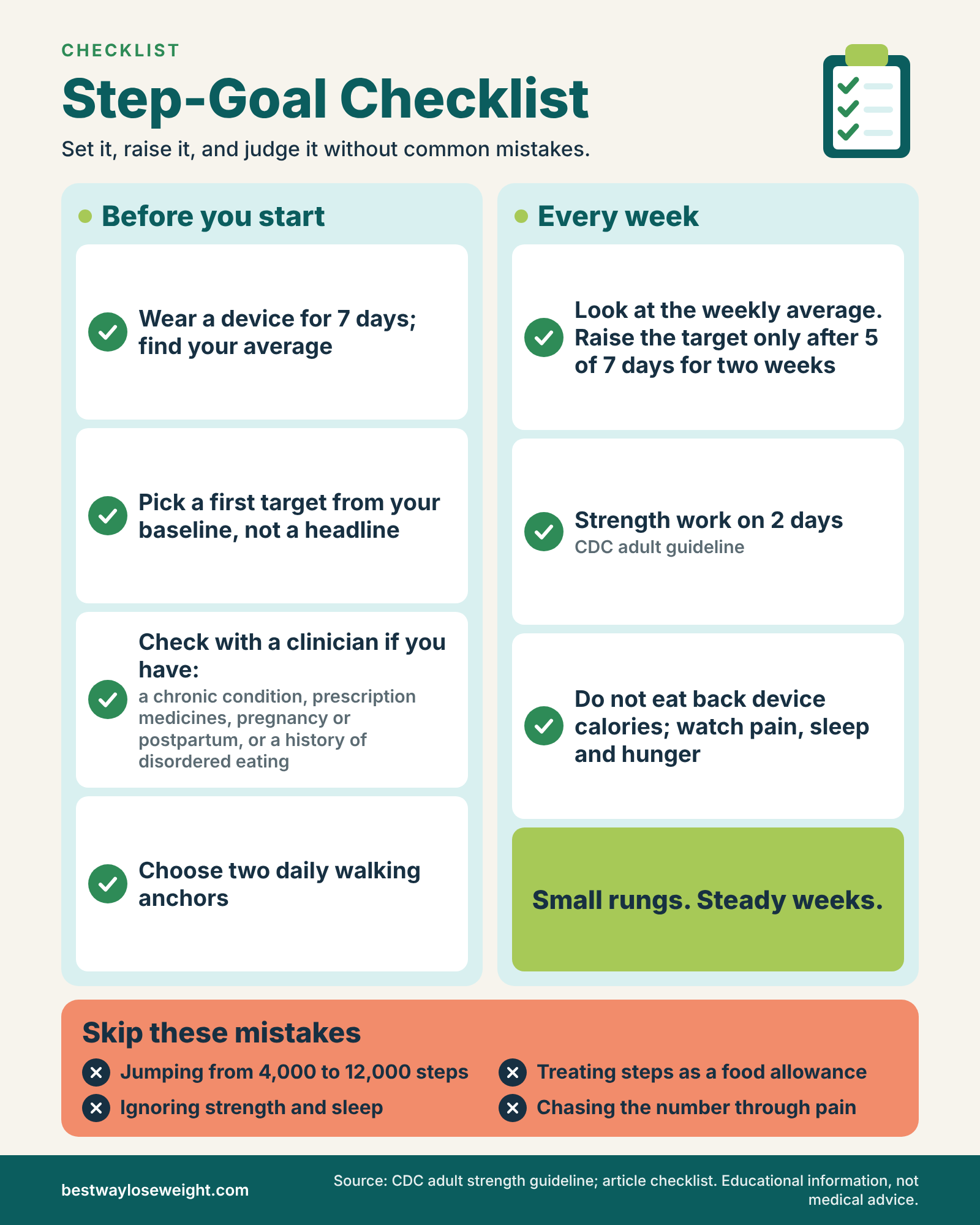
Before you start
- I’ve worn my device for 7 ordinary days and calculated my average.
- I’ve chosen a first target from the table, not from a headline.
- I’ve checked with a clinician if I have a heart, lung, kidney, diabetes or joint condition, take prescription medicines, am pregnant or postpartum, or have a history of disordered eating.
- I have supportive shoes and a few indoor options for bad weather.
- I’ve picked two daily anchors (for example, a lunch walk and an after-dinner walk).
Every week
- I looked at my weekly average, not just yesterday’s total.
- I raised my target only if I hit it on 5 of 7 days for two weeks.
- I did muscle-strengthening on 2 days this week, as the CDC recommends for adults.
- I didn’t eat back device-estimated calories.
- I noticed pain, sleep and hunger, and I adjusted instead of pushing through.
Common mistakes
Jumping from 4,000 to 12,000
A sudden tripling of your step count can lead to sore feet, shin pain and burnout. The ladder in this guide raises the number by 500 to 1,000 steps at a time for a reason.
Treating steps as permission to eat
It’s tempting to count steps as a food allowance. The math in this guide shows why that doesn’t work well: the calorie value of steps is modest and device estimates are rough.
Ignoring strength and sleep
Walking doesn’t replace resistance training, which the CDC recommends on 2 days a week for adults. Our strength training guide explains a beginner approach. Short sleep can also make hunger and routines harder, as covered in our sleep guide.
Chasing the number at the expense of the rest of life
Pacing the kitchen at 11 p.m. to hit 10,000, walking through pain, or skipping sleep to fit in steps is trading a good habit for a stressful one. A target should serve your life, and you can reset it when your life changes.
Frequently Asked Questions About Steps and Weight Loss
Targets and numbers
Can I lose weight at 5,000 steps a day?
Yes, if your eating leaves you in a calorie gap. Your estimated daily calorie needs already include the movement you do in an ordinary day, so what matters is the difference between your usual steps and any new steps you add. Someone who has averaged 3,000 steps and moves to 5,000 has added about 2,000 steps, worth very roughly 50 to 110 net calories a day depending on body weight. Five thousand steps also sits within the range where much of the observed health benefit appeared in large cohort studies.
How many steps does it take to burn a pound of body fat?
Using the static 3,500-calorie rule and the net calories per 1,000 steps from the table earlier, a 180-pound adult would need roughly 105,000 net steps, about 44 miles of walking. A 130-pound adult would need about 146,000, and a 300-pound adult about 62,500. These are rough, static numbers that ignore compensation and slowing energy needs. The takeaway isn’t to count steps per pound. The bottom line is that a pound of body fat represents a lot of walking, which is why combining food changes with steps works better than relying on steps alone.
Do I need to hit my number every single day?
No. The plan in this guide uses a weekly average, and the cohort studies measured typical steps over days or weeks, not perfection. A 10,000-step day offsetting a 5,000-step day gives you the same average as two 7,500-step days. Aim for a pattern you can repeat, and keep a few lighter days built in for recovery and busy stretches.
Do housework and standing around count as much as a deliberate walk?
For your step total, a step is a step, and incidental movement adds up. In terms of intensity, deliberate brisk walking at 100 steps a minute or more is more likely to reach moderate intensity than slow shuffling around the house. The two aren’t in competition. Both help, and a mix of everyday steps and a few planned brisk walks fits the 150-minute guideline more reliably than either alone.
Practical questions
Is it better to take one long walk or several short ones?
The guidelines and the CDC’s own advice count activity done in shorter bouts, and the CDC arthritis page specifically mentions 5- to 10-minute sessions. The step-count research looks at the daily total rather than the pattern. The best option is the one you’ll repeat. If a single 40-minute walk fits your schedule, great. If three 12-minute walks fit better, that works too.
Do treadmill steps count the same as outdoor steps?
Generally, yes for the purposes of your total, though your device may count them differently depending on where you wear it and whether you hold the handrails. On a treadmill, you control speed and incline precisely, which makes it easy to hit a steady cadence. Outdoors, terrain and hills add variety and effort. Using both gives you options when the weather turns.
Should I use a weighted vest or ankle weights to burn more?
This guide didn’t review trial evidence on weighted vests or ankle weights, so we won’t make claims about how much they add. Extra load does raise effort, and it also loads joints and can change how you walk, particularly with ankle weights. If you’re curious, start with a clinician or physical therapist’s guidance, especially if you have knee, hip, back or balance concerns. Most people can raise intensity more simply with a faster pace or a hill.
Will walking more reduce belly fat specifically?
You can’t choose where your body takes fat from. Walking can contribute to overall energy balance, and overall fat loss may come with a smaller waistline for many people, but no walking routine targets one area. Where weight comes off first varies from person to person. If waist circumference matters for your health, track it along with other measures, and talk with your clinician about what a healthy target looks like for you.
Health situations
Is it okay to walk every day?
For most healthy adults, daily walking at a comfortable intensity is fine, and many people do it without problems. Listen to soreness, joint pain and fatigue, and take a lighter day when you need one. If you have a medical condition, an injury or pain that worsens with walking, ask your clinician or physical therapist how often and how hard you should walk.
Do steps still matter if I’m taking a weight-loss medication?
Activity and nutrition remain part of overall health and body composition care when someone is using weight-management medication, but the medication decisions belong to the person’s prescriber. Don’t change or stop a prescription because of a step goal, and ask your clinician how to build activity and protein-conscious eating into your plan. Our complete weight loss guide covers the basics of a sustainable approach, and the medication-specific details are best discussed with your own clinician.
What if my clinician recommends fewer steps than this guide suggests?
Follow your clinician. Step ranges in this article come from population research, and they can’t account for your heart, joints, medicines, history or symptoms. A plan that your care team has tailored for you outranks any general number. If you’d like to understand why, ask them, and share this guide if it helps the conversation.
Are these step goals appropriate for teenagers and children?
No. This guide is written for adults and doesn’t address growth, development or the specific considerations for young people. For adolescents, activity and weight questions are best handled with a pediatrician or other qualified clinician who can look at the whole picture.
Bottom Line
The takeaway
What to remember
There’s no proven number of steps a day to lose weight. The research gives us a few solid guideposts. Pedometer programs produce modest changes. Large cohort studies link roughly 5,000 to 8,000 steps a day with much of the health benefit. A 2026 meta-analysis of randomized lifestyle trials found that groups who kept weight off were averaging around 8,200 to 8,500 steps a day. And food intake usually does most of the work in the early weight-loss phase. Build your number from your own baseline, raise it slowly, and let it support a modest calorie plan instead of replacing one.
Your next step
This week, wear your device for seven ordinary days and calculate your average. Choose a first target from the table, add two small walking anchors to your day, and plan to check in after two weeks. If you have health conditions, ask your clinician before ramping up. When you’re ready for the next piece, our guides on walking for weight loss and the full evidence-based weight loss guide are the natural next reads.
Editorial and medical-review note
What this article is
This article is educational and is not personal medical advice. It was fact-checked against the sources listed below as of October 7, 2026. It makes no promises about weight loss. Several studies were read through publisher, institutional or news summaries rather than full text, as noted in the source list. Calorie figures are estimates built from published MET values and stated assumptions.
Review status
This article is flagged for qualified clinical review before publication. No reviewer is named here, and no clinical endorsement is implied. Step-count research and guidance are updated regularly, so check current sources if you’re reading this later.
Sources
All sources were reviewed on October 7, 2026 unless noted. Some studies were read through publisher, institutional or news-service summaries because the full text wasn’t accessible; those are labeled.
Primary sources (government and clinical guidelines)
CDC and NIDDK guidance
- Centers for Disease Control and Prevention. Adult Physical Activity Guidelines (reviewed December 2023).
- Centers for Disease Control and Prevention. Physical Activity and Weight Management (reviewed December 2025).
- Centers for Disease Control and Prevention. Measuring Physical Activity Intensity (reviewed December 2025).
- Centers for Disease Control and Prevention. Physical Activity and Arthritis (reviewed February 2024).
- Centers for Disease Control and Prevention. Heat and Athletes (reviewed June 2024).
Reference tools
- National Institute of Diabetes and Digestive and Kidney Diseases. Body Weight Planner.
- Compendium of Physical Activities (2024 Adult Compendium). Walking MET values.
Research and supporting literature
Step counts and health outcomes
- Ding D, et al. Daily steps and health outcomes in adults: a systematic review and dose-response meta-analysis. The Lancet Public Health 2025. Figures read via an Epocrates summary; the PubMed page could not be opened.
- Paluch AE, et al. Daily steps and all-cause mortality: a meta-analysis of 15 international cohorts. The Lancet Public Health 2022.
- Lee IM, et al. Association of step volume and intensity with all-cause mortality in older women. JAMA Internal Medicine 2019. Read via a ScienceDaily summary.
- Banach M, et al. The association between daily step count and all-cause and cardiovascular mortality: a meta-analysis. European Journal of Preventive Cardiology 2023. Read via a ScienceDaily summary.
- Tudor-Locke C, et al. How many steps/day are enough? For adults. International Journal of Behavioral Nutrition and Physical Activity 2011.
- Tudor-Locke C, et al. How fast is fast enough? Walking cadence (steps/min) as a practical estimate of intensity in adults: a narrative review. British Journal of Sports Medicine 2018;52(12):776-788.
- NBC News. The truth about 10,000 steps a day (interview with Catrine Tudor-Locke on the origin of the number).
Weight-change trials, reviews and measurement
- El Ghoch M and colleagues. Systematic review and meta-analysis of step counts in randomized lifestyle trials for weight loss and maintenance. International Journal of Environmental Research and Public Health 2026;23(4):522 (exact title not confirmed). Read via a ScienceDaily summary of the ECO 2026 presentation; a repository copy appeared in search results but was not opened.
- Bravata DM, et al. Using pedometers to increase physical activity and improve health: a systematic review. JAMA 2007. Figures read via a Medical News Today summary.
- Richardson CR, et al. A meta-analysis of pedometer-based walking interventions and weight loss. Annals of Family Medicine 2008.
- Shaw K, et al. Exercise for overweight or obesity. Cochrane Database of Systematic Reviews 2006.
- Fuller D, et al. Reliability and validity of commercially available wearable devices for measuring steps, energy expenditure and heart rate: systematic review. JMIR mHealth and uHealth 2020.
- Stanford Medicine. Fitness trackers accurately measure heart rate but not calories burned (news release on Shcherbina et al., 2017).

