

Weight loss after 50 works by the same basic rules as at any age, but the priorities shift. A modest, steady calorie shortfall still drives fat loss, yet protecting muscle, bone, joints, balance, and independence matters more now than it did at 30. This guide explains what changes, what doesn’t, and how to build a plan around real life: a worked calorie example, protein targets, a strength-and-walking schedule, a 12-week step-by-step plan, and “if this, then that” troubleshooting. You won’t find promises about how much you’ll lose or how fast, because nobody can honestly make them.
It’s written for adults in their 50s, 60s, and beyond who want to lose weight on purpose, and for the people who help them. It is educational, not personal medical advice, and it builds on our broader guide to how to lose weight safely. Where a medical condition, a medication, or a symptom changes the picture, the guide says so and points you toward the right clinician.
Key Takeaways: Weight Loss After 50 at a Glance
The short version
What matters most
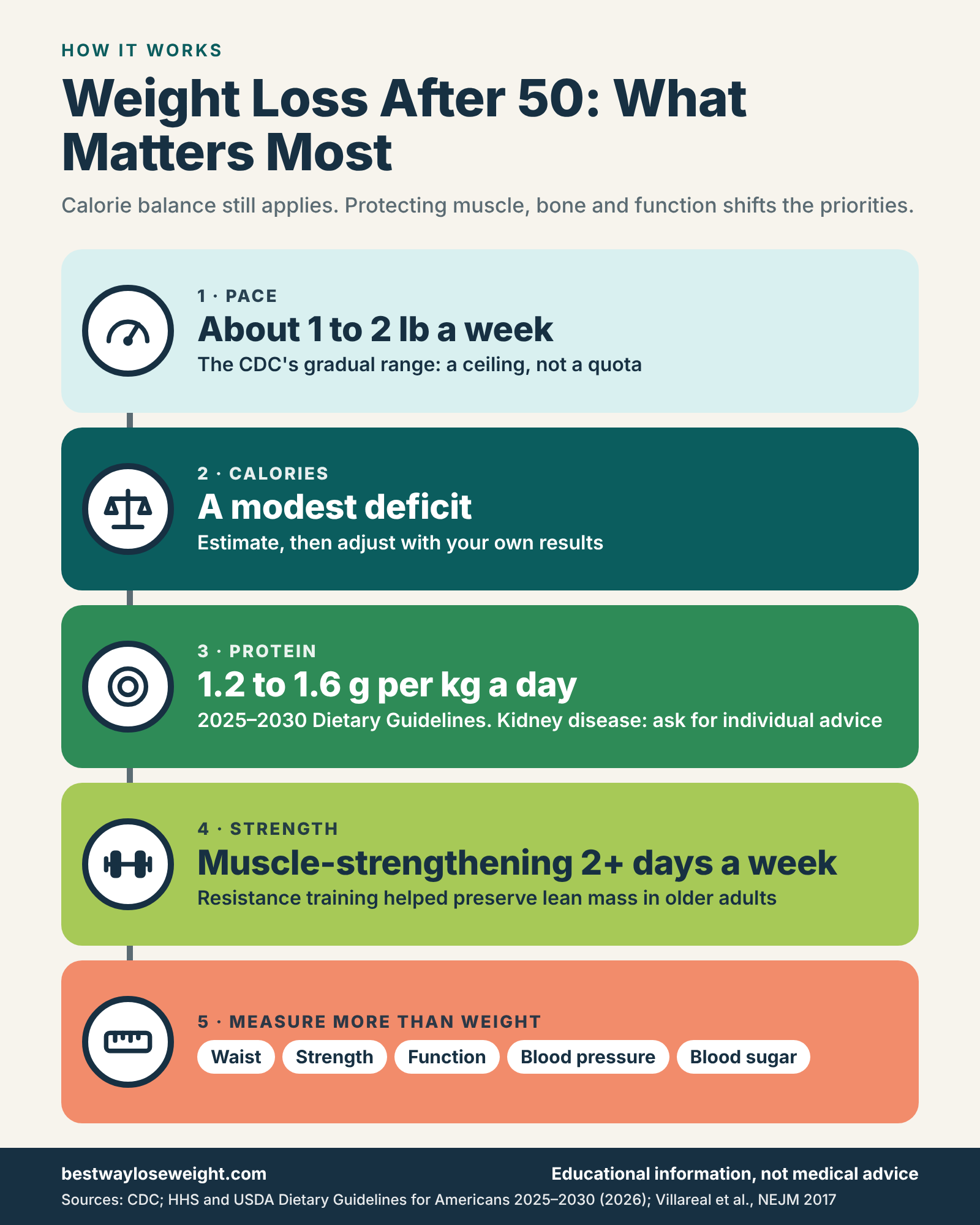
- Aim for a modest, sustainable pace. The CDC describes about 1 to 2 pounds a week as a gradual, steady pace that is more likely to be maintained than faster loss. Many people in their 50s and beyond do better at the slower end, and that’s fine.
- Protect muscle on purpose. Resistance training two or more days a week plus adequate protein are the two most practical levers. The 2025–2030 Dietary Guidelines for Americans list 1.2 to 1.6 grams of protein per kilogram of body weight per day.
- Measure more than the scale. Waist, strength, walking speed, blood pressure, and blood sugar often tell you more about health than pounds alone.
- Small losses count. NIDDK notes that losing 5% to 7% of starting weight can help prevent or delay type 2 diabetes, and 3% to 5% may reduce liver fat.
- Weight loss can have trade-offs for bone and muscle. Strength work, calcium and vitamin D from food, and avoiding crash dieting help manage them.
What this guide does not claim
It doesn’t claim that age makes weight loss impossible, or that it makes it easy. It doesn’t promise a specific number on the scale. And it doesn’t suggest that one diet, supplement, or workout is the answer. Research on weight loss specifically in people in their 50s is thinner than research on people who are younger or much older, so several findings below come from trials of people 65 and older or from mixed-age groups. Where that’s the case, the text says so.
Who this guide fits, and who needs a different route
A good fit if you
You’re an adult in your 50s or later, you have a body mass index (BMI, a height-to-weight ratio) in the overweight or obesity range or a waist measurement that concerns you, and you’re otherwise stable. You want a plan that doesn’t ask you to live on 1,200 calories and a stopwatch. You’re open to some strength training, even if you’ve never touched a weight. If you’re also managing a condition such as high blood pressure or prediabetes, the plan here is a reasonable foundation to review with your clinician.
Talk with a clinician before you start if
Check in first if you take medicines for diabetes (some can cause low blood sugar when you eat less), blood pressure medicines, or blood thinners; if you have kidney disease, heart disease, osteoporosis, or a recent fracture; if you’ve had chest pain, dizziness, or fainting with exertion; if you’re in perimenopause or menopause and symptoms are disrupting sleep or mood; if you have a history of an eating disorder; or if you’ve been losing weight without trying. Those situations call for individual advice, not a general guide.
What Weight Loss After 50 Actually Involves
Before any plan, it helps to separate what’s different from what’s merely believed to be different. Plenty of advice aimed at older adults either overstates how “broken” the metabolism is or pretends nothing has changed. Neither is accurate.
What changes in your 50s and 60s
Muscle and strength drift downward unless you train
Skeletal muscle (the muscle attached to your bones, which moves you and burns energy) tends to decline gradually with age. The decline is not a sudden event at 50, and its pace varies a lot from person to person. It’s strongly shaped by how much you use your muscles, what you eat, and whether illness or inactivity has interrupted your routine. The practical consequence: when you lose weight after 50, you want more of that loss to come from fat and less from muscle, and the tools for that (resistance exercise and enough protein) are the same ones that protect strength and balance later.
Daily energy needs may be a little lower, mostly because of activity
Many people burn fewer calories than they did in their 30s, but the reason is less mysterious than “a slow metabolism.” Fewer steps, more sitting, less muscle, and a smaller appetite for movement all add up. That’s useful, because activity and muscle are partly in your control. The practical consequence: calorie estimates from online calculators are starting points, not verdicts, and the right number is the one you confirm by tracking your own results for a few weeks.
Hormones shift, and the picture differs by sex
For women, the menopausal transition usually falls between about 45 and 55 (MedlinePlus lists 45 to 55 as the most common age range for reaching menopause). Falling estrogen is linked with hot flashes, sleep disruption, and loss of bone density, and it may nudge body fat toward the abdomen. Our article on menopause and weight gain covers that in detail. For men, testosterone tends to decline slowly with age, but a low reading and symptoms need a clinician’s evaluation; a general guide can’t tell you whether that applies to you.
What does not change
Energy balance still governs fat loss
If you consistently take in fewer calories than you use, your body draws on stored energy, including fat. That doesn’t change at 50, 60, or 70. What changes is the margin for error: a deficit that’s too large, paired with little protein and no strength work, costs more lean tissue than it would in a younger person who is active. Our guide to the calorie deficit calculation walks through the arithmetic in detail; this article applies it to the over-50 context below.
Lifestyle change works in older adults too
The NIDDK’s summary of the Diabetes Prevention Program (DPP), a large U.S. trial in adults at high risk for type 2 diabetes, reports that the lifestyle program, which aimed for 7 percent weight loss and 150 minutes of weekly activity, lowered the chance of developing diabetes by 58 percent compared with placebo. In adults 60 and older, the reduction was 71 percent. That’s a risk-reduction result in people who were at high risk, not a promise of weight loss for everyone, but it does show that structured lifestyle change isn’t wasted on older adults.
Why the goal should be broader than “a number on the scale”
Fat loss and weight loss are not the same thing
Scale weight includes fat, muscle, bone, water, and the food in your digestive tract. A person can lose five pounds of mostly water and glycogen (stored carbohydrate) in a week, or lose fat while gaining muscle and see the scale barely move. After 50, the second pattern is the one worth chasing, which is why a tape measure and a strength log belong in your toolkit alongside the scale.
Function is a legitimate goal
Walking farther without stopping, getting up from a chair without pushing off, carrying groceries upstairs, playing on the floor with grandchildren: those are outcomes that matter more to many people than the last ten pounds. A 2017 randomized trial in the New England Journal of Medicine (Villareal and colleagues) compared diet plus aerobic exercise, diet plus resistance exercise, diet plus both, and a control group in older adults with obesity. Physical performance improved most in the combined group. Weight fell about 9 percent in the exercise groups, and lean mass and bone density declined less in the groups that included resistance training. We return to that trial in the exercise section.
Is Losing Weight After 50 Worth It? Benefits, Trade-Offs, and a Safe Starting Point
The honest answer is “often yes, with some caveats.” The caveats are specific enough that they should shape the plan rather than scare you off it.
Benefits with reasonable evidence behind them
Modest loss can move the needle on risk factors
The CDC states that a 5 percent reduction in body weight can improve blood pressure, cholesterol, and blood sugar. The NIDDK adds that losing at least 5% to 7% of starting weight can help prevent or delay type 2 diabetes. For someone who weighs 190 pounds, 5 to 7 percent is roughly 9.5 to 13.3 pounds. That’s a more reachable target than the “ideal weight” many people carry in their heads, and it’s one that research ties to measurable health markers. Larger losses may bring additional benefit for some conditions, but the first few percent are where the evidence is easiest to defend.
Joints, mobility, and everyday function
The NIDDK lists osteoarthritis among the conditions linked with overweight and obesity, and says modest weight loss can improve symptoms of several of them. The CDC’s arthritis guidance recommends low-impact options such as walking, swimming, cycling, tai chi, and water exercise, because they cause little or no pain. In the Villareal trial above, the combined diet-plus-exercise group improved its Physical Performance Test score from about 27.9 to 33.4 on a 36-point scale, compared with smaller gains in the aerobic-only and resistance-only groups. Those participants were older adults with obesity, so the size of the effect may not transfer neatly to someone in their early 50s who is already fairly active.
Risks and trade-offs specific to this stage of life
Muscle and bone can be lost along with fat
A review by Cava, Yeat, and Mittendorfer (Advances in Nutrition, 2017) reported that in people with obesity, diet-induced weight loss of 8 to 10 percent was accompanied by muscle mass reductions of roughly 2 to 10 percent, and that resistance exercise helped preserve muscle and improve strength. Bone is a separate concern. In the Look AHEAD trial, an analysis of people with type 2 diabetes reported by Johnson and colleagues (Archives of Osteoporosis, 2023) found greater femoral-neck bone loss in the intensive lifestyle group than in controls at year 8, a difference that was no longer statistically significant at years 12 to 16. Total-hip bone loss was greater in men in the intervention group at both time points, but not in women. That population had type 2 diabetes, and the trial doesn’t tell us how much of this applies to people without it. The practical takeaway is not “don’t lose weight.” It’s “pair weight loss with strength training, adequate protein, calcium, and vitamin D, and ask about bone health if you’re at higher risk.”
Unintentional weight loss is a different situation
If your weight is dropping and you aren’t trying, that isn’t a weight-loss success story to optimize. Mayo Clinic states that losing more than 5 percent of your weight over 6 to 12 months without trying is a concern, and that for older adults or people with ongoing medical issues even a smaller loss may be an important sign. Book a medical visit rather than adjusting your diet.
Setting a starting point: where you are today
BMI and waist circumference: useful, imperfect
The NIDDK classifies a BMI of 18.5 to 24.9 as healthy weight, 25 to 29.9 as overweight, 30 and above as obesity, and 40 and above as severe obesity. BMI is a screening tool, not a diagnosis, and it’s less informative in people who have lost significant muscle, because muscle loss can leave BMI looking “normal” while body fat is high. The NHLBI says risk for heart disease and type 2 diabetes increases when waist circumference exceeds 35 inches for women or 40 inches for men, particularly when most fat is carried around the middle. To measure, stand and place a tape measure around your middle just above your hipbones, and measure just after you breathe out.
What to ask your clinician to check
You don’t need a pile of tests to begin, but it’s reasonable to ask whether your blood pressure, fasting blood sugar or A1c, and cholesterol panel are current. These give you a baseline to compare with later, which is far more motivating than a feeling that “my numbers must be better.” Ask also whether any of your medicines are linked with weight gain or appetite changes, and whether your bone density has ever been checked. Don’t stop or adjust any prescription on your own; bring the question to the prescriber.
Setting Realistic Goals, Pace, and a Calorie Range After 50
This is where most plans either succeed quietly or fail loudly. Overly aggressive targets tend to cost muscle and sap energy, then get abandoned. A moderate target you can repeat every week is a better bet.
How fast and how much: pace and percent goals
Pace: the CDC’s gradual range
The CDC says people who lose weight at a gradual, steady pace of about 1 to 2 pounds a week are more likely to keep it off than people who lose faster. That’s a ceiling for most people, not a quota. Plenty of adults in their 50s and 60s lose closer to half a pound to a pound a week on average, with fast weeks, flat weeks, and the occasional uptick. If you’re very sedentary at the start, or you take medicines that affect appetite or fluid, your own pace may be slower, and that doesn’t mean you’re doing it wrong.
Percent goals and a worked example
Percent goals scale to your body. Take someone who weighs 190 pounds and wants an initial goal. Three percent is about 5.7 pounds, 5 percent is 9.5 pounds, 7 percent is 13.3 pounds, and 10 percent is 19 pounds. If their pace averages half a pound a week, 13 pounds takes about 26 weeks, roughly six months. Written down like that, the timeline looks long, but it matches the kind of pace behind most lasting results, and it leaves room for holidays, illness, travel, and the weeks life gets in the way. For a heavier person, say 230 pounds, 5 percent is 11.5 pounds and 10 percent is 23 pounds. Use these as rough targets you revisit at 12 weeks, not as promises.
Working out your calorie range, step by step
Estimate maintenance with a standard equation
One widely used method is the Mifflin-St Jeor equation, which estimates basal metabolic rate (BMR, the energy your body uses at complete rest). Using kilograms and centimeters: BMR = 10 × weight (kg) + 6.25 × height (cm) − 5 × age (years), then +5 for men or −161 for women. Multiply BMR by an activity factor, commonly 1.2 for mostly sedentary, 1.375 for lightly active, and 1.55 for moderately active, to estimate maintenance calories. These formulas and factors come from general nutrition practice rather than a source this article opened, and they’re estimates with real error, so treat them as a first draft. Our calorie deficit calculation guide covers other approaches.
Example 1: a 56-year-old woman, 5 ft 5 in (165.1 cm), 190 lb (86.2 kg). BMR = 10 × 86.2 + 6.25 × 165.1 − 5 × 56 − 161 = 862 + 1,032 − 280 − 161 ≈ 1,453 calories. At a lightly active factor of 1.375, maintenance is about 2,000 calories. A deficit of roughly 300 calories a day suggests starting near 1,700. A deficit of 500 would give about 1,500, which is close to her estimated BMR and leaves little room for error, so the gentler number is a safer first try.
Example 2: a 62-year-old man, 5 ft 10 in (177.8 cm), 230 lb (104.3 kg). BMR = 10 × 104.3 + 6.25 × 177.8 − 5 × 62 + 5 = 1,043 + 1,111 − 310 + 5 ≈ 1,849 calories. At a mostly sedentary factor of 1.2, maintenance is about 2,220. A deficit of around 400 calories suggests roughly 1,800 a day to start. If his weekly average weight doesn’t budge over three or four weeks with accurate logging, the estimate may be too high; if he’s dizzy, constantly cold, or training feels impossible, it may be too low.
Choosing a deficit, and where the floor is
A deficit of 250 to 500 calories a day is a common, moderate range, and the old rule that 3,500 calories equals a pound of fat is a rough guide that tends to overstate results as weight comes off and the body adapts. Don’t use the equation to justify going very low. Diets under roughly 800 calories a day, often called very-low-calorie diets, are medical interventions that belong under clinician supervision. For most people over 50, going slightly higher on calories and keeping protein and strength training in place does more for muscle than squeezing the last 100 calories out of the day.
Tracking beyond the scale
Use several measures, not one
Scale weight bounces by a pound or two day to day from sodium, fluid, digestion, and hormones. Weigh at the same time under similar conditions, and track the weekly average rather than reacting to single readings. Add a waist measurement every two to four weeks, and a simple strength or function marker such as how many controlled chair stands you can do in 30 seconds, how far you walk in 6 minutes, or the weight you use for a given exercise. If strength is stable or rising while the waist shrinks, you’re likely preserving muscle even if the scale lags.
A scorecard you can actually use
The table below lays out what to measure, how, and why it matters after 50. You don’t need all of them; pick three or four you’ll actually track.
| Measure | How to track it | Why it matters after 50 | How often |
|---|---|---|---|
| Weekly average weight | Weigh most mornings, same conditions; average the week | Smooths out daily fluid swings so you see the real trend | Daily weigh-ins, weekly review |
| Waist circumference | Tape just above hipbones after exhaling | Tracks abdominal fat, which the NHLBI links to heart and diabetes risk; may move before the scale does | Every 2 to 4 weeks |
| Strength log | Record weight, sets, and reps for each lift or exercise | Stable or rising strength suggests muscle is being preserved | Every session |
| Function test | Chair stands in 30 seconds, or distance walked in 6 minutes | Connects weight loss to everyday independence | Every 4 to 6 weeks |
| Blood pressure, A1c, lipids | Clinician visit or home cuff | These are the markers modest weight loss may improve | As your clinician advises |
| Energy, mood, sleep, hunger | Brief weekly rating, 1 to 5 | Warning signs that the deficit is too aggressive or something else is going on | Weekly |
Eating for Weight Loss After 50: Protein, Plate Quality, and Calorie Traps
Nothing in this section requires a special diet. The aim is to get enough protein and key nutrients inside a modest calorie budget, using foods you’ll buy again next week.
Protein: how much, how to spread it, and who should adjust
What the 2025–2030 Dietary Guidelines say
The 2025–2030 Dietary Guidelines for Americans, released by HHS and USDA in early 2026, state a protein range of 1.2 to 1.6 grams per kilogram of body weight per day. The same document states that some older adults need fewer calories but still need equal or greater amounts of key nutrients such as protein, vitamin B12, vitamin D, and calcium. Harvard’s Nutrition Source commentary on the guidelines noted that this range is 50 to 100 percent higher than earlier minimums and that many Americans already eat enough protein, so the practical value of the range depends on who you are and what you currently eat. The wording above reflects the guidelines document and that commentary as of October 2026; check the source if you plan to quote it. Our dedicated article on how much protein you need to lose weight goes deeper on the evidence.
A worked example: turning grams per kilogram into grams per day
To convert pounds to kilograms, divide by 2.2. A 180-pound person weighs about 81.6 kilograms, so 1.2 to 1.6 grams per kilogram works out to roughly 98 to 131 grams a day. Spread across three meals, that’s about 33 to 44 grams each. The table below shows a few starting weights. Whether to calculate from current body weight or from a goal weight isn’t spelled out in the guidance I reviewed; some dietitians use a goal or adjusted weight for people with higher body weights, so this is a good question for a registered dietitian.
| Body weight | Kilograms | Daily range (grams) | Per meal if spread over 3 meals |
|---|---|---|---|
| 150 lb | 68.0 | 82 to 109 | 27 to 36 g |
| 180 lb | 81.6 | 98 to 131 | 33 to 44 g |
| 200 lb | 90.7 | 109 to 145 | 36 to 48 g |
| 220 lb | 99.8 | 120 to 160 | 40 to 53 g |
| 250 lb | 113.4 | 136 to 181 | 45 to 60 g |
Who should not simply copy these numbers
The NIDDK says that some people with chronic kidney disease may need to consume moderate amounts of protein so waste doesn’t build up in the blood, and advises working with a dietitian or health care professional to find the right balance. That means anyone with kidney disease, or who has been told their kidney function is reduced, should get an individual target before raising protein. The same applies if you have a liver condition or have been given other dietary restrictions. Also note that Cava and colleagues described the muscle benefit of higher protein during weight loss as small, and said it didn’t clearly improve strength, which is another reason resistance training is paired with it rather than replaced by it.
Building the plate: fiber, whole foods, and bone-supporting nutrients
Make the filling foods the default
The dietary guidelines tell people to prioritize fiber-rich whole grains, and fiber, along with protein and water-rich vegetables, is one of the easiest ways to feel full on fewer calories. A practical template for lunch and dinner: fill about half the plate with non-starchy vegetables, a quarter with a protein food, a quarter with a fiber-rich carbohydrate such as beans, lentils, oats, quinoa, or sweet potato, and add a modest portion of fat such as olive oil, nuts, or avocado.
Approximate protein in common foods, rounded and worth confirming on labels: 3 ounces of cooked chicken breast has about 25 grams; 3 ounces of salmon about 20 grams; one large egg about 6 grams; three-quarters of a cup of plain Greek yogurt about 15 to 17 grams; half a cup of cottage cheese about 12 to 14 grams; half a cup of firm tofu about 10 grams; half a cup of canned beans about 7 grams.
Calcium, vitamin D, and vitamin B12: food first, then ask
The dietary guidelines name calcium, vitamin D, and vitamin B12 among nutrients older adults still need in full. The NIAMS says a diet rich in calcium and vitamin D helps maintain bone health and recommends weight-bearing exercise such as walking. When you eat less overall, intake of these can slip without you noticing. Dairy or fortified soy products, canned fish with soft bones, leafy greens, and fortified cereals are common sources of calcium; fatty fish and fortified foods contribute vitamin D; B12 comes mainly from animal foods and fortified products. Whether you need supplements, and how much, depends on your diet, medications, and lab results, so that’s a conversation for your clinician or dietitian, not a general recommendation.
A plate for one or two, with the budget in mind
Cooking for one or two people shouldn’t mean throwing food away or living on frozen dinners. Frozen vegetables and fish, canned beans, eggs, oats, rotisserie chicken portioned into containers, and store-brand Greek yogurt cover most of a protein-forward, fiber-friendly pantry without a premium price. The sample day later in this guide shows how those pieces combine.
Calorie traps that matter more as your needs shrink
Alcohol: calories and sleep, with no precise cutoff
The dietary guidelines say to consume less alcohol for better overall health, without a numeric limit in the wording I reviewed. Alcohol supplies about 7 calories per gram (a figure from general nutrition references), which means a couple of drinks can equal a small meal without making you feel fuller. For many people it also fragments sleep, and poor sleep in turn raises appetite for convenience food the next day. If you drink most evenings, track it for two weeks before judging; some people find that trimming it is the single easiest change they can make. If you take medications that interact with alcohol or have liver disease, ask your clinician about it directly.
Liquid calories and highly processed snack foods
The guidelines advise avoiding highly processed packaged foods that are salty or sweet, such as chips, cookies, and candy, and say that no amount of added sugars is recommended, with no more than 10 grams in one meal. Harvard’s commentary described that as stricter than before and noted the term “highly processed” is still loosely defined. You don’t need perfection. Sugary coffee drinks, juice, regular soda, and sweetened smoothies deliver calories with little fullness, so they’re easy places to cut first. Packaged snacks eaten straight from the bag while watching television are another common culprit; serving a portion into a bowl is a small friction that tends to work.
Exercise After 50: Strength, Walking, and Balance While Weight Comes Down
Diet does most of the work of creating a calorie deficit. Exercise does most of the work of keeping muscle, strength, and balance intact while you do it. That’s why the evidence for older adults keeps pointing to a combination.
Resistance training: the non-negotiable piece
Why it earns a place in your week
In the Villareal trial, the groups that included resistance training lost less lean mass and bone density than the aerobic-only group, and gained strength: about 19 percent in the resistance group and 18 percent in the combined group, according to the published abstract. Cava and colleagues likewise concluded that a progressive resistance program alongside a lower-calorie diet reduced the loss of muscle mass in middle-aged and older adults. The CDC’s guidance for adults 65 and older, and for adults 18 to 64, calls for muscle-strengthening activities on at least 2 days a week targeting all major muscle groups. Our guide to strength training for weight loss provides more detail on programming.
A starter structure for two or three days a week
A simple, widely used framework (general practice, not a prescription): two or three non-consecutive days a week, one to two sets of 8 to 12 repetitions of six to eight exercises that cover legs, hips, back, chest, shoulders, and core. For example: sit-to-stand from a chair or goblet squat, hip hinge or glute bridge, wall or incline push-up, seated or bent-over row with bands or dumbbells, overhead press with light weights, and a plank on the counter or floor. Pick a load where the last two or three reps feel challenging but your form holds. Add reps first, then weight, when the set gets easy. As an example of progression, someone who starts with chair sit-to-stands might do 2 sets of 8 for the first two weeks, then 2 sets of 10, then 2 sets of 12, then lower the chair height or hold a light weight at the chest and drop back to 8 reps. Logging each session takes a minute and makes progress visible even when the scale is quiet. If you’re new, a few sessions with a qualified trainer or physical therapist are worth the money.
Modifications for joints, injuries, and equipment limits
Pain isn’t a requirement for progress. Use a pain-free range of motion, swap barbells for bands or machines, and use a chair for support. If knees complain with squats, try box squats to a higher chair or leg presses; if shoulders complain, press at an angle or use lighter weights with higher repetitions. The CDC suggests that people with arthritis start slowly and pay attention to how the body feels. If you have uncontrolled blood pressure, heart disease, a recent surgery, or osteoporosis with fractures, get guidance on which movements to avoid.
Aerobic activity and everyday movement
The 150-minute framework, applied sensibly
The CDC’s adult guidance is 150 minutes a week of moderate-intensity activity (or 75 minutes of vigorous activity, or an equivalent mix), with more benefit above that level; for adults 65 and older the aerobic target is the same. Moderate effort means you can talk but not sing. Many people reach 150 minutes with brisk walks of 20 to 30 minutes on five days. If that’s too much now, start with 10 minutes after meals and grow from there; the CDC’s older-adult page stresses that some activity is better than none. Our guide to walking for weight loss explains how to progress.
Where daily steps fit
Step counts are a convenient proxy for total movement, but there isn’t a single magic number, and the research is observational and varies by population. A practical approach: measure your average for a week, then raise it by 500 to 1,000 steps a day every couple of weeks until walking feels like a natural part of your day. Intensity can be as simple as picking up your pace for a few minutes at a time.
Balance, falls, and knowing when to adjust
Include balance work from the start
The CDC lists balance activities, such as walking heel to toe or standing up from a seated position, as part of the recommendations for older adults. Practicing them adds only a few minutes: stand on one leg next to a counter, walk heel to toe along a hallway, or stand from a chair without using your hands. Tai chi is another option the CDC names for people with arthritis because it causes little or no pain.
When fall risk changes your plan
The CDC reports that in 2024 falls caused more than 43,000 deaths among adults 65 and older and about 4.5 million emergency department visits, and notes that falls can be prevented. Weight loss can change your balance and your medication needs in ways that are worth watching. If you’ve fallen recently, feel unsteady, or take several medicines that cause drowsiness or low blood pressure, ask your clinician about a fall-risk assessment such as the CDC’s STEADI program, and consider physical therapy before ramping up.
A sample week that combines all three
One way to lay it out
This schedule is an example, not a prescription. Adjust days to your life, and swap in swimming or cycling if walking bothers your joints.
| Day | Main activity | Approximate time | Notes |
|---|---|---|---|
| Monday | Full-body strength session A | 30 to 40 minutes | Six to eight exercises, one to two sets each |
| Tuesday | Brisk walk | 20 to 30 minutes | Conversational pace |
| Wednesday | Balance practice plus easy walk | 15 to 30 minutes | Add stretching if joints feel stiff |
| Thursday | Full-body strength session B | 30 to 40 minutes | Different exercise variations from A |
| Friday | Brisk walk or cycling | 20 to 30 minutes | Low-impact if knees or hips are sore |
| Saturday | Longer easy activity | 30 to 60 minutes | Hike, garden, swim, dance, or play with family |
| Sunday | Rest or light movement | 0 to 20 minutes | Recovery matters; keep the walking habit loose |
Making the schedule fit a real life
If a week falls apart, protect the two strength sessions first and let the walks flex. Two short strength sessions and a handful of brisk walks beat a perfect plan that you abandon by Wednesday. If your schedule is irregular, tie sessions to existing anchors, such as strength training before your morning coffee or a walk after dinner.
A 12-Week Plan for Weight Loss After 50, Step by Step
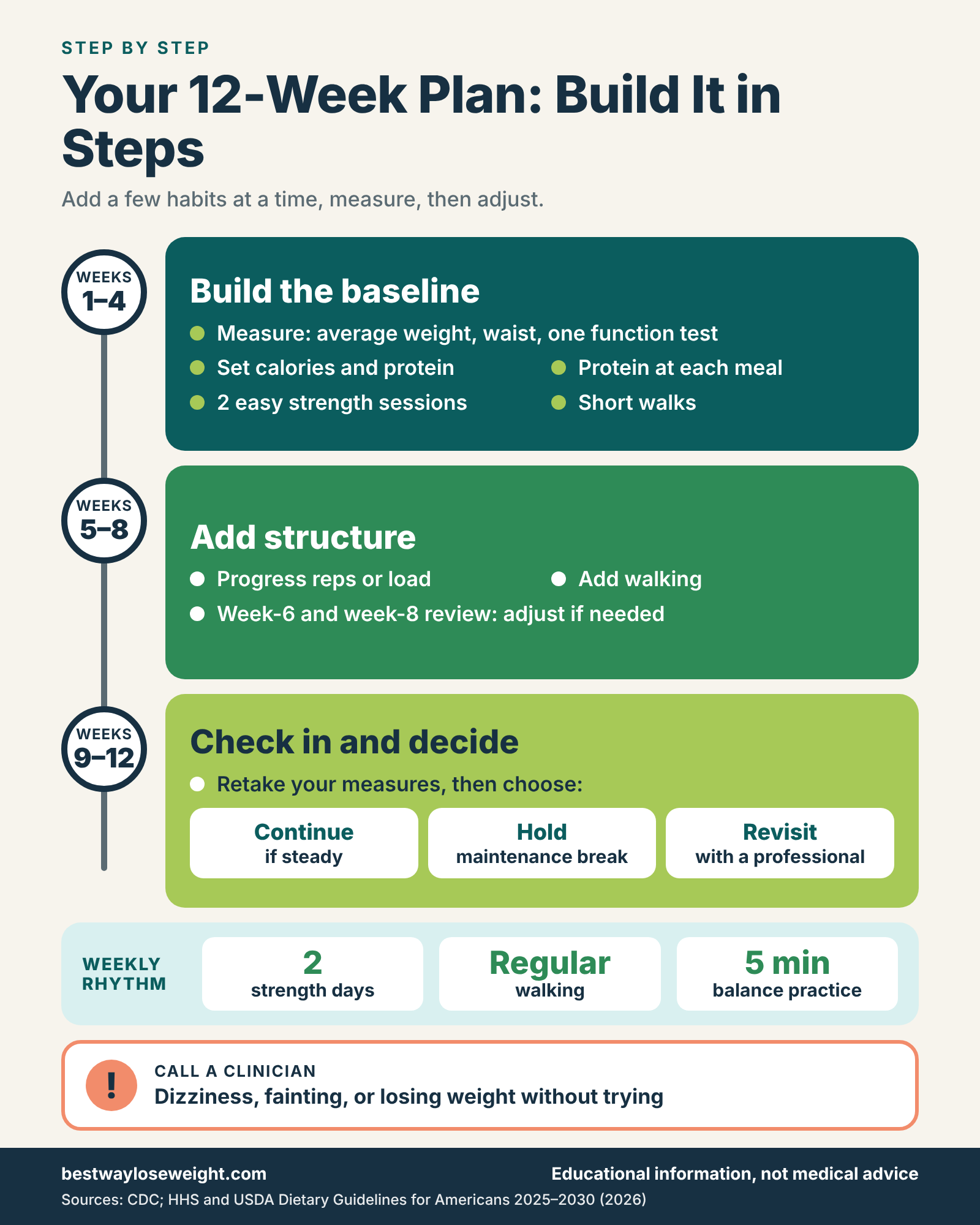
Everything above turns into action here. The plan is deliberately gradual: each phase adds one or two habits rather than ten. If you take medicines for diabetes or blood pressure, run this plan past your clinician before week 1 and again before you reduce calories.
Weeks 1 to 4: build the baseline
Week 1: measure, set up, and change almost nothing
Record your starting weight (average of several mornings), waist, one function test, and your typical eating for three to five days without trying to improve it. Estimate maintenance calories with the method above and decide on your protein range. Book any medical check-ins you flagged earlier. A short week-1 checklist: baseline weight average, waist measurement, one function test, three to five days of normal-eating notes, a calorie and protein target written down, equipment on hand, and the first two strength sessions booked on the calendar. Clear a few practical obstacles: buy a tape measure, a kitchen scale if you’ll use it, resistance bands or a pair of dumbbells, and the protein foods you intend to eat. Changing nothing for a week feels backward, but it gives you the accurate baseline every later decision depends on.
Weeks 2 to 4: first three habits
Introduce three habits only. First, eat a protein food at every meal, aiming toward the range you calculated. Second, start two strength sessions a week at an easy level, focusing on form. Third, add short walks, such as 10 minutes after your largest meal. Move toward your calorie target in steps: reduce intake by about half your planned deficit in week 2, then reach it in week 3. Log your food honestly for these weeks; estimates of intake are notoriously low, and accurate logging for even a short stretch teaches portion sizes you can use afterward.
Weeks 5 to 8: add structure and progress
Progress the training and the walking
By week 5 your strength sessions should feel manageable. Increase reps or load slightly, keeping the last repetitions challenging but clean. Raise your weekly walking by 10 to 15 percent or add a third day of activity. If your joints protest, shorten the longest session and add another short one rather than pushing through pain. Keep your balance practice going in the background; it takes five minutes.
The week-6 and week-8 review
At week 6, compare your weekly weight average with week 3. A drop of roughly a quarter to a full pound a week is consistent with the pace described above. If it’s flat and your logging has been accurate, trim 100 to 150 calories or add activity; don’t leap to a big cut. If you’re losing faster than 1 to 2 pounds a week, eating more is a legitimate fix, particularly if your strength is slipping. At week 8, repeat your waist and function tests. Falling waist plus steady strength is a good sign even if the scale is stubborn. Our guide to weight loss plateaus covers what to do when the scale stalls.
Weeks 9 to 12: consolidate and plan the next phase
The 12-week check-in
Retake every baseline measure. Compare average weight, waist, strength, function, and the biomarkers your clinician tracks. Ask yourself what felt sustainable and what felt like a fight. Maybe the morning strength session stuck but the evening walk didn’t; that tells you where to put your effort next. Note any aches, sleep problems, or mood changes that crept in. This is also the right moment to bring results to a clinician or registered dietitian if you’d like individualized adjustments.
Choosing what comes next
You have roughly three options. Continue the same phase if progress is steady and the plan feels good. Hold at the current weight for a few weeks (a maintenance break) if you’re tired or life has become demanding; that’s a legitimate strategy, not a failure. Or revisit the goal with a professional if you’ve reached your target or if progress has stalled despite accurate tracking. All three are reasonable, and none of them requires starting over.
A sample day of eating at about 1,600 to 1,700 calories
One day, laid out
This example fits a person whose estimated target is in the high 1,600s. The calorie and protein values are rounded estimates from typical package values and will vary by brand and portion; check labels and adjust to your needs.
| Meal | What’s on the plate | Approx. calories | Approx. protein (g) |
|---|---|---|---|
| Breakfast | 3/4 cup plain nonfat Greek yogurt, 1/2 cup berries, 2 tablespoons walnuts, 1 slice whole-grain toast | 360 | 22 |
| Lunch | Large salad with 4 oz grilled chicken, 1/2 cup chickpeas, mixed vegetables, 1 tablespoon olive-oil dressing | 500 | 44 |
| Snack | 1/2 cup low-fat cottage cheese and a pear | 190 | 13 |
| Dinner | 5 oz baked salmon, 1 cup roasted broccoli with 1 teaspoon oil, 1/2 cup cooked quinoa | 470 | 36 |
| Evening | 1 cup 2% milk or fortified soy milk | 120 | 8 |
| Total | about 1,640 | about 123 |
How to adapt it
Swap proteins freely: eggs, tofu, lentils, canned tuna, turkey, or beans can all stand in. If you’re vegetarian, check your total protein, because plant sources usually need larger portions to match animal sources. If the day above is too much food, trim the nuts, oil, or the evening milk first; if you’re too hungry, add vegetables, fruit, or another fiber-rich carbohydrate. For a cheaper version, replace salmon with canned salmon or sardines, or with eggs and beans, and use frozen vegetables.
Medical Factors That Change the Equation After 50
Several health issues become more common in midlife and later, and some of them directly affect weight. The aim here isn’t to diagnose; it’s to help you know what to bring up with a clinician.
Menopause, hormones, and sex-specific considerations
Women: the menopausal transition
MedlinePlus says the menopausal transition typically begins in the 40s, that the most common age for reaching menopause is between 45 and 55, and that falling estrogen can bring hot flashes, sleep problems, mood changes, bone loss, and higher cholesterol and cardiovascular risk. It also notes that overweight or obesity can make hot flashes worse. Weight gain is a recognized concern around this time, but the picture mixes hormonal shifts with aging, sleep loss, and lifestyle changes, and untangling them is not straightforward. For deeper coverage, see our article on menopause and weight gain. MedlinePlus describes hormone therapy as a treatment option for symptoms and advises discussing safety with a provider; whether it’s appropriate for you is a decision for you and your clinician, not something a weight-loss guide can settle.
Men in midlife
Men’s weight patterns in their 50s and 60s are shaped by less muscle, more sitting, sleep apnea, alcohol, and stress, among other things. Symptoms people often attribute to “low testosterone,” such as fatigue, low mood, and reduced drive, overlap heavily with sleep problems, depression, and excess weight itself. If those symptoms are bothering you, a clinician can evaluate them properly rather than guess. This guide doesn’t make claims about testosterone treatment.
Medications, conditions, and sleep
Medicines that can affect weight or appetite
Some prescription medicines are associated with weight gain or increased appetite in some people, and which ones apply to you depends on your specific prescriptions; that’s general pharmacology knowledge rather than a finding from the sources opened for this article. If you suspect a medicine is affecting your weight, don’t stop it or change the dose on your own. Ask the prescriber or a pharmacist whether alternatives or adjustments exist. Also tell your prescriber before significantly reducing calories if you take insulin or other glucose-lowering medicines, since lower intake can change how much medication your body needs.
Conditions worth screening for
The NIDDK lists type 2 diabetes, high blood pressure, sleep apnea, fatty liver disease, osteoarthritis, and depression among the conditions linked with overweight and obesity. If weight loss seems unusually hard or you have loud snoring, daytime sleepiness, persistent low mood, or very low energy, mention them at your next appointment. Thyroid problems can also affect weight and energy and are commonly checked with a blood test; whether yours should be is for your clinician to say.
Sleep: the quiet variable
The CDC lists sleep needs of 7 or more hours for ages 18 to 60, 7 to 9 hours for ages 61 to 64, and 7 to 8 hours for ages 65 and older. Short or fragmented sleep tends to push appetite and cravings in the wrong direction and makes workouts feel harder. Regular bed and wake times, a cool, dark bedroom, limiting caffeine late in the day, avoiding large meals and alcohol right before bed, and keeping screens away for at least 30 minutes before sleep are among the CDC’s practical suggestions. If you consistently struggle, ask about sleep apnea or insomnia evaluation.
Prescription medications, procedures, and how care is paid for
Where weight-loss medication may fit
Lifestyle change is the foundation, but it isn’t the only tool, and medications and surgery are legitimate options for some adults with obesity or weight-related conditions, chosen with a clinician. This article doesn’t compare drugs, give doses, or recommend any of them, and the details change quickly. Our article on GLP-1 medications for weight loss covers benefits, limits, and safety considerations as of its own source dates. One point matters especially after 50: whatever method you choose, the muscle, bone, and protein considerations in this guide still apply, and are worth raising with your care team.
Counseling, coverage, and what to ask
The U.S. Preventive Services Task Force gave a “B” grade in 2018 to intensive, multicomponent behavioral interventions for adults with a BMI of 30 or higher, describing programs with at least 12 group or individual sessions in the first year, per the AAFP’s summary of the recommendation. The Centers for Medicare & Medicaid Services covers intensive behavioral therapy for obesity in primary care for beneficiaries with a BMI of 30 or higher, with a schedule that starts with weekly visits for the first month, then every other week through month 6, then monthly if the person lost at least 3 kilograms in the first six months. Coverage rules for medications, nutrition counseling, and programs differ by plan and change, so call your plan or ask your clinician’s office before assuming anything is covered.
Troubleshooting Weight Loss After 50: If This Happens, Try This
Every plan runs into friction. The point of troubleshooting is to change one variable at a time so you know what actually worked.
When the scale stops moving
Check measurement and logging before changing the plan
Before assuming your metabolism has stalled, rule out the boring explanations. Are you using weekly averages? Has the scale been compared at the same time of day? Have portion sizes crept up since the first month, which they commonly do? Are weekend meals and drinks being logged? Did you add salt-heavy foods, start a new medication, or have a hard training week that holds fluid in your muscles? Fluid shifts can mask fat loss for a week or two, which is why waist and strength measures are valuable. Most “plateaus” under three weeks are noise or logging drift rather than a true halt.
A short adjustment ladder
If four weeks of accurate data show no downward trend, move up a ladder one rung at a time. First, tighten logging for two weeks. Second, add 1,000 to 2,000 steps a day. Third, reduce intake by 100 to 150 calories, favoring snacks and liquid calories over protein. Fourth, review sleep and alcohol. Fifth, talk to a clinician or dietitian, particularly if a medicine, thyroid issue, or menopausal change might be involved. Our article on weight loss plateaus expands on each step. Don’t jump straight to a severe cut, since that’s the move most likely to cost muscle.
Hunger, fatigue, and mood
If you’re constantly hungry
Persistent hunger is a sign to adjust food composition before willpower. Check protein at each meal, add fiber-rich vegetables, beans, or oats, and make sure meals are large enough that dinner isn’t a rescue mission. Look at sleep as well; poor sleep tends to raise appetite. If hunger is intense despite adequate protein and a modest deficit, your deficit may be too big, and a smaller one is a better choice. Eat enough to stay out of the “starving by 4 p.m.” zone, because that’s where snack bags get opened.
If you feel tired, dizzy, or unwell
Some fatigue is normal in the first weeks of a new routine. Persistent dizziness, fainting, palpitations, new swelling, confusion, or unusual weakness are not normal side effects of a modest deficit, and they need prompt medical attention, especially if you take blood pressure medicines or diabetes medicines that can lower blood pressure or blood sugar. If you feel shaky, sweaty, or confused and you take glucose-lowering medicine, follow the instructions your clinician gave you for low blood sugar and call them. Don’t try to push through those signs.
Pain, injuries, and interruptions
If joints or your back hurt
Distinguish between muscle fatigue, which usually fades within a day or two, and joint or sharp pain, which warrants changing the exercise. The CDC recommends starting slowly and paying attention to how the body feels, and lists swimming, water exercise, walking, cycling, tai chi, and dancing as lower-pain options for people with arthritis. Break walks into shorter pieces, use poles or a stationary bike, and train the muscles that support the sore joint within a pain-free range. If pain persists or worsens, see a clinician or physical therapist rather than stopping all movement.
If illness, surgery, or travel interrupts you
Interruptions are inevitable. After a short break, resume at about 75 percent of your last loads and rebuild over one to two weeks. After surgery or serious illness, get clearance and guidance on restarting. Maintaining weight during the disruption is a successful outcome, not a failure; a rough rule is that you resume the plan at the next meal, not next Monday.
A quick-reference troubleshooting table
Using the table
Match what you’re seeing to the most likely cause and a first move. These are general starting points rather than medical advice, and anything involving symptoms goes to a clinician.
| What you notice | Likely explanation | First move | When to involve a clinician |
|---|---|---|---|
| Weekly average flat for 2 weeks | Normal variation or logging drift | Keep going; tighten logging | Not needed yet |
| Flat for 4 or more weeks with accurate logging | Intake near maintenance or activity dropped | Add steps or trim 100 to 150 calories | If you take medicines that affect weight or have thyroid or menopause symptoms |
| Strength dropping | Deficit too large, protein low, or too little rest | Add 100 to 200 calories, raise protein, protect sleep | If weakness is sudden or one-sided |
| Constant hunger | Low protein or fiber, short sleep, too steep a deficit | Add protein and vegetables; smaller deficit | If intense hunger with extreme thirst or frequent urination |
| Dizziness or fainting | Dehydration, medicine interaction, or too few calories | Stop exercise, sit down, hydrate | Same day, especially with chest pain or palpitations |
| Knee, hip, or back pain with exercise | Exercise selection or load too high | Switch to lower-impact options; reduce range | If pain is sharp, persistent, or follows a fall |
| Weight dropping faster than 2 pounds per week | Deficit too big or fluid loss | Eat more; check protein | If you’re not trying to lose weight |
Reading across the rows: when two problems share one cause
Several rows often point to the same underlying issue. Stalled weight, rising hunger, and falling strength together usually mean intake is too low in protein and too high in low-fullness foods, or that recovery is poor, so the first fix is food composition and sleep rather than a deeper cut. Stalled weight with good energy and steady strength more often means the plan is working on body composition and needs patience, or that logging has drifted. Pain plus a stall points to exercise selection: when movement hurts, people move less without realizing it, and daily calorie use drops. Matching the pattern to the cause keeps you from “fixing” the wrong thing.
Making It Work in Real Life: Budget, Household, Retirement, and Social Eating
A plan that only works in a perfect week isn’t a plan. This section covers the constraints people over 50 describe most often.
Time, money, and who else is at the table
Eating protein-rich and fiber-rich on a budget
Dried and canned beans, lentils, eggs, canned fish, frozen vegetables, oats, cottage cheese, and store-brand Greek yogurt are generally lower in cost per gram of protein than fresh meat and specialty products, though prices vary by region. Buying whole chickens or family packs, then portioning and freezing, stretches money. Planning two or three repeat dinners per week reduces waste and decision fatigue. If your budget is tight, prioritize protein at breakfast and lunch, where it tends to be thin, and keep dinner simple.
When your partner isn’t dieting, or you cook for family
You don’t have to cook two dinners. Build meals where the base is shared and the add-ons differ: everyone gets the same protein and vegetables, and you adjust the starchy side, the sauce, or the portion. Keep tempting foods out of easy reach rather than banning them, and talk with your household about what kind of support helps. Some people prefer encouragement; others prefer that nobody comments on their plate at all. Say which you want.
Life transitions and social settings
Retirement, caregiving, and the loss of routine
Retirement often removes the structure that shaped meals and movement, and caregiving can eat every spare hour. In both cases the fix is to rebuild a small, repeatable routine: set meal times, a morning walk, and a standing strength session scheduled like an appointment. If caregiving limits time, use ten-minute blocks, such as strength moves while the kettle boils, and make the plan about maintaining habits rather than chasing a particular pace. Loneliness and low mood can also drive eating; if either is persistent, it’s worth raising with a clinician.
Restaurants, holidays, and drinks with friends
Decide your priorities before you arrive rather than negotiating at the table. At restaurants, choose a protein-forward entrée, ask for dressings and sauces on the side, split a dessert, and take half home. At holidays, enjoy the foods you’d miss, skip the ones you wouldn’t, and return to your normal routine at the next meal. With alcohol, pick one or two drinks, alternate with water or sparkling water, and eat before you drink. None of these are about willpower; they’re about having a default so you aren’t deciding while hungry.
Keeping Weight Off and Avoiding Common Mistakes After 50
Getting to a lower weight is one skill; staying there is another. The habits that created the loss are usually the same ones that protect it.
Maintenance: staying in a range instead of at a number
Shift from deficit to a “landing zone”
When you reach a goal, or when you decide to pause, raise calories gradually, perhaps by 100 to 200 a day every week or two, while watching your weekly average. Instead of defending one exact number, define a landing zone of about five pounds. If you drift above it, return to the habits that worked, such as logging for a couple of weeks, or adding steps. The CDC’s point that gradual losers are more likely to keep weight off supports building slower, sturdier habits in the first place.
Habits worth keeping for life
Keep strength training, protein at each meal, regular walking, weekly weigh-ins, and attention to sleep. The Diabetes Prevention Program’s long-term follow-up reported that, at 15 years, the lifestyle group still had a 27 percent lower rate of developing diabetes than the placebo group, per the NIDDK; that finding is about diabetes risk rather than weight, but it suggests the benefits of lifestyle change can outlast the formal program. Staying connected to a group, coach, or clinician check-in also helps many people, and the 2018 USPSTF recommendation specifically favored programs with repeated sessions.
Common mistakes that cost older adults the most
Cutting calories too hard, too fast
A steep deficit paired with low protein and no strength work is the classic recipe for losing muscle along with fat, then feeling weak and regaining weight. If you’re losing faster than the CDC’s 1 to 2 pounds a week range, or your workouts are getting worse, eat more. It’s counterintuitive, but more food in the right places often improves the long-term outcome.
Treating strength training as optional
Walking is valuable, and it’s easier to start, but walking alone doesn’t give you the muscle-preserving effect resistance training does. The Villareal trial’s combined group improved most on the physical performance measure. If you only have energy for one addition, make it two short strength sessions a week.
Relying on products rather than habits
Supplements, teas, patches, and “hormone-balancing” programs promise more than they can deliver, and some interact with medications. If a product claims to melt away fat or work without changes to eating and activity, treat that as a warning sign. Ask a pharmacist or clinician before taking anything new, and be especially careful if you take blood thinners, diabetes medicines, or heart medicines.
A priority ladder for deciding what to change first
The ladder
When you can’t do everything, work from the bottom rung upward: (1) safety first, meaning medical clearance and review of medicines; (2) protect muscle, meaning two strength sessions a week and protein at every meal; (3) get a modest deficit through food quality and portions; (4) add steady walking and movement; (5) fix sleep and alcohol; (6) fine-tune with tracking, then consider professional support or medication if progress is stuck or health risks are high. The order matters because steps lower on the ladder make the higher ones safer and more effective.
Using the ladder in the real world
If you’re overwhelmed, find the lowest rung you haven’t secured and work only on that for two weeks. For example, someone who walks every day but hasn’t started strength training should start there rather than tightening calories. Someone who strength trains but sleeps five hours may do more for their results by fixing sleep than by cutting 100 more calories. Treat it as a guide, not a rule.
Frequently Asked Questions About Weight Loss After 50
These questions are ones the sections above don’t already answer in full.
Getting started and setting expectations
Is weight loss harder after 50 than after 40?
For many people it feels harder, mainly because muscle, sleep, and activity tend to erode a bit more, and hormonal changes add noise. But the underlying mechanics are the same, and structured programs have worked in older groups: the DPP lifestyle arm lowered diabetes risk by 71 percent in adults 60 and older, according to the NIDDK. If you’re coming from your 40s, our article on weight loss after 40 covers the earlier stage of the same story.
How much weight can I realistically lose in six months?
There’s no honest number that fits everyone, because results depend on your starting weight, medicines, sleep, activity, and how consistently you can follow the plan. A more useful frame is the percent goals above: many people aim first for 5 to 7 percent of starting weight, since that range is tied to improvements in blood pressure, blood sugar, and cholesterol. Some people will exceed that and some will fall short while still improving their health markers.
Do I have to count calories?
No, but some form of feedback helps. Counting for two to four weeks teaches portion sizes and shows where calories hide. After that, many people switch to a simpler system, such as a plate template, fixed breakfast and lunch, and logging only dinners and weekends. If counting triggers anxiety, or you have a history of disordered eating, skip it and work with a clinician or registered dietitian on another approach.
Do I need to see a doctor before I begin?
If you’re generally healthy and starting with moderate walking and light strength work, many people begin without a formal visit, but a check-in is wise. It’s strongly advisable if you take medicines for diabetes or blood pressure, have heart, kidney, or bone disease, have chest symptoms or dizziness with exertion, or haven’t had recent routine bloodwork. Medicare, for example, covers intensive behavioral therapy for obesity in primary care for those with a BMI of 30 or higher.
Food, exercise, and common claims
Is intermittent fasting a good idea after 50?
No trials in people over 50 were reviewed for this article, so no claim is made about whether it works better or worse than regular meals. A practical point: compressing meals into a short window can make it harder to reach protein targets and train well, and fasting can interact with diabetes and blood pressure medicines. If you like it, it can be a way to reduce evening eating. If you take glucose-lowering medicine, ask your prescriber first.
Is walking enough on its own?
Walking helps your heart, mood, joints, and daily calorie use, and for some people it’s the right first step. But the trial evidence discussed above found muscle and function benefits were greatest when diet was paired with resistance exercise, and the CDC recommends muscle strengthening on at least 2 days a week. If you walk now and want to improve results, adding strength sessions is usually the best next addition.
Can I target belly fat?
Exercising one body area does not selectively burn fat from that area; that idea, called spot reduction, is not well supported, though no specific trial is cited here. Fat loss happens across the body according to your own pattern. What you can do is reduce overall body fat and track your waist, which the NHLBI links to risk when it exceeds 35 inches for women or 40 for men. Core exercises still help posture and stability.
Are supplements or “metabolism boosters” worth buying?
Most are a poor use of money and some are risky, especially with medications. No product replaces the basics of calorie balance, protein, strength training, and sleep. If you’re interested in a specific supplement, such as vitamin D or calcium, ask whether blood tests or your diet suggest you need it, rather than buying a product that claims to speed up weight loss.
Health considerations
Will losing weight weaken my bones?
It can reduce bone density somewhat, and the evidence from the Look AHEAD analysis (people with type 2 diabetes) showed greater hip bone loss in men in the intensive group. That doesn’t mean you should avoid weight loss. It does mean weight-bearing exercise, resistance training, adequate calcium and vitamin D, and avoiding crash dieting are worthwhile, and that you can ask your clinician whether bone density testing makes sense for you.
Can I lose weight if I have arthritis or knee pain?
Yes, with adjustments. The CDC lists swimming, water exercise, walking, cycling, tai chi, and dancing as options that cause little or no pain, and recommends starting slowly. Food changes do much of the work of weight loss, so exercise can be shaped around your joints. A physical therapist can personalize this, especially after a joint replacement or injury.
Does menopause make weight loss impossible?
No. The transition can bring changes in sleep, mood, body fat distribution, and bone density, all of which make the work feel harder, but strategies like protein, strength training, and sleep protection still apply. If symptoms are significant, ask a clinician about options; our menopause article explains more.
How can I tell whether I’m losing muscle?
The simplest signs are declining strength, reduced stamina on the same walk, and difficulty with chair stands, together with a scale weight that drops faster than expected. A body composition scan can estimate lean mass, but consumer scales are rough. Logging your lifts and doing a regular function test is a more practical check, and a clinician can order more precise testing when there’s a reason to.
Bottom Line: Weight Loss After 50
Six points to remember
What to do
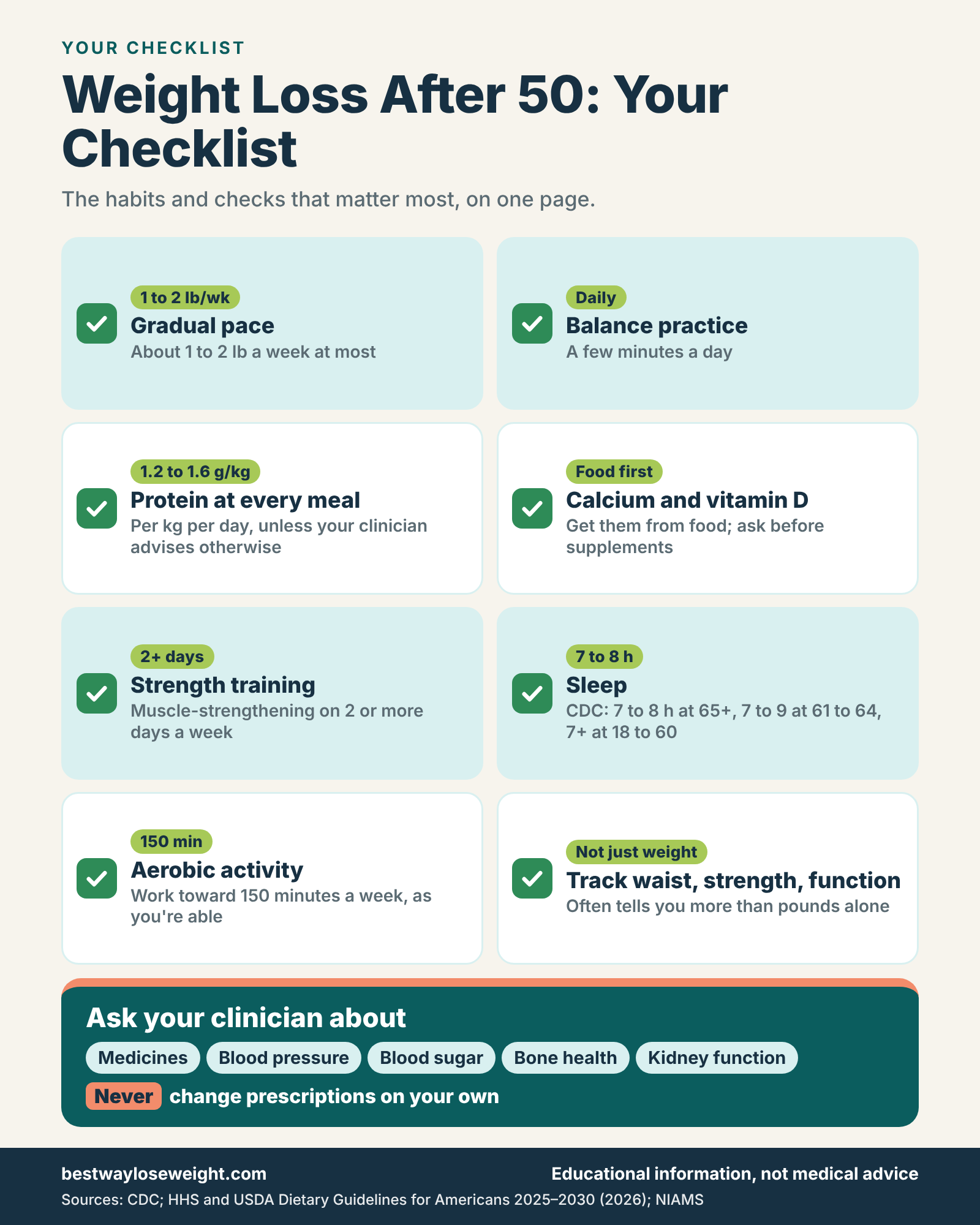
- Start with a modest deficit and a pace you can sustain, guided by the CDC’s 1 to 2 pounds a week as an upper range.
- Eat protein at each meal, working toward the 1.2 to 1.6 grams per kilogram range unless you have kidney disease or other medical limits.
- Do resistance training at least two days a week, add regular walking, and practice balance.
- Track waist, strength, and function along with weight.
- Protect sleep, limit alcohol, and keep up with calcium and vitamin D from food.
- Involve your clinician early if you take medicines, have chronic conditions, or struggle despite a solid plan.
What to avoid
Avoid crash diets, skipping strength work, ignoring symptoms such as dizziness or sudden weakness, stopping or adjusting prescriptions on your own, and chasing products that promise to bypass the basics. If you’re losing weight without trying, see a clinician.
Questions to bring to your next appointment
Before you start
- Are my blood pressure, blood sugar, and cholesterol where they should be, and how often should we recheck them?
- Do any of my medicines affect weight, appetite, or blood sugar when I eat less?
- Do I have a reason to limit protein, such as kidney concerns?
- Should I have a bone density test, and are there exercises I should avoid?
As you go
- Is my pace of weight loss appropriate for my health?
- Should we check thyroid, sleep apnea, mood, or menopausal symptoms if progress stalls?
- Would a registered dietitian, physical therapist, or structured program help?
- If lifestyle changes aren’t enough, what other options might be appropriate for me, and what are the risks and limits?
Editorial and medical-review note
Scope and sourcing
Review status
This article is flagged for qualified clinical review before publication. No reviewer has yet signed off, and none is named here.
Sources
Primary sources (government and clinical guidelines)
Federal health agencies and programs
- CDC. Adult Physical Activity Guidelines (current).
- CDC. Physical Activity Guidance for Older Adults (current).
- CDC. Losing Weight (current).
- CDC. Adult Obesity Facts (2017 to March 2020 data on the page when accessed).
- CDC. About Sleep (current).
- CDC. Physical Activity and Arthritis (current).
- CDC. Older Adult Falls (page updated September 2026).
- NIDDK. Diabetes Prevention Program (DPP) (current).
- NIDDK. Health Risks of Overweight and Obesity (current).
- NIDDK. Definition and Facts for Overweight and Obesity (current).
- NIDDK. Eating and Nutrition for Chronic Kidney Disease (current).
- NHLBI. Assessing your weight and health risk (current).
- NIAMS. Osteoporosis (current).
- MedlinePlus (NLM). Menopause (current).
- Centers for Medicare & Medicaid Services. National Coverage Determination: Intensive Behavioral Therapy for Obesity (current).
Dietary and preventive-care guidelines
- HHS and USDA. Dietary Guidelines for Americans, 2025–2030 (2026).
- American Academy of Family Physicians. USPSTF recommends intensive behavioral intervention for obesity (2018 summary of the U.S. Preventive Services Task Force recommendation).
Research and supporting literature
Randomized trials
- Villareal DT, et al. Aerobic or Resistance Exercise, or Both, in Dieting Obese Older Adults. New England Journal of Medicine, 2017.
- Johnson KC, et al. The long-term effect of intentional weight loss on changes in bone mineral density in persons with type 2 diabetes: results from the Look AHEAD randomized trial. Archives of Osteoporosis, 2023.
Reviews and expert commentary
- Cava E, Yeat NC, Mittendorfer B. Preserving Healthy Muscle during Weight Loss. Advances in Nutrition, 2017.
- Harvard T.H. Chan School of Public Health, The Nutrition Source. Dietary Guidelines for Americans 2025–2030: progress on added sugar, protein hype, saturated fat contradictions (January 2026).
- Mayo Clinic. Unexplained weight loss: when to see a doctor (current).

