

A low carb diet for weight loss can work, and for some people it works well. It tends to reduce hunger, simplify food choices, and lower blood sugar swings. But the best head-to-head evidence says it isn’t magic. When researchers compare low-carb eating with other well-built diets over a year or longer, the weight difference is usually small. What matters most is whether you can keep eating that way, and whether the version you choose is built from real food.
This guide explains what “low carb” actually means, how it affects the scale in week one versus month six, what major trials and reviews found, who should talk to a clinician first, and how to build meals, a grocery list, and a three-day sample plan. You’ll also get worked math for turning a calorie target into grams of protein, carbs, and fat, plus a troubleshooting section for stalls, cravings, and exercise.
It’s educational, not personal medical advice. If you take diabetes medication, are pregnant, or have a history of disordered eating, read the safety sections before you cut carbs. For the full foundation behind any eating pattern, start with our complete evidence-based guide to losing weight safely.
Key Takeaways: What a Low-Carb Diet Can and Can’t Do
What the evidence supports
Weight loss comparable to other diets
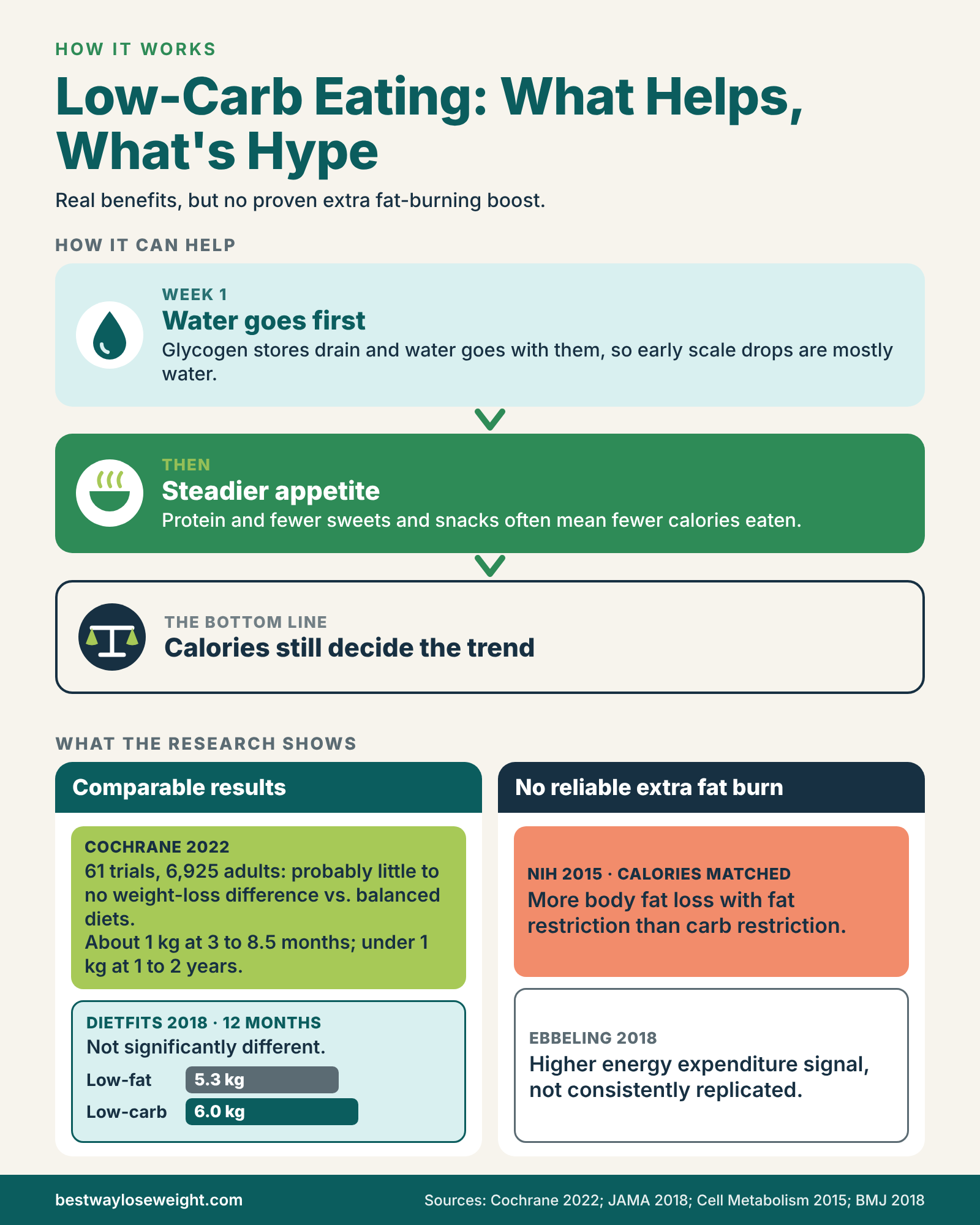
- A 2022 Cochrane review of 61 randomized trials found probably little to no difference in weight loss between low-carb and balanced-carb diets, about 1 kg (2.2 lb) at 3 to 8.5 months and under 1 kg at one to two years.
- Low-carb diets help many people lose weight, but so do low-fat and Mediterranean-style diets when people follow them.
- Your average results will depend more on how long you stick with the plan than on the carb number itself.
Appetite, blood sugar, and simplicity
- Higher protein and fewer refined carbs often make meals more filling, so some people eat less without counting.
- Cutting carbs lowers blood glucose in many people with type 2 diabetes, which is why clinicians sometimes use it, with monitoring.
- A short list of “yes” foods can make grocery trips and restaurant orders easier.
What the evidence does not support
Special fat-burning or metabolism claims
- Controlled feeding studies don’t show that low-carb eating makes you lose more body fat when calories are matched. One inpatient study found slightly less fat loss on the low-carb arm.
- Early rapid weight drops are largely water tied to stored carbohydrate, not a measured jump in fat loss.
- Claims that carbs alone drive weight gain are an unproven hypothesis, not a settled finding.
Safe-for-all or long-term superiority
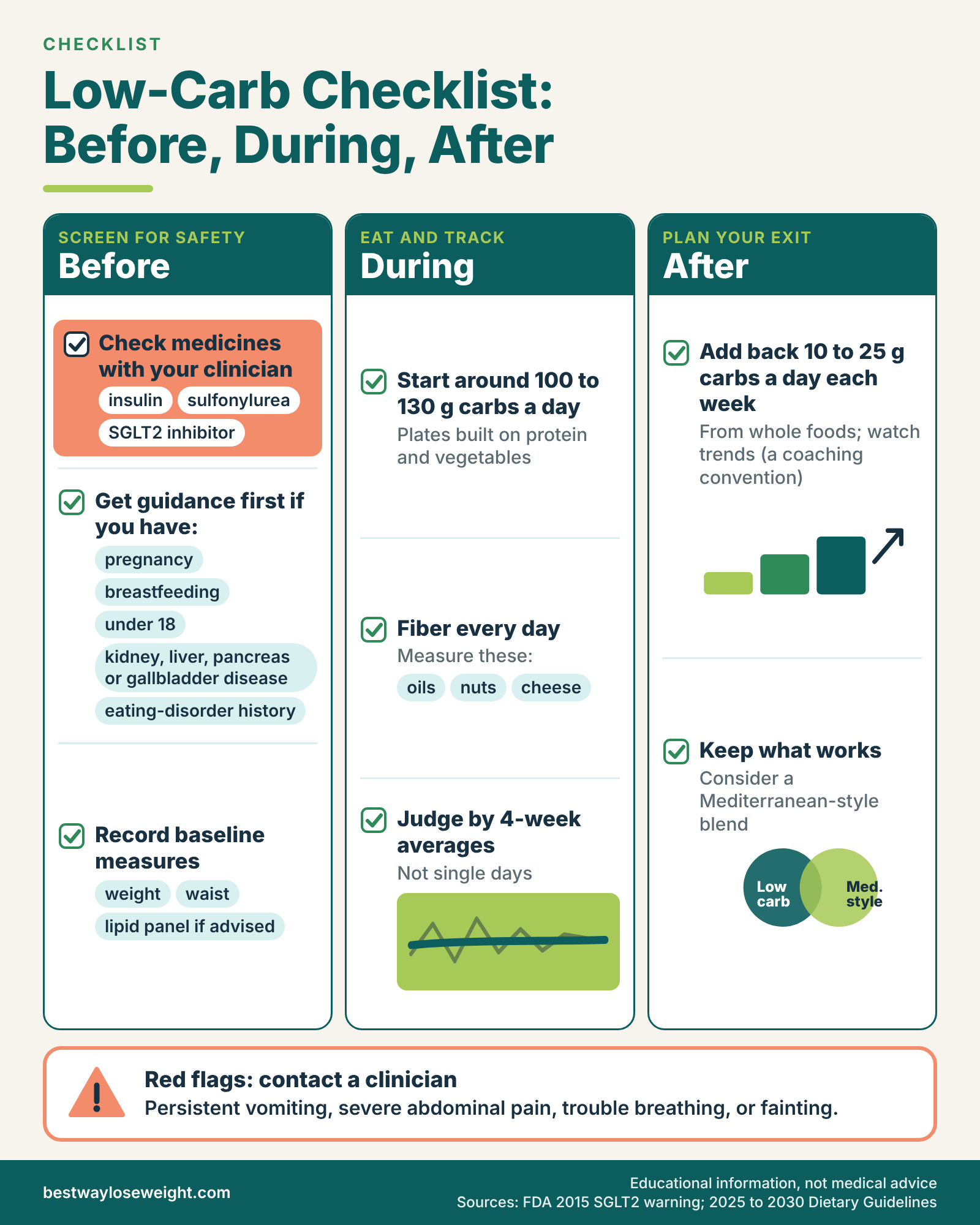
- People who use SGLT2 inhibitors or insulin, are pregnant or breastfeeding, have kidney disease, or have a history of an eating disorder need clinician guidance first.
- Trials rarely run beyond two years, so long-term heart and mortality effects remain uncertain, and they likely depend on food quality (plant versus animal sources).
- Very low-carb plans can raise LDL cholesterol in some people. That’s worth checking with a blood test rather than assuming.
What Counts as a Low-Carb Diet?
There’s no single legal or scientific definition. That’s the first reason low-carb research is hard to read: one study’s “low-carb” group may eat 120 grams of carbohydrate a day while another’s eats 20. Before you compare results or pick a plan, it helps to put the numbers on the table.
Carbohydrate is one of three macronutrients (the big energy-providing nutrients, along with protein and fat). It includes sugars, starches, and fiber. Your body breaks digestible carbohydrate down into glucose, its main quick fuel. Foods like bread, rice, pasta, potatoes, fruit, milk, beans, and sweets all contain it, while meat, fish, eggs, oils, and most non-starchy vegetables contain little.
Carb ranges from moderate to ketogenic
Grams and percentages in common use
Researchers and clinicians commonly sort lower-carb eating into rough tiers. The cutoffs below are working conventions rather than official standards, and different papers draw the lines in slightly different places.
- Moderately lower carb: roughly 26% to 45% of calories, which is about 130 to 225 grams on 2,000 calories.
- Low carb: under about 130 grams a day, or under about 26% of calories.
- Very low carb or ketogenic: often 20 to 50 grams a day, or under about 10% of calories.
For comparison, the national guideline range described below is 45% to 65% of calories, so even a “moderately lower” plan is a deliberate step below the usual recommendation.
Net carbs and why labels differ
Net carbs is a marketing and tracking term, not a regulatory one. It usually means total carbohydrate minus fiber (and sometimes minus sugar alcohols). The idea is that fiber isn’t digested into glucose the way starch is, so it shouldn’t count against your budget. That logic is reasonable for whole foods such as broccoli, berries, chia, and beans.
It gets shakier with packaged “low-carb” bars and snacks. Sugar alcohols, isolated fibers, and other additives can behave differently from person to person, and some cause gas or loose stools. If you track net carbs, choose one method, apply it consistently, and don’t treat a product as free just because its front label says “net 2g.”
Where the national guidance and nutrient requirements fit
The 130-gram RDA and the 45% to 65% range
The Dietary Reference Intakes from the National Academies set a Recommended Dietary Allowance of 130 grams of carbohydrate a day for people over age one. The stated basis is the glucose the brain and nervous system need for optimal function. The same reference sets an Acceptable Macronutrient Distribution Range of 45% to 65% of calories from carbohydrate, which works out to about 225 to 325 grams on a 2,000-calorie day (University of Florida IFAS Extension summary of the DRIs).
Two points matter for low-carb dieters. First, the RDA is a population benchmark for adequacy, not a prohibition. The body can make glucose from protein and glycerol, and in ketosis the brain uses ketones for part of its energy. Second, a plan below 130 grams a day sits outside the national range, so it’s reasonable to ask what you gain in exchange and who should monitor it.
What the 2025 to 2030 Dietary Guidelines emphasize
The 2025 to 2030 Dietary Guidelines for Americans, released by HHS and USDA on January 7, 2026, shifted attention toward whole foods, protein at meals, and limits on highly processed foods and refined carbohydrates (AJMC coverage of the release). Published summaries describe a protein target of 1.2 to 1.6 grams per kilogram of body weight per day, two to four daily servings of whole grains, and an emphasis on minimizing refined carbohydrates (American Family Physician summary).
Notice what that means in practice. The new guidance leans on food quality rather than setting a low-carb target. That fits well with the low-carb idea of cutting sweets, refined starches, and sugary drinks, and less well with plans that drop all fruit, legumes, and whole grains. As of October 2026, check the current text on DietaryGuidelines.gov for exact wording, since summaries vary.
Common versions people follow
Liberal low-carb (about 100 to 130 grams)
This is the most sustainable version for many people. It keeps room for fruit, beans, a serving or two of whole grains or potatoes, and dairy. Most of the carbs you cut come from sweetened drinks, desserts, white bread, chips, and large portions of rice or pasta. If you’ve never tracked carbs before, this tier is a solid starting point because it rarely triggers the flu-like adjustment period described later.
Strict low-carb (about 50 to 100 grams)
At this level, most carbs come from vegetables, berries, nuts, seeds, dairy, and small amounts of legumes. Bread, pasta, rice, and potatoes become occasional. Meals revolve around protein and non-starchy vegetables. It takes more planning, and it’s where label reading starts to matter.
Ketogenic (about 20 to 50 grams)
A ketogenic diet restricts carbs enough that the liver starts producing ketones, molecules the body can use as an alternative fuel. That state is called nutritional ketosis. It’s usually high in fat. Ketosis from a diet is different from ketoacidosis, a dangerous medical emergency seen mainly in type 1 diabetes and in some people on certain diabetes medicines (covered in the safety section). Ketogenic plans are the hardest to sustain socially and the most likely to cause side effects, so they’re best reserved for people with a clear reason and appropriate support.
Low-carb with Mediterranean-style foods
A hybrid approach is also common: lower in refined carbohydrate, built around olive oil, fish, nuts, vegetables, and legumes in measured portions. It borrows low-carb’s appetite benefits without giving up fiber-rich foods. If that sounds appealing, compare it with our practical guide to the Mediterranean diet for weight loss.
How a Low-Carb Diet for Weight Loss Works
People often explain low-carb weight loss with a single story: carbs raise insulin, insulin stores fat, so fewer carbs means less fat storage. It’s an appealing story, and part of it is true. But the best-controlled studies suggest that most of the benefit comes from a few more ordinary mechanisms. Understanding them helps you set expectations and fix problems when the scale stalls.
Water weight, glycogen, and the first week
What glycogen is and why it holds water
Glycogen is the form your body uses to store carbohydrate in the liver and muscles. Each gram of glycogen is stored with several grams of water. When you cut carbs sharply, glycogen stores drain, and the water leaves with them. That’s why many people see a drop of a few pounds in the first week or two.
That drop is real on the scale, but it isn’t the same as fat loss. It also reverses fairly quickly when carbs return, which is why people sometimes feel alarmed after a restaurant meal or a birthday dinner. A two- or three-pound jump overnight after a pasta dinner is usually water and food weight, not fat gain.
How to read week-one results
Treat the first one to two weeks as a “settling” period. If you lose weight quickly and it levels off, that’s the expected pattern, not a stall. Judge progress with a longer lens: the average of your daily weights across a week, compared with the previous week, plus how your clothes fit and how your energy and hunger feel. Our guide to the weight loss plateau walks through how to tell water shifts from true stalls.
Appetite, protein, and calorie intake
Why many people end up eating less
Weight change still comes down to energy balance over time, as explained in our explanation of how a calorie deficit works. The question is how a low-carb pattern helps people land in a deficit without feeling miserable.
Several features likely contribute. Meals built around protein, eggs, fish, meat, dairy, or tofu tend to be filling. Removing sweet drinks and snack foods deletes a source of easy calories. A smaller menu of acceptable foods can reduce the number of decisions and the amount of grazing. And in ketosis, some people report less hunger, though this isn’t universal and the mechanism isn’t fully settled. None of this requires a special metabolic effect, only a reduction in calories eaten.
The insulin hypothesis: what testing has shown
The carbohydrate-insulin model proposes that high-carb diets drive fat storage through insulin, making people hungrier and less energetic. Lowering carbs, in this view, shifts the body toward burning fat. This is testable, and controlled feeding studies have tested it.
In a 2015 study at the NIH Clinical Center published in Cell Metabolism, 19 adults with obesity stayed in a metabolic ward for two 2-week periods. Calories were cut by 30% either by trimming carbohydrate (fat unchanged) or by trimming fat (carbohydrate unchanged). Insulin dropped and fat burning rose on the low-carb diet, as predicted, yet body fat loss was greater with the fat-restricted diet (PubMed record for Hall and colleagues, 2015; trade-press summary). The study was short and small, and Hall noted that over longer periods the same model predicts differences between equal-calorie diets would shrink. The takeaway isn’t that low-fat wins. It’s that lower insulin by itself didn’t produce extra fat loss when calories were controlled.
Energy expenditure: the “metabolic advantage” debate
The Ebbeling maintenance trial
One of the most cited arguments for a metabolic advantage is a 2018 BMJ randomized trial by Ebbeling and colleagues. After 164 adults lost about 12% of their body weight, they were assigned for 20 weeks to diets with 60%, 40%, or 20% of calories from carbohydrate, with protein held at 20%. Total energy expenditure was higher on the low-carb diet by roughly 209 to 278 kcal per day compared with the high-carb diet, with larger differences among people with higher insulin secretion (Harvard T.H. Chan School of Public Health summary; BMJ paper).
If true and durable, that’s a meaningful extra, roughly the calories in a small snack each day. But other nutrition scientists have questioned how expenditure was measured and whether the effect holds across study designs, and the trial received funding from an organization that advocates for low-carb research. It’s best described as an interesting, unreplicated signal rather than an established benefit you can count on.
What inpatient studies add
Tightly controlled inpatient studies, where researchers measure every meal and use calorimetry, generally find that any extra calorie burn from lower-carb eating is small. Combined with the 2015 NIH study above, the practical reading is: don’t plan your diet around a hidden metabolic bonus. Plan it around an intake you can sustain, and treat any bonus as a pleasant surprise.
What this means for your plan
If a carbohydrate-lowering strategy is going to help you, the likeliest routes are the plain ones: fewer calorie-dense sweets and snacks, more protein and fiber-rich vegetables, steadier appetite, and a menu that’s easy to follow. That’s good news, because those routes are available in many eating patterns. It also means you can adjust your carb level up or down to fit your body and life without “breaking” anything.
What the Research Says: Low-Carb vs. Other Diets for Weight Loss
You’ll hear that low-carb “beats” other diets, or that it “doesn’t work long-term.” Both claims are too simple. The evidence base is large, but the trials differ in how low the carbs went, how much support participants received, and how long they ran. The sections below sort the major sources by design so you can see what each one can and can’t tell you.
Systematic reviews and meta-analyses
The 2022 Cochrane review
Cochrane is a nonprofit that publishes rigorous evidence syntheses. Its 2022 review pooled 61 randomized controlled trials with 6,925 adults who had overweight or obesity, comparing low-carb diets with “balanced” diets, meaning moderate macronutrient ratios in line with official guidance. For weight loss, the authors concluded there was probably little to no difference: the average gap was about 1 kg (2.2 lb) at 3 to 8.5 months and less than 1 kg at one to two years. Diastolic blood pressure, HbA1c (a three-month blood sugar marker), and LDL cholesterol were also similar, with or without type 2 diabetes. Certainty was rated moderate, and the longest trials lasted two years. Most participants didn’t already have heart disease or major cardiovascular risk factors (Cochrane featured review summary; Cochrane Library record).
The 2020 BMJ network meta-analysis
A network meta-analysis is a statistical method that compares many treatments at once, even if some were never tested head-to-head. Ge and colleagues pooled 121 randomized trials with 21,942 participants, covering 14 named diets and three control diets. At six months, versus a usual diet, low-carb diets produced about 4.6 kg (10 lb) of average weight loss and low-fat diets about 4.4 kg (9.6 lb), both with moderate certainty. Blood pressure fell by roughly 5 mm Hg on both patterns. LDL cholesterol dropped less on low-carb diets (about 1 mg/dL) than on low-fat diets (about 7 mg/dL). By 12 months, weight and risk-factor benefits had largely faded across macronutrient patterns, with the Mediterranean diet the exception (BMJ abstract).
The 2014 JAMA comparison of named diets
An earlier JAMA meta-analysis by Johnston and colleagues examined 48 randomized trials with 7,286 participants and concluded that weight-loss differences between individual named diets were small. Low-carb and low-fat approaches had nearly identical results at 12 months, and the authors emphasized that adherence mattered more than diet type (American College of Cardiology journal scan; PubMed record).
Randomized trials worth knowing
DIETFITS: low-carb versus low-fat for 12 months
The DIETFITS trial, led by Christopher Gardner at Stanford and published in JAMA in 2018, randomized 609 adults aged 18 to 50 with a BMI of 28 to 40 and no diabetes to a “healthy low-fat” or “healthy low-carb” diet for a year. Both groups received 22 counseling sessions focused on whole foods, vegetables, and avoiding added sugar and refined flour. Weight loss was about 5.3 kg (11.7 lb) on the low-fat diet and 6.0 kg (13.2 lb) on the low-carb diet, a difference that wasn’t statistically significant. Individual results ranged from about a 30 kg loss to a 10 kg gain in both arms.
The study also tested whether genotype patterns or insulin secretion predicted who would do better on which diet. They didn’t (TCTMD report on DIETFITS). Notice how much variation hid behind the averages. In practice that means the diet you choose is a hypothesis you test on yourself, not a verdict handed down by a trial.
The 2021 NIH inpatient study of free eating
In a different design, researchers at the NIH Clinical Center had 20 adults without diabetes live on a metabolic unit for four weeks. They ate a minimally processed, plant-based, low-fat diet for two weeks and a minimally processed, animal-based, very low-carb diet for two weeks, with all meals provided and no calorie limit. Participants ate about 550 to 700 fewer calories a day on the low-fat plant-based diet. The low-carb diet produced lower and steadier insulin and glucose levels. The authors cautioned that a lab setting may not reflect real-world adherence and that long-term effects were unknown (NIH news release).
That result pushes back on the idea that low-carb always cuts appetite more. It likely depends on which foods fill the plate and how calorie-dense they are. Fiber-rich, water-rich foods can be very filling, and so can protein-rich ones.
The 2015 NIH calorie-matched study
This was the study described earlier: 19 adults, two 2-week periods, equal 30% calorie cuts through carbs or fat. It’s one of the cleanest tests of “does lowering insulin help you burn more body fat,” and the answer in that short window was no, though the low-carb diet did change hormones and fuel use as expected. It’s small and short, so it informs the mechanism question more than it settles real-world results.
How to read these results without overreading them
Averages hide individual responses
A group average is just a middle point. In DIETFITS, some people lost 60 pounds and some gained 20 on the same assigned diet. Researchers couldn’t predict who would land where from genetics or insulin response. The honest implication is that you can’t know in advance whether you’ll do well on low-carb, and an eight- to twelve-week trial of the approach, with a clear way to measure it, is a reasonable experiment for many adults.
Adherence, dropout, and support
Diet trials typically include counseling, check-ins, and accountability that the average person lacks. Dropout is common in all arms, and results often include everyone who started, whether or not they stayed with the plan. Higher-support trials can overestimate what an unsupported person will do. The practical response is to build your own supports: a weekly weigh-in routine, a grocery list, a fallback plan for busy days, and one person who knows what you’re trying.
What the evidence cannot tell us yet
Most trials ran 12 months or less. Few followed people for five years or more, and fewer still looked at heart attacks, strokes, or mortality rather than blood markers. Participants were often middle-aged adults without major disease. So we can say low-carb is a reasonable short- to medium-term option for many adults. We can’t say it’s better, or safer, over decades.
| Source | Design and size | Main finding | Main limitation |
|---|---|---|---|
| Cochrane review, 2022 | 61 randomized trials, 6,925 adults with overweight or obesity | Probably little to no difference in weight loss vs. balanced diets (about 1 kg at 3 to 8.5 months; under 1 kg at 1 to 2 years) | Trials up to 2 years; few participants with existing heart disease |
| Ge et al., BMJ, 2020 | Network meta-analysis, 121 trials, 21,942 participants | Low-carb and low-fat similar at 6 months; effects largely faded by 12 months; LDL fell less on low-carb | Indirect comparisons; varied trial quality |
| Johnston et al., JAMA, 2014 | Meta-analysis, 48 trials, 7,286 participants | Small differences between named diets; adherence stressed | Older data; heterogeneous diets |
| DIETFITS, JAMA, 2018 | 609 adults, 12 months, high counseling support | About 5.3 kg (low-fat) vs. 6.0 kg (low-carb); no significant difference; genotype and insulin did not predict response | Participants aged 18 to 50 without diabetes; heavy support |
| NIH inpatient study, 2021 | 20 adults, 2 weeks per diet, all food provided | About 550 to 700 fewer calories eaten per day on low-fat plant-based diet vs. animal-based low-carb diet | Very short; small; not a test of everyday life |
| Hall et al., Cell Metabolism, 2015 | 19 adults, two 2-week periods, calorie-matched | More body fat loss with fat restriction than carb restriction | Short and small; informs mechanism more than outcomes |
| Ebbeling et al., BMJ, 2018 | 164 adults after weight loss, 20 weeks | Higher energy expenditure on 20% carb diet (about 209 to 278 kcal/day vs. 60% carb) | Not consistently replicated; measurement debated; advocacy-linked funding |
Benefits of a Low-Carb Diet Beyond the Scale
If low-carb eating doesn’t reliably beat other diets for weight, why do so many clinicians and patients keep using it? Because weight isn’t the only outcome, and for some people other benefits matter more.
Blood sugar and type 2 diabetes
What the American Diabetes Association consensus says
The American Diabetes Association’s 2019 nutrition therapy consensus report states that there is no single ideal percentage of calories from carbohydrate, protein, and fat for everyone with diabetes. It also notes that reducing overall carbohydrate intake has the most evidence for improving blood glucose and A1c. For selected adults with type 2 diabetes who aren’t reaching their glycemic targets, very low-carb eating may be considered, with three cautions: its long-term effect on glycemia is uncertain, cardiovascular risk factors need monitoring, and long-term adherence is difficult (Today’s Dietitian summary of the ADA consensus report). The 2022 Cochrane comparison above found similar HbA1c with low-carb and balanced diets over the longer term, which suggests the benefit may be most visible early on.
Why medication review comes first
When carbohydrate intake falls, so does the amount of glucose entering the blood, and the dose of glucose-lowering medication that was right on a higher-carb diet might now be too strong. That can cause low blood sugar (hypoglycemia). Decisions about adjusting diabetes medication belong to the prescribing clinician. If you take insulin, a sulfonylurea, or an SGLT2 inhibitor, talk with your care team before changing your eating pattern. The SGLT2 concern is described in the safety section below.
Blood pressure, triglycerides, and cholesterol
Blood pressure and triglycerides
In the BMJ network meta-analysis, both low-carb and low-fat diets lowered systolic blood pressure by around 5 mm Hg at six months, mostly alongside weight loss. Triglycerides, a type of blood fat, are often reported to fall on lower-carb diets, which makes sense because sugary drinks and refined starches are common triglyceride drivers. Still, the Cochrane review found no meaningful long-term difference from balanced diets in its headline cardiovascular markers. The benefit appears to track weight loss and diet quality more than the carb number.
LDL cholesterol is the wild card
LDL cholesterol, often called “bad” cholesterol, is a risk marker for heart disease. In the BMJ analysis it dropped less on low-carb diets than on low-fat ones at six months, and in some individuals LDL rises on very high-fat plans, especially when saturated fat is large. Responses vary widely. If you start a low-carb diet, ask your clinician about a lipid panel before and a few months after, particularly if you have high LDL, a family history of early heart disease, or you’re on a statin.
Satiety, simplicity, and personal fit
Fewer decisions, clearer rules
Some people find that a clear rule such as “no sugary drinks, no bread basket, protein and vegetables first” is easier to follow than counting calories. A short list of default meals reduces daily negotiation. If you’ve struggled with portion control on starchy and sweet foods, a rule-based approach may fit better than a flexible one. That’s a legitimate reason to choose low-carb, as long as the rules aren’t so rigid that they create anxiety.
When a lower-carb pattern may suit your preferences
Enjoyment counts as evidence. If you love eggs, fish, cheese, nuts, salads, roasted vegetables, and grilled meat, a lower-carb plan won’t feel like a sacrifice. If your favorite foods are rice, noodles, tortillas, and fruit, it may feel like a constant fight, and a plan like the Mediterranean pattern or a balanced high-protein approach may suit you better. For a protein-forward alternative that doesn’t restrict grains, see our practical guide to a high-protein diet for weight loss.
Limits, Side Effects, and Who Should Be Careful
Low-carb eating is generally well tolerated by healthy adults, but it isn’t risk-free for everyone, and the stricter the plan, the more these issues matter. This section covers common short-term effects, longer-term questions, and the groups who should involve a clinician first.
Common short-term effects
The “keto flu” and the first few weeks
Many people describe a rough patch after sharply cutting carbs: headache, tiredness, nausea, dizziness, brain fog, and a general “flu-like” feeling. A 2020 qualitative analysis in Frontiers in Nutrition reviewed 448 posts from 300 users across 43 online forums. It identified 54 distinct symptoms, with “flu,” headache, fatigue, nausea, and dizziness reported most often. Symptoms typically started within days, and reports resolved between days 3 and 30, with a median of about 4.5 days. The authors note the research is early and based on self-reports, so it can’t tell us how common or severe the problem is (Frontiers in Nutrition, 2020).
A gradual reduction, instead of an overnight drop to 20 grams, may make an adjustment period gentler. If symptoms are severe or last more than a few weeks, check in with a clinician rather than pushing through.
Constipation and low fiber
Fiber comes mainly from fruit, vegetables, beans, and whole grains. When a low-carb plan removes beans and grains and replaces them with meat and cheese, fiber drops and constipation is a common result. Build fiber back in with non-starchy vegetables at every meal, berries, chia or ground flaxseed, nuts, avocado, and, if your carb budget allows, a half-cup of beans or lentils. Our list of high-fiber foods for weight loss includes options that fit a lower-carb budget.
Cramps, dizziness, and fluid balance
Carbohydrate restriction increases fluid and sodium loss through the kidneys in the early days. Lightheadedness when standing, muscle cramps, or unusual fatigue can show up. Drinking enough fluid and including regular, ordinary salted foods may help many people. But if you take blood pressure medication or a diuretic (“water pill”), or you have heart or kidney disease, don’t change your salt or fluid intake on your own. Ask your clinician what’s right for you.
Longer-term questions
Saturated fat and LDL cholesterol
The American Heart Association recommends keeping saturated fat under 6% of calories, which is about 13 grams a day on a 2,000-calorie diet, and replacing some meat with beans, fish, or nuts and using liquid vegetable oils (American Heart Association). Many low-carb menus can exceed that quickly: a tablespoon of butter carries roughly 7 grams of saturated fat, and an ounce of cheddar about 6. The 2025 to 2030 U.S. guidelines are reported to cap saturated fat at 10% of calories, and the two benchmarks differ, so ask your clinician which target fits your heart-risk profile.
A practical approach is to lean on fish, poultry, eggs, nuts, seeds, olive oil, avocado, and tofu or tempeh for a good share of your protein and fat, and to treat butter, bacon, and fatty cuts of red meat as occasional rather than daily staples.
What observational mortality data suggest
A 2018 Lancet Public Health study by Seidelmann and colleagues followed 15,428 U.S. adults in the ARIC cohort and combined the results with other cohorts, for a total of 432,179 people. They found a U-shaped pattern: the lowest mortality risk was seen at about 50% to 55% of calories from carbohydrate, with higher risk at both low and high intakes. The source of the replacement calories mattered. When carbs were replaced with animal-derived protein and fat, mortality risk was higher (hazard ratio 1.18); with plant-derived replacements, it was lower (0.82) (Lancet Public Health abstract record).
This is observational data: people reported their usual diets on questionnaires, and other habits that go along with eating patterns can distort the numbers. It can’t prove cause and effect. But it fits a common-sense reading: if you go low-carb, it’s likely wiser to fill the gap with nuts, seeds, olive oil, legumes, fish, and vegetables than with processed meats and large amounts of cheese.
Nutrient gaps to watch
If a plan cuts out fruit, legumes, and whole grains, it can fall short on fiber, potassium, magnesium, folate, and vitamin C unless you replace them on purpose. Leafy greens, avocados, nuts, seeds, fish, dairy, and berries help. A basic blood panel and a conversation with a registered dietitian can show whether any gaps are developing, especially if you’re staying under about 50 grams for months.
Who should talk to a clinician first
People who use diabetes medicines, especially insulin, sulfonylureas, and SGLT2 inhibitors
In December 2015, the FDA warned that SGLT2 inhibitors (a diabetes medicine class) can cause ketoacidosis, a serious buildup of blood acids, even when blood sugar isn’t very high. The agency listed risk factors such as reduced calorie intake, alcohol misuse, acute illness or surgery, and reduced insulin dosing, and told patients to stop the medicine and seek immediate care if they had nausea, vomiting, abdominal pain, tiredness, or trouble breathing. Patients were also advised to tell their provider before starting the medicine if they planned a dietary change (FDA Drug Safety Communication, December 4, 2015). Because a ketogenic diet changes ketone levels and food intake, anyone on this class of medicine should get individualized medical advice before trying one. As of October 2026, check the current label for your specific medicine.
Pregnancy, breastfeeding, children, and teens
Pregnancy and breastfeeding raise energy and nutrient needs, and growing children and teens have their own requirements. Weight-loss diets of any type should be supervised by a clinician in these groups. That’s especially true for strict low-carb or ketogenic plans.
Kidney, liver, pancreas, and gallbladder conditions
Higher protein and higher fat loads can matter for people with chronic kidney disease, liver disease, a history of pancreatitis, or gallbladder problems. Whether a low-carb approach is appropriate depends on the condition, stage, and medications. A nephrologist, hepatologist, or registered dietitian can individualize it. Rapid weight loss of any kind can also be a risk factor for gallstones.
A history of disordered eating
Rules that label whole food groups as “bad” can trigger restriction and binge cycles in people with a history of an eating disorder or those at risk. If you’ve had an eating disorder, or counting and rules tend to take over your thinking, work with a clinician or registered dietitian who specializes in this area before trying any restrictive plan.
People taking GLP-1 or other weight-management medication
Appetite-lowering medicines can make it difficult to eat enough protein and fluid, and combining them with a very low-carb plan adds more restriction. Nutrition decisions while on such medication should be coordinated with the prescriber. For background on how these medicines work, see our patient-friendly guide to GLP-1 medications.
| Situation | Why carbs matter | Practical next step |
|---|---|---|
| Insulin or sulfonylurea use | Less carbohydrate can lower blood sugar and raise the risk of hypoglycemia on an unchanged dose | Ask your prescriber how to monitor and whether doses need adjusting before changing meals |
| SGLT2 inhibitor use | FDA has warned of ketoacidosis, sometimes with near-normal glucose; low intake is a listed risk factor | Discuss any low-carb or ketogenic plan first; know the warning symptoms |
| Blood pressure medicine or diuretic | Early fluid and sodium loss may lower blood pressure further | Ask whether home readings or dose reviews are needed |
| Pregnancy, breastfeeding, adolescents | Higher nutrient and energy needs | Use clinician-guided nutrition; avoid unsupervised restriction |
| Kidney, liver, pancreas, or gallbladder disease | Protein and fat loads and rapid weight loss can matter | Get condition-specific guidance from a specialist or dietitian |
| Eating-disorder history | Food rules can worsen restriction and bingeing | Work with a clinician experienced in eating disorders |
| High LDL or strong family heart history | Some people see LDL rise on high-fat plans | Get a lipid panel before and after about 8 to 12 weeks |
A Decision Framework: Is a Low-Carb Diet a Good Fit for You?
Instead of asking whether low-carb is “good,” ask whether it fits your health, your preferences, and your life right now. Use the three screens below in order. If you stop at the first one, that’s the screen working as intended.
Three screens before you start
Screen 1: Safety
Look at Table 2 above. If you use insulin, a sulfonylurea, or an SGLT2 inhibitor; are pregnant or breastfeeding; are under 18; have kidney, liver, pancreas, or gallbladder disease; or have a history of an eating disorder, pause and talk to a clinician or registered dietitian first. Nothing in this guide replaces that conversation. If none of those apply, you can move to the next screen, though a routine checkup with a lipid panel is still a sensible baseline.
Screen 2: Preferences and daily life
Think about what you eat on a normal week. How often do you eat out? Who do you cook for? Are bread, rice, tortillas, or fruit central to your family’s meals or your culture’s food? A diet that fights your food traditions or your household’s routines is hard to keep. If most of your meals are already built around eggs, yogurt, fish, chicken, salad, and vegetables, the change will be small. If most are built around rice, noodles, or sandwiches, you might prefer a smaller carb reduction instead of a strict one.
Screen 3: Goals and timeline
Are you trying to lose 10 pounds for a medical reason, improve blood sugar, or find a plan that quiets constant snacking? Those goals fit low-carb well. If you’re trying to reach a specific number by a specific event in a few weeks, remember that rapid early drops are mostly water and that sustainable fat loss tends to proceed at a more gradual pace. The CDC notes that people who lose weight at a gradual, steady pace of about 1 to 2 pounds a week are more likely to keep it off (CDC guidance on losing weight). That’s a general population statement, not a promise for any individual.
If-then guidance for common situations
If you love bread, rice, and pasta
Try a liberal low-carb or “carb-aware” approach, around 100 to 150 grams a day, instead of a strict one. Keep your favorite starch once a day in a measured portion, and fill the rest of the plate with protein and vegetables. You’ll still cut a lot of refined carbohydrate without feeling deprived.
If you have prediabetes or type 2 diabetes without major complications
Lower-carb eating has some of the strongest evidence for glucose control in this group, but it needs monitoring and, often, medication review. Ask your clinician or a certified diabetes care and education specialist how to track glucose, what to do if you see low readings, and how often to check labs.
If you lift weights or train hard
Many recreational lifters do fine at moderate low-carb levels, particularly if protein is adequate and total calories aren’t too low. High-intensity and endurance training can feel flat on very low carbs for some people. If workouts suffer, consider moving carbs around your sessions, as described in the exercise section later. Our beginner’s guide to strength training for weight loss covers how to protect muscle while eating in a deficit.
If you cook for a family
You don’t need two dinners. Build the main dish around protein and vegetables, then let each person add rice, potatoes, or bread on the side. You’d skip the starch or take a small scoop. That keeps the evening meal low-stress and keeps the focus on you, not on rules for everyone else.
Run it as an 8- to 12-week experiment
Set your baseline and measures
Before you change anything, record a few things: your weight on three or four mornings, waist measurement, how hungry you feel between meals on a 1 to 10 scale, energy level, and, if your clinician agrees, blood pressure, fasting glucose, and a lipid panel. Photos of your meals for a week can reveal what you actually eat now.
Decide in advance what “working” means
Write down the criteria before you start. For example: “Lose about 0.5 to 1.5 pounds per week on a four-week average, feel less snack-driven, no new symptoms, and I can see myself eating this way at a family dinner.” If you hit most of them, continue. If not, tweak the carb level, food quality, or calorie intake, or move to a different pattern. Treating it as an experiment removes the pressure of success or failure and makes switching a normal step, not a defeat.
How to Build a Low-Carb Diet for Weight Loss, Step by Step
Whether you’re aiming for 130 grams or 30, the same building blocks apply. The steps below take you from picking a range to a plate you can repeat. Calories still matter, so we’ll tie the carb target back to an energy budget.
The step-by-step method
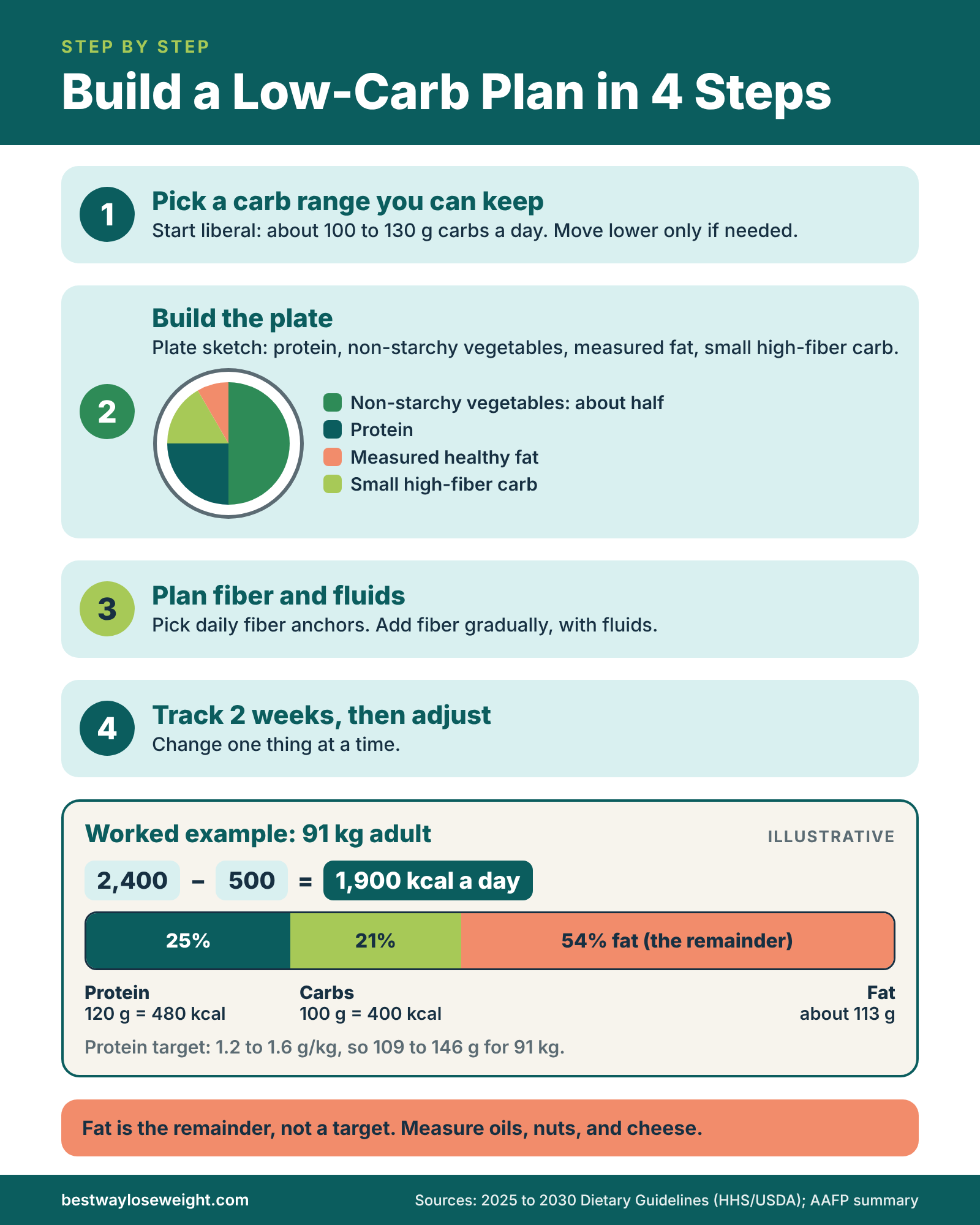
Step 1: Choose a starting carb range
If you’re new to this, start in the liberal range of about 100 to 130 grams a day. It’s the easiest to follow, the least likely to cause flu-like symptoms, and enough of a reduction to cut most sweets and refined starches. If after four weeks you’re comfortable and want more of a change, step down to 75 to 100 grams. Reserve ketogenic levels for cases with a clear reason and supervision.
Step 2: Build the plate
Aim for the same pattern at most meals: a palm-sized portion or two of protein (eggs, fish, poultry, lean meat, tofu, Greek yogurt), a large serving of non-starchy vegetables (about half the plate), a measured portion of fat (olive oil, avocado, nuts), and, if your carb budget allows, a small scoop of a high-fiber carb such as beans, berries, or a half cup of oats. Eating protein at each meal fits the emphasis in the 2025 to 2030 U.S. guidelines.
Step 3: Plan fiber and fluids
Pick two or three fiber anchors you’ll eat daily, such as a big salad, roasted broccoli or cauliflower, berries, chia seeds, or lentil soup. Drink water or unsweetened drinks through the day. If constipation shows up, increase vegetables and fiber gradually rather than all at once, and add fluid with it.
Step 4: Track for two weeks, then adjust
For two weeks, write down what you eat or use a tracking app. You’re not looking for perfection. You want to see your carb range, whether protein is adequate, and where hidden carbs and extra calories are sneaking in. After two weeks, decide what to tweak: more vegetables, fewer nuts, a different breakfast, or a slightly higher or lower carb target.
Worked example: from a calorie target to grams of protein, carbs, and fat
The numbers below are an illustration, not a prescription. They show how to move from a calorie estimate to a plan. Your own numbers will differ. Use our TDEE calculator guide to estimate your maintenance calories, and see our guide to calculating a calorie deficit for the reasoning behind the deficit.
Step A: Estimate maintenance and choose a modest deficit
Assumptions: a 200 lb (91 kg) adult with an estimated maintenance intake of about 2,400 calories a day (from a TDEE estimate, which is only a starting point). A moderate deficit of around 500 calories per day gives a target of 1,900 calories.
Formula: 1,900 = 2,400 − 500. A common rule of thumb says a 500-calorie daily deficit corresponds to about 1 pound a week, but that is only an approximation. Real-world results vary because water shifts, adherence, and metabolic adaptation all play a role. Don’t use a number like this as a promise to yourself, and avoid going far below your estimated needs. Very low-calorie diets belong under clinician supervision.
Step B: Set protein first
The 2025 to 2030 guidance, as summarized by the American Academy of Family Physicians, cites 1.2 to 1.6 grams of protein per kilogram of body weight per day. For 91 kg, that range is 109 to 146 grams. Choose a point inside it that you can reach with real food, for example 120 grams a day, which is 480 calories (protein has 4 calories per gram). People with kidney disease should get an individualized protein target from their care team instead of using this range. For more on this topic, see our guide to how much protein you need to lose weight.
Step C: Pick carbs, then let fat fill the remainder
Choose your carb budget. For the liberal range, say 100 grams, or 400 calories (4 calories per gram). Subtract protein and carbs from the total: 1,900 − 480 − 400 = 1,020 calories left for fat. Fat has 9 calories per gram, so 1,020 ÷ 9 is about 113 grams.
At a strict 50 grams of carbohydrate (200 calories), the remainder is 1,900 − 480 − 200 = 1,220 calories, or about 136 grams of fat. By percentage, the 100-gram plan works out to about 25% protein, 21% carbohydrate, and 54% fat. The 50-gram plan is about 25%, 11%, and 64%.
The key thing to see here: fat is not a goal to hit; it’s the leftover. If you aren’t hungry, don’t force down extra fat to reach the number. On a low-carb diet, extra butter and oil are the most common reason the deficit disappears without anyone noticing.
What these plans look like at the grocery store
Take the 100-gram version. A day could include a vegetable-and-egg breakfast with berries, a big salad with salmon and olive oil at lunch, a snack of Greek yogurt and almonds, and chicken thighs with roasted vegetables and a small portion of beans at dinner. That’s real food in ordinary amounts. If the totals don’t match the target on your tracker, small adjustments to oil, nuts, and cheese portions usually fix it.
Choosing and adjusting your carb budget
Comparing carb tiers
Use Table 3 as a rough map. Most people don’t need to stay at the strict end of the spectrum to see results, and moving up the table is not “failing.”
| Tier (daily carbs) | What typically fits | May suit | Watch for |
|---|---|---|---|
| Moderately lower (about 130 to 200 g) | Fruit, legumes, whole grains in measured portions; fewer sweets and refined starches | First-time dieters, active people, families | Smaller appetite effect; still need calorie awareness |
| Liberal low-carb (about 100 to 130 g) | Fruit daily, one starch serving, beans, dairy | Most beginners; people who like variety | Easy to creep up with snacks and drinks |
| Strict low-carb (about 50 to 100 g) | Vegetables, berries, nuts, dairy, small legume portions | People who want a stronger rule-based approach, with clinician input if on medication | Fiber gaps, more planning, label reading |
| Ketogenic (about 20 to 50 g) | Mostly protein, fats, non-starchy vegetables | Select cases with medical guidance | Flu-like adjustment, LDL changes, social difficulty, medication interactions |
When to move up or down
Move down a tier if you’ve tracked accurately for four weeks, your carbs are consistent, and your four-week weight average is flat. First check calories and portions of fats, since they’re more often the culprit. Move up a tier if you feel persistently tired, struggle with workouts, can’t keep up with the plan socially, or find yourself thinking about food constantly. Switching tiers is normal. The goal is a version that works for you most weeks, not a tier that looks good on paper.
Low-Carb Food Ideas: What to Eat, Portion, and Watch
A food list helps most when it explains why an item fits and how much room it takes in your budget. For deeper food-by-food nutrition, our guide to the best foods for weight loss covers filling, nutritious options across eating patterns.
Foods that usually fit comfortably
Protein foods
Most animal proteins contain little to no carbohydrate. Eggs, fish and shellfish, poultry, lean beef and pork, plain Greek yogurt, cottage cheese, tofu, and tempeh all fit. Fatty fish such as salmon, sardines, and trout bring omega-3 fats. Processed meats such as bacon, sausage, and deli meats are low in carbs but also high in sodium and saturated fat, so they work better as occasional foods. Check labels on sausages and marinated meats, since some contain added sugar.
Non-starchy vegetables
This is the group that most improves a low-carb plan. Leafy greens, broccoli, cauliflower, zucchini, cucumbers, peppers, mushrooms, green beans, asparagus, tomatoes, and cabbage carry few digestible carbs per cup and a lot of volume and fiber. They’re the main reason to be generous with portions: you can eat a lot of them while keeping the carb total low. Roasting, sautéing with olive oil, and adding herbs and spices keep them from tasting like diet food.
Fats, nuts, seeds, and dairy
Olive oil, avocado, nuts, seeds, nut butters, and full-fat or reduced-fat dairy are common. They’re also calorie-dense, so portions matter. A tablespoon of oil has about 120 calories, and a quarter cup of almonds has roughly 200. Measure them at first. Choose unsaturated sources most of the time to keep saturated fat in check.
Foods to portion instead of ban
Fruit
Berries are the lowest in carbs and highest in fiber among common fruits, so they fit nearly every tier. Apples, oranges, and pears fit in liberal and moderate plans. Bananas, grapes, mango, and dried fruit pack more sugar per serving and are easier to overeat. Whole fruit has fiber and water that fruit juice lacks, so juice is the first item to cut.
Beans, lentils, and whole grains
Legumes bring protein, fiber, and minerals. A half cup of cooked lentils or black beans has roughly 20 grams of carbohydrate, but also around 7 to 8 grams of fiber. In a 100-gram budget, that’s a good trade. In a 30-gram budget, it’s a big chunk. Whole grains such as oats, quinoa, and brown rice can also fit in smaller portions at the liberal end. The 2025 to 2030 guidelines, as summarized, suggest two to four servings of whole grains daily, which you may or may not reach on a stricter plan.
Starchy vegetables
Potatoes, sweet potatoes, corn, peas, and winter squash contain more carbohydrate than leafy vegetables but also provide potassium, vitamins, and fiber (especially with the skin). A small baked potato or half a sweet potato fits in many moderate plans. Cooling cooked potatoes and rice before eating them changes some starch to a form that digests more slowly, though the effect is modest and shouldn’t be oversold.
Hidden carbs, labels, and eating out
Drinks, sauces, and dressings
Liquid calories are where most surprise carbs hide. A 12-ounce regular soda has roughly 39 grams, and sweetened coffee drinks, juices, and sports drinks can contain as much. Ketchup, barbecue sauce, teriyaki, sweet chili, honey mustard, and many salad dressings contain added sugar. Look for “added sugars” on the Nutrition Facts label and choose olive oil and vinegar, mustard, hot sauce, or simple herb dressings.
“Low-carb” packaged foods
Bars, breads, pastas, and snacks labeled “keto” or “low-carb” aren’t automatically helpful. Many are high in calories, expensive, and made with sugar alcohols or isolated fibers that cause gas or loose stools in some people. They can be a convenience on a busy day, but the best low-carb foods are the ones without a marketing label: an egg, a chicken breast, a cucumber, a bag of frozen broccoli.
Restaurants and social meals
Many restaurant meals adapt easily: a burger bowl or lettuce wrap, grilled fish with extra vegetables, a salad with chicken and dressing on the side, or fajita fillings without the tortillas. Ask for vegetables in place of fries or bread. Don’t skip a meal out because you’re worried about a few grams. One meal doesn’t determine your outcome, and rigid rules in social settings are a common reason people drop the plan.
| Food and portion | Approx. total carbs | Comment |
|---|---|---|
| 1 large egg | Under 1 g | Protein-rich staple |
| 3 oz cooked chicken, fish, or beef | 0 g | Check marinades and breading |
| 1 cup raw chopped broccoli | About 6 g | Roughly 2 to 3 g of that is fiber |
| 1 cup raw chopped cauliflower | About 5 g | Flexible rice or mash substitute |
| ½ medium avocado | About 6 g | Most of it is fiber; calorie-dense |
| 1 oz almonds (about 23) | About 6 g | About 160 to 170 calories |
| ¾ cup plain nonfat Greek yogurt | About 6 to 8 g | Flavored versions can have much more |
| 1 cup 2% milk | About 12 g | Mostly lactose, a natural sugar |
| 1 cup strawberries | About 12 g | Berries fit most plans |
| 1 cup blueberries | About 21 g | Use ½ cup in stricter plans |
| 1 medium apple | About 25 g | Fiber slows digestion |
| ½ cup cooked lentils or black beans | About 20 g | About 7 to 8 g fiber; protein too |
| 1 slice whole-wheat bread | About 12 g | Some thin or “light” breads have fewer |
| ½ cup cooked white rice | About 22 g | Restaurant portions are often 3 times this |
| 1 cup cooked pasta | About 40 g | Typical restaurant plates have 2 to 3 cups |
| 12 oz regular soda | About 39 g | No fiber, no protein |
Sample Low-Carb Meal Plan and Grocery List
The three days below are examples of how the pieces fit, not a prescription. Each day lands at roughly 80 to 100 grams of carbohydrate and is built around protein and vegetables. Portions, and therefore calories, depend on your needs, so scale them to your own target from the worked example above. Totals are approximations from typical values. For a longer, fully planned menu with a calorie focus, see our 7-day weight loss meal plan.
Three sample days at about 80 to 100 grams of carbs
Day 1 (about 85 to 90 g)
- Breakfast: three-egg scramble with spinach and mushrooms cooked in a teaspoon of olive oil, plus ½ cup blueberries.
- Lunch: large salad with cucumber, tomatoes, canned salmon, ¼ avocado, olive oil, and vinegar, with ½ cup chickpeas on top.
- Snack: ¾ cup plain Greek yogurt and 1 oz almonds.
- Dinner: roasted chicken thighs (skin removed), a heaping portion of roasted broccoli, and ½ cup cooked lentils.
Day 2 (about 95 to 100 g)
- Breakfast: ¾ cup Greek yogurt, 1 cup sliced strawberries, and a tablespoon of chia seeds.
- Lunch: turkey and cheese rolled in large lettuce leaves with mustard, half an avocado, and an apple.
- Snack: celery sticks with 2 tablespoons natural peanut butter.
- Dinner: shrimp stir-fry with two cups of mixed non-starchy vegetables and ½ cup cooked rice.
Day 3 (about 80 to 85 g)
- Breakfast: ½ cup cottage cheese with ½ cup blueberries and a few walnuts.
- Lunch: tuna salad made with olive-oil mayonnaise, served over cucumber slices with a side salad and one slice of whole-wheat toast.
- Snack: an ounce of cheese and a small apple.
- Dinner: grilled sirloin, roasted zucchini and bell peppers, and half a small baked potato with the skin on.
Budget, time, and plant-based constraints
Eating low-carb on a tight budget
Low-carb eating doesn’t require specialty products. The least expensive building blocks are usually eggs, canned fish and chicken, frozen vegetables, cabbage, store-brand plain Greek yogurt, chicken thighs and drumsticks, and dried beans and lentils in measured portions. Skip the branded “keto” products, which tend to cost more. Buying vegetables frozen reduces waste and keeps the nutrients, and a rotisserie chicken can anchor three meals.
Cooking when you’re short on time
Pick one cooking session a week and make two proteins (for example, baked chicken thighs and hard-boiled eggs), a sheet pan of roasted vegetables, and a jar of simple dressing. Then assemble bowls and salads in ten minutes day to day. Rotisserie chicken, bagged salad, canned tuna, and frozen stir-fry vegetables fill in the gaps on rough days.
A vegetarian or plant-forward version
It’s possible but takes more intention, because most plant proteins come with carbohydrate. Eggs, dairy, tofu, tempeh, edamame, nuts, seeds, and small portions of lentils and beans do much of the work. Keep an eye on total protein, vitamin B12 (found in animal foods and fortified products), and iron. A registered dietitian can help with a vegan version, which is harder to keep below very low carb levels. Given the Seidelmann data, a plant-forward low-carb pattern may also be the more attractive version over time, though that evidence is observational.
A basic grocery list
Fresh and refrigerated
Eggs, plain Greek yogurt, cottage cheese, cheese, chicken thighs or breasts, fish fillets, ground turkey or lean beef, leafy greens, broccoli, cauliflower, zucchini, peppers, cucumbers, tomatoes, mushrooms, berries, lemons, and fresh herbs.
Freezer and pantry
Frozen vegetables and berries, frozen shrimp or fish, canned salmon, sardines, and tuna, olive oil, vinegar, mustard, nuts and seeds, natural nut butter, canned or dried beans and lentils, unsweetened tea and coffee, spices, and low-sodium broth.
Troubleshooting a Low-Carb Plan: Stalls, Cravings, Energy, and Exercise
Even a well-built plan hits snags. The goal is to diagnose the likely cause, make one change at a time, and give it two weeks before judging.
When the scale stops moving
Check how you’re measuring
Weigh at the same time of day, ideally in the morning after using the bathroom, and compare weekly averages instead of single days. Water, sodium, hormones, and digestion move the scale by a few pounds without any change in body fat. If your waist measurement or the fit of your clothes is improving, you may be making progress the scale hides. Our guide to the weight loss plateau and the explainer on how long a plateau lasts offer more detail.
Look for calorie-dense extras
On low-carb plans, the usual culprits are oil in cooking, cheese, nut butters, handfuls of nuts, cream in coffee, and “fat bombs.” A tablespoon of olive oil adds about 120 calories; two or three tablespoons a day beyond what you realized can erase a deficit. Weigh or measure fats for a week. If you aren’t hungry, you can eat a little less fat.
Re-estimate your needs
As weight drops, daily calorie needs drop with it. A calorie target that produced results at 200 pounds may be a maintenance level at 180. If you’re also sleeping poorly or under heavy stress, appetite and activity can drift. Review your estimate using the TDEE guide, and consider whether a short break at maintenance helps before another push.
Cravings and low energy
Managing cravings without willpower contests
Cravings are not a character flaw. They often reflect hunger, sleep loss, stress, or the sudden removal of a favorite food. Make sure you’re eating enough protein and vegetables at meals, keep ready-to-eat snacks like Greek yogurt, hard-boiled eggs, or berries within reach, and give yourself a planned way to enjoy the food you miss, such as a small portion of dessert on a weekend. If you feel preoccupied with food or rules, loosen the plan.
Fatigue, dizziness, and brain fog
These are common in the first couple of weeks. They may improve with adequate fluids, enough overall calories, and a less aggressive carb cut. If they persist, if you faint, if your heart races, or if you have nausea, vomiting, abdominal pain, or trouble breathing, stop and contact a clinician. That is particularly important if you take diabetes medicine.
Exercise while eating lower carb
Walking and everyday movement
Low- to moderate-intensity movement such as walking is rarely limited by carbohydrate intake. It’s one of the most dependable ways to support a deficit, and it’s easy to keep on a lower-carb plan. Our guide on walking for weight loss explains how to build up gradually.
Strength training and hard workouts
Resistance training helps protect muscle in a calorie deficit, which is why adequate protein plus lifting is a strong pairing. Some people notice that hard intervals or long endurance sessions feel flat on very low carbs. If that happens, a modest portion of fruit, oats, or a small potato before or after the session can help, and it doesn’t ruin your plan. Experiment and keep notes.
Don’t let the plan crowd out sleep and recovery
Short sleep increases hunger and cravings for many people, which can cancel the appetite benefits of a lower-carb plan. If you’re sleeping poorly, fixing that can do more for adherence than another dietary tweak. See our overview of how sleep affects hunger and habits.
After the Weight Loss Phase: Maintenance and Long-Term Planning
Many diets get you to a lower weight and then offer little guidance on what comes next. Planning the transition early is one of the best predictors of staying on track.
Reintroducing carbohydrate
A gradual step-up approach
A common practical approach is to add back about 10 to 25 grams of carbohydrate a day each week, mostly from whole-food sources such as fruit, beans, oats, and potatoes. This is a coaching convention, not a protocol proven in trials. Watch your four-week weight trend, hunger, energy, and digestion. If weight begins creeping up, hold at the previous level or move back one step.
What to watch as you go
Expect a small scale bump when carbs return, since glycogen and water come back with them. Don’t interpret it as fat gain. Track your trends over several weeks. Many people find a long-term “sweet spot” that is lower in refined carbohydrate than before but not strictly low-carb, and that is a perfectly good outcome.
Choosing a pattern you can keep
Low-carb as a tool, not an identity
Since the best evidence shows similar average results across well-built diets, you can treat low-carb as one tool among several. Use it when it helps, such as to calm snack-driven eating or to improve glucose control with your clinician’s guidance, and relax it when life calls for flexibility. The bottom line: the plan that you can stick with is the plan that works.
Blending with Mediterranean-style eating
Combining lower refined carbohydrate with olive oil, fish, nuts, vegetables, and legumes keeps many of low-carb’s strengths while preserving fiber and variety. In the BMJ network meta-analysis, the Mediterranean diet was the pattern that kept some benefits at 12 months, though the data are not strong enough to call it a winner. Our guide to the Mediterranean diet for weight loss shows how.
Pairing with meal timing strategies
Some people combine lower-carb eating with time-restricted eating. That isn’t necessary, and stacking restrictions can make life harder. If you’re curious, read what the evidence says about intermittent fasting first, and avoid combining strategies if you take glucose-lowering medicine or have a history of disordered eating.
When to get professional support
A registered dietitian can individualize carb targets, check for nutrient gaps, and help with maintenance. Consider asking for a referral if you have diabetes, kidney disease, high LDL, a long history of yo-yo dieting, or you’re stuck despite accurate tracking.
Low-Carb Diet for Weight Loss: Frequently Asked Questions
Getting started and everyday eating
How many carbs should I eat to lose weight?
There’s no single number. Many adults start around 100 to 130 grams a day and adjust. Stricter levels exist, but trials suggest total calories and adherence matter as much as the carb target. If you take diabetes medicine, ask your clinician before choosing a number.
How fast will I lose weight?
It varies widely. Early drops are often water, and long-term loss differs a lot from person to person. In DIETFITS, some people lost about 30 kg in a year and some gained weight on the same diet. Use a four-week average and your own criteria rather than a fixed expectation.
Do I still need to count calories?
Not necessarily. Some people lose weight by following food rules and eating until satisfied. If your progress stalls, spending a week measuring portions, particularly of fats and nuts, will usually show why. Counting is a tool you can pick up and set down.
Can I eat fruit?
Yes, in most plans. Berries fit nearly all tiers; larger fruits like bananas and mangoes take a bigger share of a small carb budget. Only the strictest ketogenic plans exclude most fruit.
What about alcohol?
Alcohol adds calories (about 7 per gram) and lowers inhibition around food. Beer and sweet cocktails carry carbs, while spirits with zero-sugar mixers carry few. The FDA lists alcohol misuse among the risk factors for ketoacidosis in people taking SGLT2 inhibitors, so anyone on those medicines should ask their clinician first.
Can I combine low-carb with a GLP-1 medicine?
That’s a decision for you and your prescriber. Appetite suppression can make it hard to meet protein and fluid needs, so very restrictive plans aren’t automatically a good match. Ask for individual guidance.
Safety, health, and long-term use
Is a low-carb diet safe long term?
For many healthy adults, moderate low-carb eating built from whole foods appears reasonable. Evidence on very low-carb eating beyond two years is limited, and observational data suggest the foods you replace carbs with may matter. Periodic checkups, a lipid panel, and attention to fiber and saturated fat are sensible.
Will it raise my cholesterol?
Responses vary. In pooled trials LDL fell less on low-carb than on low-fat diets at six months, and some individuals see LDL rise. Prioritize unsaturated fats, fish, nuts, and plant foods, and get a lipid panel before and after about 8 to 12 weeks.
Can I do this as a vegetarian or vegan?
A vegetarian version is practical with eggs, dairy, tofu, tempeh, nuts, and seeds. A vegan version at very low carb is difficult and benefits from a dietitian’s help to cover protein, B12, iron, and calcium.
Why do I have bad breath or a metallic taste?
It’s often reported in ketosis and likely related to ketones in the breath and urine. It tends to ease with time, hydration, and good oral hygiene, or by raising your carb intake slightly. If you notice a fruity smell along with nausea, vomiting, or abdominal pain and you take diabetes medicine, seek medical care.
When should I stop and call a clinician?
Contact one if you have persistent vomiting, severe abdominal pain, trouble breathing, fainting, a racing heart, extreme weakness, or symptoms that last beyond a few weeks. Seek urgent care for severe symptoms. If you take diabetes medication, ask in advance what readings should prompt a call.
Bottom Line
The short version
What to do this week
Check Table 2 for safety flags. If you’re clear, pick a liberal starting range of about 100 to 130 grams, build plates around protein, non-starchy vegetables, and measured healthy fats, and track for two weeks. Cut sweet drinks and refined starches first. Plan a few fiber anchors and a fallback meal for busy days. Set your success criteria in writing, and review after eight to twelve weeks.
What not to expect
There’s no magic bullet here. Low-carb eating isn’t a proven way to burn more fat at the same calories, and a fast first week is mostly water. It’s one reasonable option among several, with similar average results to other well-built diets in the best reviews. If it fits your life, it can be a good tool. If it doesn’t, you haven’t failed. Another pattern may fit better.
Questions to bring to your clinician
Before you start
- Do my medications, including diabetes and blood pressure medicines, need monitoring or review if I cut carbs?
- Is a low-carb or ketogenic plan appropriate given my kidney, liver, gallbladder, or heart health?
- What baseline labs, such as a lipid panel and A1c, should I have?
After eight to twelve weeks
- Did my lipids, blood pressure, and glucose change in the direction we hoped?
- Should I adjust my carb level, saturated fat, or fiber?
- What’s my plan for maintenance, and would a dietitian referral help?
Sources
Primary sources (government and clinical guidelines)
Government and national guidance
- U.S. Food and Drug Administration. FDA Drug Safety Communication: SGLT2 inhibitors and ketoacidosis. December 4, 2015.
- Centers for Disease Control and Prevention. Losing weight. Accessed October 2026.
- U.S. Department of Health and Human Services and USDA. Dietary Guidelines for Americans, 2025 to 2030. Released January 7, 2026.
- University of Florida IFAS Extension. Carbohydrates: summary of Dietary Reference Intakes. Reflects National Academies DRIs.
Professional and clinical organizations
- American Heart Association. Saturated fat. Accessed October 2026.
- Today’s Dietitian. ADA’s 2019 nutrition therapy consensus report, summarizing the American Diabetes Association consensus report. 2019.
- American Family Physician (AAFP). Dietary Guidelines for 2025 to 2030: Recommendations From the USDA and HHS. 2026.
- AJMC. New HHS dietary guidelines take hard line on processed foods. January 14, 2026.
Research and supporting literature
Systematic reviews and randomized trials
- Cochrane. Low carbohydrate versus balanced carbohydrate diets for reducing weight and cardiovascular risk (featured review summary), and the Cochrane Library record. 2022.
- Ge L et al. Comparison of dietary macronutrient patterns of 14 popular named dietary programmes for weight and cardiovascular risk factor reduction in adults. BMJ. 2020.
- Johnston BC et al. Comparison of weight loss among named diet programs in overweight and obese adults: a meta-analysis. JAMA. 2014. See also the ACC journal scan.
- Gardner CD et al. DIETFITS trial, JAMA. 2018. Coverage: TCTMD, Diet draw: no weight loss differences between low-carb, low-fat approaches in DIETFITS.
- National Institutes of Health. NIH study compares low-fat, plant-based diet to low-carb, animal-based diet. 2021.
Mechanistic, maintenance, and observational studies
- Hall KD et al. Calorie for calorie, dietary fat restriction results in more body fat loss than carbohydrate restriction in people with obesity. Cell Metabolism. 2015. PubMed record; FoodNavigator summary.
- Ebbeling CB et al. Effects of a low carbohydrate diet on energy expenditure during weight loss maintenance: randomized trial. BMJ. 2018. Summary: Harvard T.H. Chan School of Public Health, The Nutrition Source.
- Seidelmann SB et al. Dietary carbohydrate intake and mortality: a prospective cohort study and meta-analysis. Lancet Public Health. 2018. Abstract record.
- Qualitative analysis of online forum reports of “keto flu” and keto-adaptation. Frontiers in Nutrition. 2020.

