
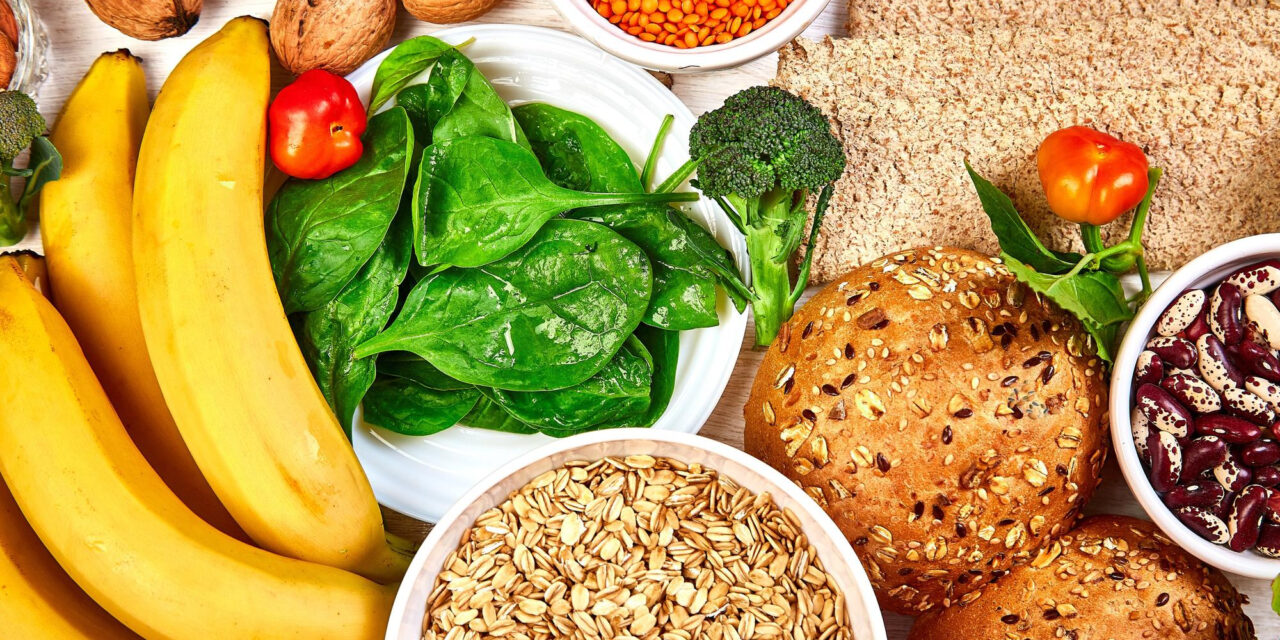
The best high fiber foods for weight loss are the ones that deliver a lot of fiber and a lot of volume for relatively few calories: beans, lentils, peas, vegetables, whole fruit, oats, and other intact whole grains. They don’t burn fat or override a calorie deficit. What they can do is make a deficit easier to live with, because fiber-rich foods tend to be more filling per bite and take longer to eat. This guide explains how that works, what the research actually found, how many grams to aim for, which foods earn a spot in your cart, and how to add fiber without a week of bloating.
It’s written for adults who want practical, evidence-based help, not a promise about pounds. Effects of fiber on weight in trials are real but modest, and they vary from person to person. Everything below is educational and doesn’t replace advice from your own clinician or a registered dietitian, especially if you have a digestive condition, take medication, are pregnant or breastfeeding, or have a history of disordered eating. Source information is current as of October 2026.
Key Takeaways: High-Fiber Eating for Weight Management
The short version
What the evidence supports
- Fiber helps most as a fullness tool, not a fat-loss tool. Pooled trials show small average weight differences in favor of higher fiber, on the order of a pound or two over weeks to months, with wide individual variation.
- Most U.S. adults eat about 16 grams of fiber a day, while common targets run from roughly 21 to 38 grams depending on age and sex. Closing even half that gap is a realistic first goal.
- A handy personal target is about 14 grams per 1,000 calories you eat. At 1,800 calories, that works out to about 25 grams.
- Beans, lentils, peas, berries, pears, apples, broccoli, oats, barley, and popcorn deliver the most fiber per calorie for the money.
What it doesn’t support
- No single “fiber food” causes weight loss. Context matters: total calories, protein, sleep, activity, and how long you can keep the pattern going.
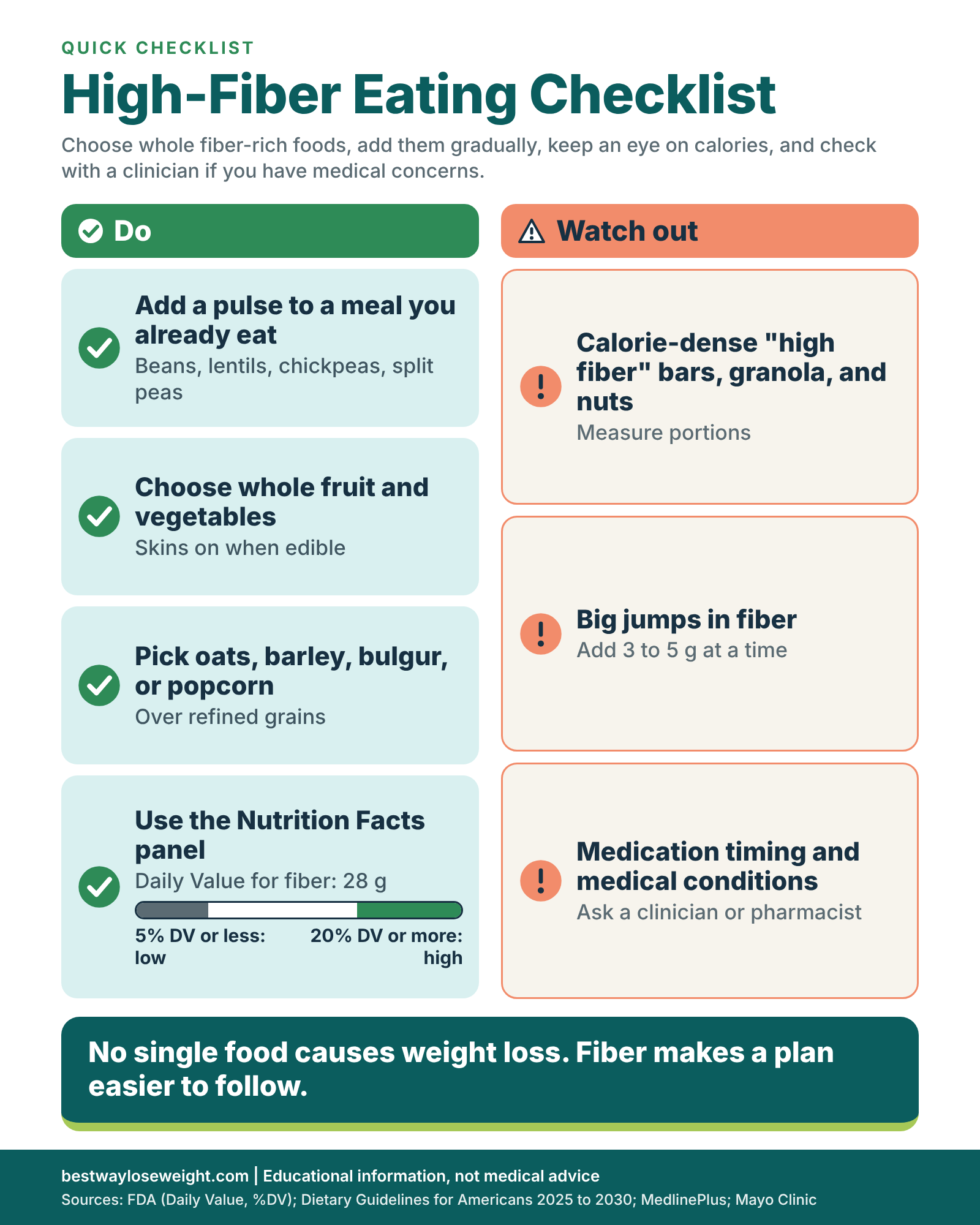
- Calorie-dense foods with a “high fiber” label (some bars, cereals, and nut-based snacks) can still stall progress if portions aren’t tracked.
- Large, fast jumps in fiber commonly cause gas, bloating, and cramping. Slow ramps work better.
What to do this week
Three moves that don’t require a new diet
- Add one pulse (beans, lentils, chickpeas, or split peas) to a meal you already eat.
- Swap one low-fiber grain or snack for a whole-food version, such as oatmeal for sugary cereal or an apple for a pastry.
- Check the Nutrition Facts panel on two staples and note the grams of fiber per serving.
When to slow down or ask first
If you have irritable bowel syndrome, inflammatory bowel disease, a history of bowel obstruction or surgery, swallowing problems, kidney disease, diabetes treated with medication, or you take a GLP-1 medication, talk with your clinician before making large fiber changes. The section on who should be careful explains why.
How High Fiber Foods for Weight Loss Actually Work
Before choosing foods, it helps to know what the fiber is doing. The mechanisms below explain why a bowl of lentil soup holds you longer than a bagel with the same calories, and why some “high fiber” products disappoint.
What fiber is, in plain English
Dietary fiber is the part of plant foods your body can’t fully break down with its own digestive enzymes. It passes through the stomach and small intestine largely intact and reaches the large intestine, where gut bacteria ferment some types of it. Fiber isn’t one substance. It’s a family of carbohydrates and related compounds, and the type matters for what it does.
Soluble, insoluble, and viscous: the three words that matter
Soluble fiber dissolves in water and, according to MedlinePlus, turns to a gel during digestion, which slows digestion. It’s plentiful in oats, barley, beans, lentils, nuts, seeds, and some fruits and vegetables. Insoluble fiber doesn’t dissolve in water; it’s concentrated in wheat bran, vegetables, and whole grains, and it adds bulk to stool and speeds movement through the gut.
Viscous fiber is a subset of soluble fiber that forms a thick gel (oat and barley beta-glucan, psyllium, pectin in fruit, and some bean fibers are examples). Viscosity is the property researchers most often link to fullness and to effects on cholesterol and blood sugar. Most real foods contain a blend. Lentils, for example, supply both soluble and insoluble fiber, so you don’t need to count each type separately.
Why “fiber” on a label includes more than one thing
The fiber number on a Nutrition Facts panel can include fiber that is naturally part of the food (the intact fiber in oats or beans) and added isolated fibers that manufacturers extract or make and put into a product. Both count toward the grams listed, but they don’t necessarily behave the same way in your body, and foods that rely on added fiber lack the vitamins, minerals, and plant compounds that come with whole foods. The label section later in this guide shows how to tell the difference.
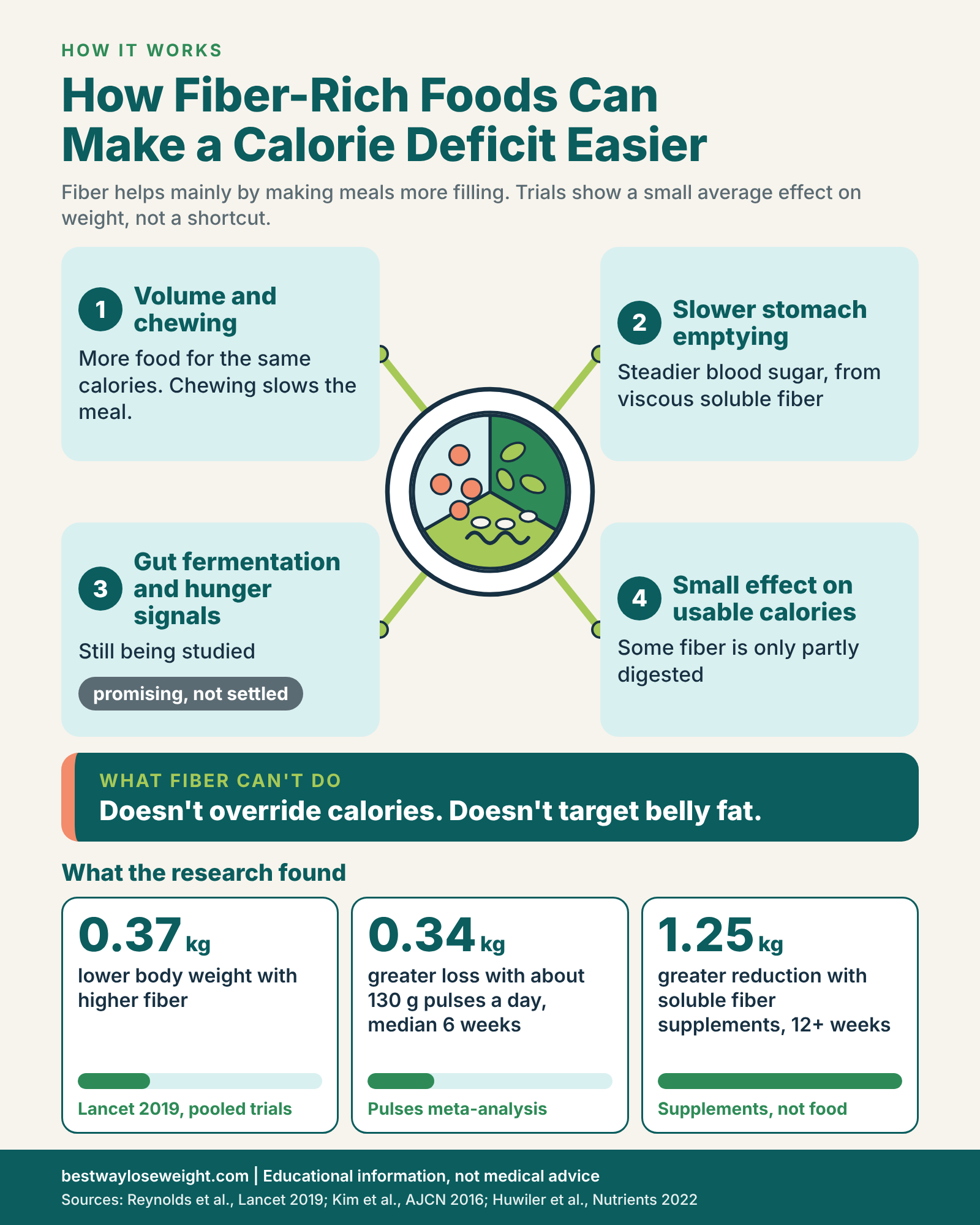
Four ways fiber-rich foods can make a calorie deficit easier
Weight loss still comes down to eating fewer calories than you use over time, a point the calorie deficit guide explains in detail. Fiber’s role is to make that smaller intake feel less like a fight. Four mechanisms are usually discussed, and they’re not equally well supported.
Volume and chewing: more food for the same calories
Fiber and water give food bulk without adding many calories. Raspberries, broccoli, lentils, and oats are physically large relative to their energy content, so a plate built from them looks and feels like a lot of food. High-fiber foods also usually take more chewing, which slows the pace of a meal and gives fullness signals time to register. This is the most intuitive mechanism, and it’s well aligned with the broader idea of choosing low energy density foods (fewer calories per bite). It doesn’t need a lab to notice. A cup of cooked oatmeal and a croissant can contain similar calories, but the oatmeal takes longer to eat and typically sits differently an hour later.
Slower stomach emptying and steadier blood sugar
Viscous soluble fiber thickens the contents of the stomach and small intestine. That can slow how quickly the stomach empties and how fast carbohydrates are absorbed, which tends to flatten the post-meal rise in blood sugar. Slower absorption is one plausible reason a meal with beans or barley leaves some people satisfied longer. Responses differ widely between individuals, and the size of this effect on real-world appetite over months is smaller than the lab effect on a single meal.
Fermentation in the gut and hunger signals: promising, not settled
Bacteria in the colon ferment certain fibers into short-chain fatty acids, and those compounds interact with gut hormones involved in appetite. This is an active research area with encouraging mechanistic findings. For practical purposes, treat it as a plausible bonus rather than a proven lever. Nobody can promise that a specific fiber will change your hunger hormones in a measurable way.
Small calorie losses in digestion
Because some fiber is only partly digested, foods rich in intact fiber can deliver slightly fewer usable calories than their label math suggests, and whole foods with intact cell walls (like nuts) don’t release all their fat during digestion. The effect is small. Think of it as a minor tailwind, not a way to eat more without consequences.
What fiber can’t do
Realistic expectations keep people from quitting a good habit after two weeks.
It doesn’t override energy balance
If a “high-fiber” breakfast contains 700 calories of granola, nuts, and dried fruit, fiber won’t cancel those calories. Foods can be high in fiber and high in calories at the same time. Nuts, seeds, avocado, and many bars are good examples. They’re nutritious, and they belong in a balanced plan, but they work best when portions are deliberate.
It isn’t a fat-burner or a spot-reduction tool
Fiber doesn’t dissolve body fat, can’t target belly fat, and isn’t shown to speed up your metabolism. Its realistic job is to help you feel satisfied on a modest calorie deficit, support digestive regularity, and improve the overall nutrition quality of your diet. Those are worthwhile jobs. They’re just not dramatic ones.
What the Research Shows About Fiber and Weight Loss
Headlines tend to swing between “fiber is the secret to weight loss” and “fiber does nothing.” The honest answer sits in between, and the details help you set expectations. The table below summarizes the main studies referenced in this guide. The sections after it explain how to read them.
| Study (design) | What was studied | Main finding | Key limit |
|---|---|---|---|
| Reynolds et al., Lancet 2019 (systematic reviews and meta-analyses) | 27 randomized trials of higher vs. lower fiber intake | Mean body weight about 0.37 kg (under 1 lb) lower with higher fiber | Average across varied trials; modest size |
| Huwiler et al., Nutrients 2022 (meta-analysis of trials) | 27 trials, 1,428 adults with overweight or obesity, isolated soluble fiber supplements for 12 weeks or more | About 1.25 kg (roughly 2.8 lb) greater weight reduction vs. control; average fiber dose about 11 g/day | Supplements, not food; average trial length 17 weeks |
| Kim et al., AJCN 2016 (meta-analysis of trials) | 21 trials, 940 participants, about 130 g (3/4 cup) pulses daily for 3 weeks or more | About 0.34 kg (0.75 lb) greater weight loss over a median of 6 weeks, without other diet changes | Short trials; small effect |
| Miketinas et al., J Nutr 2019 (secondary analysis of a 6-month trial) | Adults following one of four calorie-restricted diets | Change in fiber intake was the strongest predictor of weight loss; about 4 g/day more fiber went with roughly 3.25 lb more loss | Association, not proof of cause |
| Turner et al., ISRN Obesity 2013 (pilot RCT) | 20 adults, 4 weeks, two high-fiber reduced-calorie diets | Both groups lost about 1.4 kg; fiber rose from about 17 to 28 g/day; hunger fell | Very small, short, food provided |
| Lai et al., Front Nutr 2025 (cross-sectional NHANES analysis) | 39,184 U.S. adults, 1999 to 2018 | Higher fiber intake (about 21 g/day or more) vs. lowest (about 9 g/day or less) was linked to about 26% lower obesity | Cross-sectional; can’t show cause; diet recall error |
Trials and reviews: small average effects, consistent direction
The most direct evidence comes from randomized controlled trials, where people are assigned to eat more fiber or not. Pooled results line up in the same direction, but the numbers are small.
The 2019 Lancet series on carbohydrate quality
Reynolds and colleagues pooled evidence for the World Health Organization’s guideline process. Across 27 randomized trials covering roughly 1,294 people in intervention groups and 1,201 in control groups, higher fiber intake was linked to a mean body weight 0.37 kg lower. The same series reported that risk reductions for several outcomes in observational studies, such as heart disease and type 2 diabetes, were greatest when daily fiber intake was 25 to 29 grams. The authors graded certainty for dietary fiber as moderate. In plain terms: the direction is believable, and the size of the weight effect is small enough that fiber alone won’t carry a weight-loss plan.
Fiber supplements and weight in people with overweight or obesity
A 2022 meta-analysis in Nutrients focused on isolated soluble fiber supplements taken for at least 12 weeks. Across 27 trials and 1,428 participants, the supplement groups lost about 1.25 kg more than comparison groups, with modest improvements in BMI and waist circumference. Doses ranged from 2.6 to 29 grams per day (average near 11 grams). That’s a more noticeable difference than the food-based findings, but it’s still about 2.8 pounds on average across roughly four months, and it applies to supplements. It doesn’t automatically transfer to a plate of beans.
Beans, peas, chickpeas, and lentils
A 2016 meta-analysis of 21 trials (940 participants) in the American Journal of Clinical Nutrition looked at about 130 grams of pulses a day, roughly three-quarters of a cup. Participants who ate pulses without making other diet changes lost an average of about 0.34 kg more than controls over a median of six weeks. The researchers also attributed some of that to higher fullness. A third of a pound over six weeks won’t transform anyone’s life, but it shows that a food with real nutritional value can nudge weight in the right direction without a special diet.
Observational and secondary-analysis findings: useful, but association is not causation
Larger and longer data sets exist, but they mostly describe patterns, not causes.
A 6-month weight-loss trial: fiber as a predictor
In a secondary analysis of a 6-month randomized trial that compared four energy-restricted diets, Miketinas and colleagues found that change in fiber intake was the strongest predictor of weight loss, and the pattern held regardless of the diet’s fat or protein split. A summary from the American Society for Nutrition reported that each additional 4 grams of daily fiber went along with about 3.25 pounds more weight loss over six months. This doesn’t prove fiber caused the loss. People who eat more fiber also tend to follow their plans more closely and eat more vegetables, beans, and whole foods in general. The practical lesson is that fiber intake can serve as a marker of a plan you’re sticking with.
Population data on fiber intake and obesity
A 2025 cross-sectional analysis of NHANES data (39,184 U.S. adults) reported that adults who ate about 21 grams or more of fiber a day had roughly 26% lower obesity than those at about 9 grams or less. Average intake across the whole sample was about 16.6 grams a day, and people with obesity averaged about 15.8 grams. Cross-sectional means a single snapshot in time: it can’t tell whether fiber lowers weight or whether people at a healthy weight simply eat differently for other reasons. Self-reported 24-hour recalls also carry error.
How to read these numbers without overreading them
Three habits make the research easier to use.
Averages are not predictions for you
A mean difference of 0.37 kg hides a wide spread. Some people in those trials lost noticeably more, some lost nothing, and some gained. Your result depends on everything else in your routine. Think of fiber as one of several levers that, together with protein, calorie awareness, movement, and sleep, can move the needle over months.
Short trials answer short questions
Most of the fiber-and-weight trials ran for weeks to a few months. We have far less high-quality information about what happens over two or three years, or about which specific whole foods matter most. Where evidence is thin, this guide says so.
How Much Fiber Do You Need? Setting Your Personal Target
Most advice stops at “eat more fiber.” A usable plan needs a number, a starting point, and a pace. This section gives you all three.
The standard daily fiber numbers
Two sets of numbers appear on most websites and labels. They’re related, and knowing where each comes from avoids confusion.
Age- and sex-based recommendations
Mayo Clinic, citing the National Academy of Medicine, lists daily fiber targets of 25 grams for women age 50 or younger, 21 grams for women older than 50, 38 grams for men age 50 or younger, and 30 grams for men older than 50. MedlinePlus summarizes the overall range for older children, adolescents, and adults as about 21 to 38 grams a day. The lower numbers for older adults reflect lower typical calorie intake, not a reduced need for fiber-rich foods.
The Daily Value on the label
The FDA sets the Daily Value for dietary fiber at 28 grams per day, based on a 2,000-calorie diet. That’s the number behind the “% Daily Value” column on a Nutrition Facts panel. The FDA also notes that 5% DV or less per serving is low and 20% DV or more is high, which turns out to be a very fast way to compare products in a store aisle.
A calorie-based formula you can calculate in 30 seconds
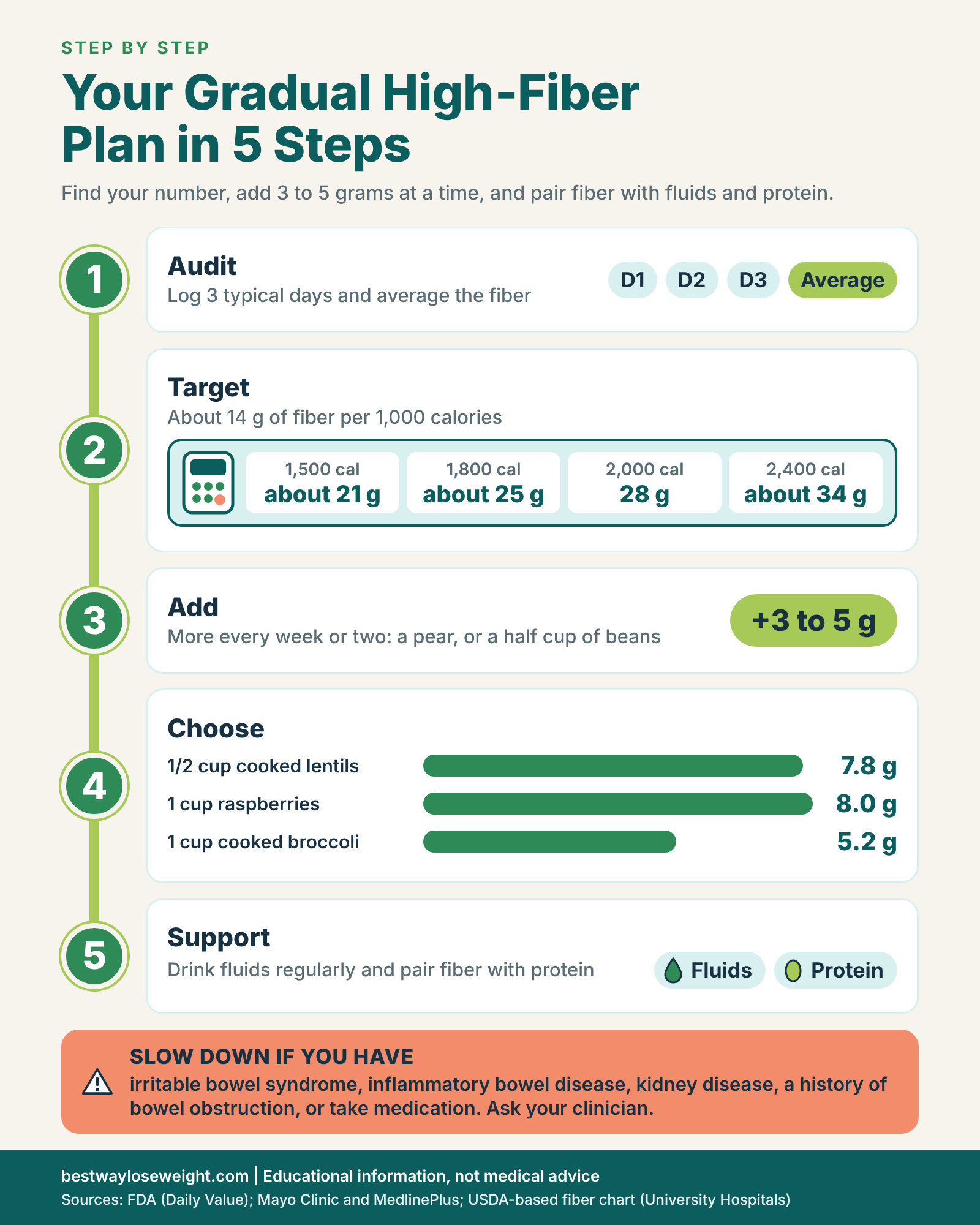
The standard targets above are built on the idea that fiber needs scale with how much you eat, at roughly 14 grams of fiber per 1,000 calories. Multiply your daily calorie intake (not a crash-diet number, but what you actually plan to eat) by 14 and divide by 1,000. Your calorie estimate can come from the approach in the TDEE calculator guide, adjusted for your planned deficit.
Worked examples
The arithmetic is simple, and it shows why a one-size-fits-all number isn’t ideal for someone eating less than average:
- 1,500 calories a day: 1.5 × 14 = 21 grams
- 1,800 calories a day: 1.8 × 14 = 25 grams (25.2, rounded)
- 2,000 calories a day: 2.0 × 14 = 28 grams (the FDA Daily Value)
- 2,400 calories a day: 2.4 × 14 = 34 grams (33.6, rounded)
Because weight loss usually involves eating somewhat fewer calories than maintenance, the formula tends to produce a target that’s a little lower than the age-based charts. Many people eating in a deficit still try to reach the age-based number, and that’s reasonable if they tolerate it. Neither is a hard cutoff.
When to aim higher or lower than the formula
Aim for the higher of the two numbers if you’re comfortable with fiber and want a long-term goal. Aim lower, and ramp slowly, if your gut is sensitive or you currently eat very little fiber. Studies in the research table above that looked at higher intakes (for example, the Lancet analysis pointing to benefits at 25 to 29 grams) are about population health, not a requirement to hit a specific gram count each day. Day-to-day variation is normal. Aim for an average across the week.
Where you are now, and a realistic first step
Most adults in the U.S. fall well short of recommendations. MedlinePlus puts average intake at about 16 grams a day, and a 2025 analysis of NHANES data found a very similar figure of 16.6 grams. A quick self-audit makes the target concrete.
A three-day fiber audit
For three ordinary days (include one weekend day), write down what you eat and look up the fiber in each food on the label or in a free food database such as USDA FoodData Central. Add it up and divide by three. Don’t change anything yet. If your average is 12 grams, your first goal isn’t 38. It’s 15 to 17 grams for two weeks, then a bit more.
A simple step-up rule
Add roughly 3 to 5 grams of fiber a day every week or two until you reach your target. That’s about one extra serving of beans, a pear, or a cup of cooked vegetables. A slower ramp costs you nothing and avoids the cramps and gas that make people think fiber “doesn’t agree” with them.
| Daily calories | Formula target (14 g per 1,000 calories) | Common first goal if you now eat about 12 g | Comment |
|---|---|---|---|
| 1,500 | About 21 g | 15 to 17 g for 2 weeks | Close to the lower end of the general adult range |
| 1,800 | About 25 g | 15 to 18 g for 2 weeks | Matches the benchmark for women 50 and younger |
| 2,000 | 28 g | 16 to 19 g for 2 weeks | Equals the FDA Daily Value |
| 2,400 | About 34 g | 17 to 20 g for 2 weeks | Above the 30 g benchmark for men over 50 and below the 38 g figure for younger men |
The Best High-Fiber Foods for Weight Loss, Group by Group
A useful high-fiber food has two traits: plenty of fiber per serving and a reasonable number of calories for the amount you’d actually eat. The groups below are ranked by how easy they make that combination. For a wider look at filling foods beyond fiber, see the guide to the best foods for weight loss.
Beans, peas, lentils, and chickpeas (pulses)
If you only add one food group, make it this one. Pulses deliver fiber, plant protein, and slowly digested carbohydrate in the same serving. The 2025 to 2030 Dietary Guidelines for Americans list beans, peas, lentils, legumes, nuts, seeds, and soy among plant-sourced protein foods, which is one reason they pair so well with weight management goals.
Why pulses lead the list
According to a USDA-based fiber chart, one-half cup of cooked lentils supplies about 7.8 grams of fiber, one-half cup of navy beans about 9.6 grams, and one-half cup of chickpeas about 6.3 grams. For roughly 115 to 135 calories, that’s a quarter to a third of a day’s target. They’re also inexpensive. The pulse trials summarized earlier used about three-quarters of a cup a day, which is more than most people will eat right away, so scale up gradually.
Canned, dried, or frozen: what’s practical
Canned beans are fine. Draining and rinsing them reduces sodium noticeably, and many brands offer low-sodium versions. Dried beans cost less per serving but need soaking and cooking time, and lentils and split peas cook without soaking in about 20 to 30 minutes. Frozen peas, edamame, and lima beans are quick additions to almost any dish. If beans give you gas, start with a few tablespoons, rinse canned beans well, and keep the portion steady for a week or two so your gut bacteria adapt.
Vegetables and fruit
Produce is the second pillar. It’s lower in fiber per cup than beans, but it’s extremely low in calories for the volume, and it can fill half the plate.
The vegetables that pull their weight
From the same USDA-based chart: one cup of cooked broccoli has about 5.2 grams of fiber, a cup of cooked sweet potato about 6.3 grams, and a cup of green beans about 4.0 grams. Artichokes, Brussels sprouts, peas, carrots, and leafy greens such as kale are other reliable contributors. Keeping edible peels on (potatoes, carrots, cucumbers) adds fiber, which MedlinePlus also recommends. Frozen vegetables are as practical as fresh and often cheaper, and the Mediterranean-style eating pattern already puts them at the center of the plate.
Fruit: choose whole, and lean on berries, pears, and apples
One cup of raspberries has about 8 grams of fiber, a medium pear about 5.5 grams, an apple with skin about 4.8 grams, and a medium banana about 3.2 grams. Juice removes most of the fiber and is far easier to drink in quantity, so whole fruit is the better tool for fullness. Dried fruit retains its fiber but concentrates the calories and sugar into a small portion, so measure it rather than snacking from the bag.
Whole grains, oats, seeds, and nuts
Whole grains still have a place in a weight-loss plan. The 2025 to 2030 Dietary Guidelines emphasize fiber-rich whole grains and discourage heavily refined grains. They’re a mixed bag by fiber density, so choose the ones that are both fibrous and intact.
Oats, barley, bulgur, popcorn, and whole-grain breads
One-half cup of cooked bulgur provides about 4.1 grams of fiber and one-half cup of pearled barley about 3.0 grams; three cups of popcorn provide about 5.8 grams, and shredded wheat cereal about 6.2 grams per cup (check the label of your brand). Oats and barley are rich in beta-glucan, the viscous fiber that FDA recognizes in a heart-health claim at 3 grams or more per day of beta-glucan soluble fiber from whole oats or barley, with at least 0.75 gram per serving of the product. For bread, look for the word “whole” first in the ingredient list and compare fiber per slice.
Chia, flax, and nuts: real fiber with a calorie catch
One tablespoon of chia seeds delivers about 4.1 grams of fiber for roughly 60 calories, which is a great ratio. One ounce of almonds provides about 3.5 grams of fiber but around 165 calories. Nuts and seeds are nutritious and filling and have a place in a healthy-weight diet. They just require a spoon or a small handful, not an open-ended snack bag.
| Food and serving | Fiber (g) | Approx. calories | Fiber per 100 calories (approx.) | Practical note |
|---|---|---|---|---|
| Raspberries, 1 cup | 8.0 | about 65 | about 12 g | Frozen works well; thaw in oatmeal |
| Broccoli, cooked, 1 cup | 5.2 | about 55 | about 9 to 10 g | Frozen is cheap and ready |
| Green beans, 1 cup | 4.0 | about 45 | about 9 g | Easy side dish |
| Navy beans, 1/2 cup cooked | 9.6 | about 130 | about 7 g | Great in soups and chili |
| Lentils, 1/2 cup cooked | 7.8 | about 115 | about 7 g | No soaking; cooks in about 20 to 30 minutes |
| Chia seeds, 1 tablespoon | 4.1 | about 60 | about 7 g | Absorb liquid; add water |
| Popcorn, air-popped, 3 cups | 5.8 | about 95 | about 6 g | Skip heavy butter and salt |
| Bulgur, cooked, 1/2 cup | 4.1 | about 75 | about 5 g | Cooks fast; rice substitute |
| Pear, medium | 5.5 | about 100 | about 5 g | Eat the skin |
| Apple with skin, medium | 4.8 | about 95 | about 5 g | Portable and cheap |
| Chickpeas, 1/2 cup cooked | 6.3 | about 135 | about 5 g | Roast, blend, or add whole |
| Sweet potato, cooked, 1 cup | 6.3 | about 180 | about 3 to 4 g | More calories per cup; filling |
| Banana, medium | 3.2 | about 105 | about 3 g | Lower fiber; convenient |
| Oats, cooked, 1 cup | about 4 | about 160 | about 2 to 3 g | Fiber per calorie is modest, but it’s filling and heart-friendly |
| Almonds, 1 oz | 3.5 | about 165 | about 2 g | Measure the portion |
Fiber grams come from a USDA-based fiber chart; calories and the per-100-calorie figures are rounded approximations that vary by brand, ripeness, and preparation, so use the label or USDA FoodData Central for precision. The oats figure is a typical rounded value.
How to Read Labels and Spot Real Fiber
Grocery aisles are full of “high fiber” claims, and not all of them mean the same thing. A few minutes with the label keeps you from paying extra for a bar that doesn’t help.
Reading the Nutrition Facts panel
Three lines tell you most of what you need: serving size, calories, and dietary fiber.
Use the 5% and 20% rule
Per the FDA, 5% DV or less of a nutrient per serving is low and 20% DV or more is high. For fiber, with a Daily Value of 28 grams, that works out to roughly 1.4 grams (low) and 5.6 grams (high) per serving. Under FDA claim rules, a food described as “high in,” “rich in,” or an “excellent source of” fiber should meet the 20% mark, and “good source” generally means 10% to 19% (about 2.8 to 5.3 grams). Check that the serving size matches how much you’d really eat, since a tiny serving can make a number look better than your real bowl.
Compare fiber against calories and added sugar
A rough ratio check: look for at least 1 gram of fiber for every 100 calories in a snack or bread (a rule of thumb, not an official standard). Cereals with 8 grams of fiber and 12 grams of added sugar per serving may not be a better choice than plain oats with berries. If added sugar is much higher than fiber, the “high fiber” claim is doing marketing work.
Whole grain terms that sound better than they are
“Fiber” and “whole grain” aren’t the same thing. A bread can be made with some whole grain and still have little fiber.
Phrases to read twice
“Multigrain” only means more than one grain, and those grains may be refined. “Wheat bread” can be colored brown without being whole wheat. “Made with whole grain” can mean a small amount. A better sign is “100% whole wheat” or “100% whole grain,” with a whole grain listed as the first ingredient. A 3-gram fiber-per-slice bread is a decent target, though not every great loaf will reach it.
Why whole matters beyond the grams
Intact or minimally processed grains (steel-cut oats, barley, bulgur) tend to digest more slowly than finely milled flour, even when the fiber numbers look similar. If you want a short rule: the less processed the grain, the better it usually works for fullness.
Added fibers, protein bars, and “net carbs”
Many packaged products now list isolated fibers in the ingredient list, such as inulin, chicory root fiber, or polydextrose.
What added fibers do and don’t offer
Isolated fibers raise the number on the label and may help with stool bulk or fermentation, but they don’t bring the vitamins, minerals, and plant compounds of beans or berries. Some people also get gas or loose stools from large amounts of inulin-type fibers, especially in the first week. They’re not harmful for most people, and they can be a convenience. They’re just not the same as a plate of lentils and vegetables.
Net carbs are a marketing term
“Net carbs” subtracts fiber (and sometimes sugar alcohols) from total carbohydrate, and it’s not an official Nutrition Facts category. If you’re comparing products, look at the actual total carbohydrate, fiber, added sugar, and calories on the standard panel.
| What you see | What it generally means | What to check next |
|---|---|---|
| “Excellent source,” “high in,” or “rich in” fiber | 20% DV or more per serving (about 5.6 g or more) | Serving size, calories, added sugar |
| “Good source of” fiber | 10% to 19% DV per serving (about 2.8 to 5.3 g) | Whether the product is a whole food |
| “Made with whole grain” | Some whole grain; the amount isn’t stated by the phrase | Ingredient order and fiber grams |
| “100% whole grain” or “100% whole wheat” | All grain ingredients are whole grain | Fiber per slice or serving |
| “Net carbs” | Not an FDA label category; set by the manufacturer | Standard panel numbers |
| Added fibers in the ingredients | Isolated fibers raise the label total | Tolerance; compare with whole-food options |
Building High-Fiber Meals: Swaps, Sample Days, and Protein Pairing
Knowing the best foods is only half the job. The other half is fitting them into breakfast, lunch, dinner, and the 3 p.m. slump without a complete rebuild of how you eat. The ideas below favor small swaps first.
Swaps that add fiber without adding many calories
Most people do better replacing something than adding on top, which is why each swap below is a trade rather than an extra.
Breakfast swaps
Replace sugary cereal or a pastry with plain oatmeal topped with berries and a spoonful of chia, a bran-flake or shredded-wheat cereal with fruit, or Greek yogurt with raspberries and a sprinkle of oats or nuts. Eggs and whole-grain toast with sliced avocado also work, though the fiber depends on the bread. If mornings are rushed, overnight oats made the night before take about five minutes and reheat or travel easily.
Lunch and dinner swaps
Swap half the rice or pasta for beans, lentils, or bulgur, or serve a smaller portion of grain alongside a bigger portion of vegetables. Replace white-flour wraps with whole wheat tortillas. Add a half cup of beans to soup, salad, or tacos. Top a baked potato with broccoli and cottage cheese or chili rather than only butter and sour cream. Frozen vegetables stirred into a pan of stir-fry, soup, or pasta sauce quietly add 3 to 5 grams of fiber without extra prep.
Three sample days with the fiber added up
The table below shows how three different eating styles can reach a realistic fiber total. Fiber numbers use the USDA-based chart values listed earlier and rounded typical values for oats and mixed vegetables, so treat the totals as approximate. These aren’t meal plans for a specific calorie goal, and they leave plenty of room for protein, dairy or alternatives, and fats. For complete structured menus, see the 7-day weight loss meal plan and the 14-day weight loss meal plan.
How to use the sample days
Pick the column closest to your calorie level and adapt it. The starter day suits someone eating around 1,800 calories who currently averages low fiber. The higher-calorie day fits an eating pattern near 2,400 calories. The budget day relies on pantry staples and frozen produce. Notice that the “solid” days land at or above the formula target without any supplements.
What the totals show
The starter day reaches about 25 grams with ordinary grocery items. The budget day hits about 32 grams while leaning on canned beans, oats, popcorn, and frozen vegetables. A single serving of lentils or chickpeas often contributes more fiber than all the other foods in the meal combined, which is why pulses show up in two of the three columns.
| Meal | Starter day (about 25 g) | Higher-calorie day (about 34 g) | Budget day (about 32 g) |
|---|---|---|---|
| Breakfast | 3/4 cup bran flakes with milk and a banana: 5.5 + 3.2 = 8.7 g | 1 cup cooked oatmeal with a banana: about 4 + 3.2 = 7.2 g | 1 cup cooked oatmeal with a banana: about 7.2 g |
| Lunch | Turkey and vegetable wrap in a whole wheat tortilla: 2.8 + about 1 = about 4 g | Lentil and broccoli bowl: 1/2 cup lentils 7.8 + 1 cup broccoli 5.2 = 13.0 g | Chickpea salad: 1/2 cup chickpeas 6.3 + cucumber and tomato about 1 = about 7 g |
| Snack | Apple with skin: 4.8 g | 1 oz almonds: 3.5 g | 3 cups air-popped popcorn: 5.8 g |
| Dinner | Chicken with green beans and bulgur: 4.0 + 4.1 = 8.1 g | Salmon with sweet potato and green beans: 6.3 + 4.0 = 10.3 g | Lentils over green beans: 1/2 cup lentils 7.8 + 1 cup green beans 4.0 = 11.8 g |
| Day total | About 25 g | About 34 g | About 32 g |
Pairing fiber with protein so meals last longer
Fiber and protein are the two nutrients most often linked to feeling full after a meal, and they complement each other. A bowl of lentil soup with a spoonful of Greek yogurt, or oatmeal with milk and nuts, brings both. Details on protein targets are in the guide to how much protein you need to lose weight, and the high-protein diet guide covers how to fit it around a calorie goal.
A plate framework that builds in both
One flexible approach: fill about half the plate with vegetables or fruit, a quarter with a protein food, and a quarter with a fiber-rich starch such as beans, lentils, barley, or whole grain. Beans and lentils count as both protein and starch, so a bean-based plate can have a smaller separate protein portion. Adjust the proportions to your appetite, activity, and preferences. It’s a starting point, not a rule.
Breakfast is the easiest place to start
If you only change one meal, breakfast usually offers the cleanest swap. Many typical American breakfasts (pastries, sweetened cereal, white toast) deliver 1 to 2 grams of fiber, while oatmeal with berries and chia can deliver 10 or more. Starting the day higher also makes it simpler to land near your target without heroic dinners.
Adding Fiber Without Gas, Bloating, or Constipation
The most common reason people give up on high-fiber eating isn’t taste. It’s a rough first week. A good ramp avoids most of that.
A four-week ramp-up plan
The principle is to change one thing at a time and let your gut adapt. MedlinePlus and Mayo Clinic both advise adding fiber gradually over several weeks, and MedlinePlus notes that gas, bloating, and cramps typically settle as digestive bacteria adapt.
Weeks 1 and 2: establish the baseline
- Do the three-day audit and note your daily average.
- Add 3 to 5 grams per day: for instance, a pear plus a half cup of berries, or a half cup of beans in one meal.
- Drink fluids regularly across the day. MedlinePlus suggests about eight glasses of water or other noncaloric beverages.
- Keep the new level steady for the full two weeks, even if you feel good enough to jump ahead.
Weeks 3 and 4: add the next layer
- Add another 3 to 5 grams, ideally from a different food type (vegetable one step, whole grain the next).
- Build toward your formula target, not past it. There’s no prize for 50 grams.
- Note how you feel after meals. Mild gas is common early on. Pain, vomiting, or no bowel movements for several days is not normal and deserves a call to your clinician.
- Hold the new level for a week, then reassess.
Troubleshooting digestive side effects
Different symptoms have different causes and fixes, so it’s worth matching the fix to the symptom.
Gas and bloating
Gas is a normal consequence of bacteria fermenting fiber. It’s most noticeable with beans, onions, cabbage-family vegetables, and added inulin-type fibers. Try smaller portions, rinse canned beans, spread fiber across meals instead of loading dinner, and give any new food two weeks. If bloating persists or comes with pain, weight loss you didn’t intend, or blood in the stool, talk with a clinician rather than self-treating with more fiber.
Constipation that gets worse instead of better
Fiber usually helps constipation, but a sudden increase without enough fluid, or a diet that’s heavy in insoluble bran with little else, can make stools harder and slower. Mayo Clinic notes that if symptoms persist despite more fiber, a clinician should check for other causes, since constipation can signal a different problem. Medications (including some pain medicines, iron, and GLP-1 medications) can also play a role.
| If you notice | A common reason | What to try first | When to call a clinician |
|---|---|---|---|
| Gas and bloating in week 1 | Gut bacteria haven’t adapted; too much, too fast | Cut the added amount in half; keep it steady for 1 to 2 weeks | Severe pain, vomiting, or symptoms that persist beyond several weeks |
| Gas mostly after beans | Fermentable carbohydrates in pulses | Start with 2 to 3 tablespoons; rinse canned beans; try lentils, which many people tolerate more easily | If any beans cause significant pain |
| Harder, less frequent stools | Too little fluid; too much bran alone | Drink fluids regularly; add fruit, vegetables, and oats instead of bran only; walk daily | No bowel movement for several days, or blood in stool |
| Looser stools | Large doses of added fibers, sugar alcohols, or sudden jumps | Reduce products with added fibers; check the ingredient list for polyols | Diarrhea lasting more than a few days |
| Feeling too full to eat enough protein | Fiber volume crowding out other foods | Eat protein first at the meal; trim a portion of vegetables or grains, not protein | If you’re losing weight faster than planned or feel weak |
Fluids, movement, and timing
Three small habits make a high-fiber plan feel better day to day.
Fluids with fiber
Soluble fiber binds water, and insoluble fiber moves it along. If water intake is very low, extra fiber can slow things down. You don’t need a gallon. Drinking regularly through the day, plus a glass with the high-fiber meals, is a solid starting point.
Daily movement and meal timing
A short walk after eating can help digestion for many people, and regular activity supports bowel regularity in general. The walking for weight loss guide explains how to build that habit. If big, fiber-rich dinners leave you uncomfortable at night, shift some of the fiber to breakfast and lunch.
Fiber Supplements vs. Food: When Each Makes Sense
Powders, capsules, gummies, and “fiber-fortified” snacks are easy to buy and easy to overestimate. They can have a role, but they work differently from a bowl of beans. Here’s how to think about the choice.
Why whole foods come first
For most people trying to lose weight, food is the better first move, for reasons that go beyond fiber grams.
What supplements leave out
Mayo Clinic’s gastroenterology guidance prefers whole foods over supplements, noting that supplements usually contain only one type of fiber rather than the variety found in foods, and that they don’t provide the micronutrients. A cup of lentils, for example, brings protein, iron, folate, potassium, and fiber in one low-cost package. A fiber powder brings fiber. Food also gives you chewing, volume, and the satisfaction of an actual meal, which is much of why high-fiber eating helps with fullness in the first place.
When food alone isn’t practical
Some situations make supplements a reasonable conversation to have with a clinician or dietitian: a medically supervised plan with limited food variety, certain bowel conditions, or a long-standing struggle to reach intake targets despite real effort. Even then, the goal is usually to complement food, not replace it.
What the evidence says about supplements, and the cautions
Supplement trials are some of the best data we have on fiber and weight, but they come with limits.
Soluble fiber supplements: modest effects over months
As summarized earlier, a 2022 meta-analysis found about 1.25 kg more weight reduction with isolated soluble fiber supplements taken for 12 weeks or longer, at an average dose near 11 grams a day. The FDA also permits a heart-health claim for psyllium husk at 7 grams a day or more (with at least 1.7 grams per serving) as part of a diet low in saturated fat and cholesterol. That’s a cholesterol claim, not a weight-loss one. A supplement can be a reasonable add-on, but treat the average effect as small and individual.
Start low, drink fluids, and mind your medications
Mayo Clinic warns that fiber supplements may cause abdominal bloating, cramping, and gas, especially at a high starting dose, so begin with a small amount and build slowly. The same guidance says fiber can reduce the absorption of some medicines, including thyroid medication, some antidepressants, and diabetes drugs, and suggests taking medications one hour before or two hours after fiber. It also cautions against taking more than 50 grams a day from supplements. Always follow the product label, which usually calls for a full glass of fluid. Anyone with swallowing difficulty, a narrowed bowel, or a history of bowel obstruction should ask a clinician before using fiber supplements. If you take prescription medication, a pharmacist can help you set the timing.
Gummies, bars, and fortified foods
These products sit between whole foods and plain supplements, and they vary widely.
Fiber gummies and chews
Gummies are convenient but often provide only a gram or two of fiber per serving, which means the label serving may need to be several pieces to match even a pear. Check the grams, the added sugar, and the serving size before assuming they’re equivalent to food.
Bars, cereals, and “protein-and-fiber” snacks
A bar with 10 grams of fiber from added chicory root fiber and 300 calories is not the same as an apple and a small handful of nuts. Some are useful travel snacks. Use the label: compare fiber, protein, added sugar, and calories, and don’t let a front-of-package claim stand in for the Nutrition Facts panel.
Making High-Fiber Eating Work on a Budget, a Schedule, and Special Diets
Advice that ignores money, time, and family doesn’t survive Wednesday. This section covers the constraints that most often derail good intentions.
A budget-friendly high-fiber shopping list
Fiber-rich foods are among the most affordable foods in the store, particularly the shelf-stable ones. A short list covers most needs.
Pantry and freezer staples
Build around rolled or steel-cut oats, dried or canned lentils and beans (low-sodium when you can), canned chickpeas, brown rice or barley, bulgur, popcorn kernels, whole wheat pasta or tortillas, and frozen broccoli, green beans, peas, and berries. Add chia or ground flaxseed if you like them. Fresh apples, pears, carrots, cabbage, and bananas are typically inexpensive and keep well. None of these needs to be organic or specialty to work.
Ways to keep the bill down
Buy dried beans and lentils in bulk, since they stretch to many servings; choose store-brand canned beans; buy frozen produce, which wastes less; and cook large pots of soup or chili with beans and freeze portions. Because beans and lentils also supply protein, they can replace some of the costlier meat in a meal. Prices vary by region and store, so compare the cost per serving rather than per package.
Busy schedules, restaurants, and family meals
The question isn’t whether you have time for fiber. It’s whether the fiber is already in the meals you grab.
Batch cooking and grab-and-go options
Spend 30 to 40 minutes once a week on a pot of lentils or bean chili, a tray of roasted vegetables, and a batch of overnight oats. Keep apples, pears, baby carrots, and single-serve popcorn at hand for snacks. A can of beans stirred into almost any frozen meal is the fastest upgrade there is. Canned soups with beans or lentils can work in a pinch, though many are high in sodium, so check the label.
Eating out and cooking for a family
At restaurants, look for bean-based sides, vegetable sides, side salads, soups that contain beans or lentils, and whole-grain options such as brown rice, when offered. Fast food is usually the hardest place; a side of beans, a salad, or fruit can help. At home with kids or a partner, add the extra fiber gradually and keep the base meal familiar, for example blending lentils into a pasta sauce or mixing half beans and half meat in tacos. Children’s fiber needs differ from adult needs, and a pediatrician or dietitian can guide families with specific concerns.
Low-carb, gluten-free, plant-based, and older-adult eating patterns
Fiber isn’t an all-or-nothing nutrient. You can reach a good intake across different eating styles, but each has a predictable weak spot.
Low-carb and gluten-free patterns
Lower-carb diets often cut beans, fruit, and whole grains, which are major fiber sources, so intake can drop without anyone noticing. The low-carb diet guide covers the trade-offs. Within a lower-carb pattern, non-starchy vegetables, berries, avocado, chia, flax, nuts, and seeds are the main fiber sources. For people with celiac disease or non-celiac gluten sensitivity, Mayo Clinic notes that wheat-based fiber sources aren’t appropriate. Gluten-free fiber options include beans, lentils, vegetables, fruit, quinoa, brown rice, buckwheat, and oats that are labeled gluten-free.
Plant-based eating and older adults
Vegetarian and vegan diets often exceed fiber targets by default. If intake is very high, MedlinePlus notes that large amounts of fiber can interfere with the absorption of minerals such as iron, zinc, magnesium, and calcium, so variety and attention to those nutrients matter. For adults over 50, the benchmarks drop to 21 grams for women and 30 grams for men, and chewing or dental problems may make raw vegetables and tough grains hard. Cooked, mashed, or blended options such as lentil soup, oatmeal with stewed fruit, and well-cooked beans keep fiber accessible. The guide to weight loss after 50 covers other age-related considerations such as muscle and appetite.
Who Should Be Careful With a High-Fiber Plan
For most healthy adults, eating more fiber-rich foods is a low-risk change. For some people, the right amount, type, and speed are different. This section is about safety, not scare tactics, and it’s the part of the article where “ask your clinician first” is the real answer, not a disclaimer.
Digestive conditions where fiber advice is individualized
Fiber is helpful in many bowel conditions and troublesome in others, depending on the condition, the phase, and the type of fiber.
Irritable bowel syndrome, inflammatory bowel disease, and diverticular disease
People with irritable bowel syndrome often find that some fibers (for example, coarse wheat bran or certain fermentable carbohydrates) worsen gas and pain while others are better tolerated. People with inflammatory bowel disease may be advised to limit fibrous raw vegetables, skins, seeds, and nuts during flares or when the bowel is narrowed, and people recovering from a diverticulitis flare are usually given phase-specific guidance. Because the advice differs by person and by phase, a gastroenterologist or registered dietitian should guide your fiber plan if you have one of these conditions.
Bowel obstruction, bowel surgery, gastroparesis, and swallowing problems
A history of bowel obstruction, a narrowed intestine, recent abdominal or bariatric surgery, delayed stomach emptying (gastroparesis), or difficulty swallowing can all make high-fiber foods or fiber supplements unsafe or uncomfortable. Surgical teams typically give staged eating instructions after bariatric surgery, and those instructions take priority over general guides like this one.
Medications and other health conditions
Fiber can interact with how some medicines are absorbed and with how blood sugar behaves, so a few groups need a plan with their care team.
Diabetes medications and GLP-1 medications
Higher-fiber eating can change blood sugar patterns, which is often beneficial but can matter for people who take insulin or other glucose-lowering medicines. Changes to medication belong to your prescriber, not to a food swap, so tell your clinician before making large diet changes. Many people taking GLP-1 medications report reduced appetite and digestive effects such as constipation, so fiber and fluid choices are worth discussing with the prescribing clinician. Our guide to GLP-1 medications covers what these medicines are and what to ask. As noted earlier, some medications should be taken one hour before or two hours after fiber supplements.
Kidney disease and mineral concerns
Many fiber-rich foods (beans, whole grains, some vegetables and fruit) are also higher in potassium and phosphorus. People with chronic kidney disease are sometimes advised to limit these minerals, and a renal dietitian can balance fiber with kidney safety. Anyone at risk of low iron, zinc, calcium, or magnesium should also keep in mind MedlinePlus’s note that very large fiber intakes may interfere with absorption of those minerals.
Pregnancy, breastfeeding, adolescents, and eating-disorder history
Fiber-rich foods are a normal part of a healthy diet in pregnancy and breastfeeding, but weight-loss dieting during those times is a decision for an obstetric clinician. Teens and children have different fiber and calorie needs, and a pediatric clinician or dietitian is the right guide. If you have a history of an eating disorder, counting grams of fiber or aiming for “fullness” through food volume may be unhelpful or triggering. Choose a plan with a clinician who understands your history.
Symptoms that shouldn’t be managed at home
A few signs mean the issue isn’t about fiber at all.
Seek prompt medical care for
Severe or worsening abdominal pain, repeated vomiting, a swollen and rigid abdomen, an inability to pass stool or gas, black or bloody stools, or fainting should be evaluated promptly, not adjusted with more or less fiber.
Book an appointment for
A new, lasting change in bowel habits, unintentional weight loss, persistent bloating, or constipation that doesn’t improve after a few weeks of gradual changes is worth a visit, in line with Mayo Clinic’s advice that constipation which persists despite more fiber may signal an underlying disorder that needs different treatment.
Common Mistakes and What to Do If the Scale Doesn’t Move
Adding fiber is simple, and so are the mistakes. Most of them come from expecting one food to do the whole job.
Why calories per bite matter: a 100-calorie comparison
Fiber is one reason some foods feel bigger on the plate. The table below compares approximate 100-calorie portions, which makes the difference in volume and fiber visible. This is an illustration of energy density, not a shopping rule: every food in the table can fit a healthy diet.
What the comparison shows
A 100-calorie serving of raspberries is about a cup and a half, while 100 calories of potato chips is closer to ten chips. The fiber varies just as widely: about 12 grams in the berries versus under 1 gram in the chips. The comparison doesn’t mean chips are forbidden. It means that if hunger is the problem, building meals from foods in the top half of the table gives you more food and more fullness for the same calorie budget.
What it doesn’t show
Fullness is more than fiber and volume. Protein, fat, how fast you eat, how much you enjoy the food, and your sleep all influence how long a meal satisfies you. A food that is not high in fiber (such as Greek yogurt or an egg) can still be a smart, filling choice.
| Food | About 100 calories looks like | Approx. fiber |
|---|---|---|
| Raspberries | About 1 1/2 cups | About 12 g |
| Cooked lentils | A little under 1/2 cup | About 7 g |
| Apple with skin | 1 medium apple | About 5 g |
| Air-popped popcorn | About 3 cups | About 6 g |
| Cooked oatmeal | About 5/8 cup | About 2.5 g |
| Apple juice | A bit under 1 cup | Under 1 g |
| Potato chips | About 2/3 ounce, or around 10 chips | Under 1 g |
Five mistakes that quietly cancel the benefit
Each of these is common, fixable, and nothing to feel bad about.
Treating “high fiber” as a license to eat more
A high-fiber granola, trail mix, or bar can easily pack 400 to 600 calories into a small serving. Look at calories and portion size before you look at fiber. If you love granola, measure it as a topping, not a bowl.
Jumping from 12 grams to 40 in a weekend
A rapid increase is the surest way to feel miserable and quit. Use the ramp-up plan above: 3 to 5 additional grams at a time, with fluids.
Letting fiber crowd out protein
If a very fibrous plate leaves you too full to eat enough protein, you might end up hungry later or lose more muscle than you’d like during weight loss. Eat the protein portion first, and use fiber-rich foods to round out the meal.
Relying on juice, smoothies, or bars instead of whole foods
Juice removes most fiber. Blended smoothies keep fiber but are easier to drink fast and can hide a lot of calories. They can work, but they don’t provide the chewing and slower pace of whole foods.
Expecting a straight line on the scale
Adding fiber changes how much food sits in your digestive tract, and body weight on the scale can bounce by a pound or two from day to day for reasons that have nothing to do with fat. Look at the trend over weeks, not a single weigh-in.
If your weight isn’t moving: an if-then guide
If you’ve added fiber for a few weeks and the scale hasn’t budged, work through the possibilities in order.
If you’re still hungry
Check protein first, since fiber alone rarely carries a meal. Check sleep, because short sleep tends to increase appetite (see the sleep and weight loss guide). Check whether the fiber is spread across the day, and whether your fluid intake is steady. Consider whether you’re skipping meals and getting overly hungry at night. If hunger remains intense, discuss it with a clinician rather than cutting calories further.
If the scale is flat or creeping up
Count the calorie-dense “healthy” additions (nuts, olive oil, avocado, granola, dried fruit) for a week. They often explain a stall. Then review the broader picture in the weight loss plateau guide and reconfirm your calorie estimate using the calorie deficit approach. For the overall framework that ties food, activity, sleep, and medical context together, return to the complete guide to losing weight safely.
Frequently Asked Questions About High-Fiber Foods and Weight Loss
These questions cover points not fully answered above.
Amounts and basics
Can you eat too much fiber?
Yes, in practical terms. Very large intakes, especially when increased quickly, commonly cause gas, bloating, cramping, and loose or hard stools. Mayo Clinic advises against exceeding 50 grams a day from supplements, and MedlinePlus notes that very large fiber intakes may interfere with absorption of iron, zinc, magnesium, and calcium. For most adults, reaching 25 to 38 grams from varied foods, depending on age and sex, is well within the range typically studied, but anyone with a digestive condition or kidney disease should follow personalized guidance.
Do the 2025 to 2030 Dietary Guidelines still recommend fiber-rich foods?
Yes, though the emphasis is framed around food types. The edition released in January 2026 prioritizes fiber-rich whole grains over refined grains, names beans, peas, lentils, nuts, seeds, and soy among plant-sourced protein foods, and calls for limiting highly processed foods and refined carbohydrates. Summary materials list 2 to 4 servings of whole grains a day. Some nutrition professionals commenting on the release noted that fiber was less directly emphasized than in earlier editions. The FDA Daily Value for fiber remains 28 grams on labels. Check the current official documents when you read this, since guidance pages can be updated.
Should I subtract fiber grams from my calorie count?
Generally no. Most apps and labels count fiber as part of total carbohydrate and calories, and the energy fiber supplies, if any, is small and varies by type. Some fermentable fibers yield a few calories after bacteria process them, while others yield almost none. The simplest approach is to log what the label says. If you’re trying to be precise, remember that calorie labels carry their own margin of error anyway.
Is soluble or insoluble fiber better for weight loss?
Viscous soluble fibers (oat and barley beta-glucan, psyllium, pectin) are the ones most often linked to slower digestion and greater fullness in studies. Insoluble fiber helps with stool bulk and regularity, which matters for comfort. You don’t need to choose, because most whole foods contain both. Eating a variety of beans, oats, fruit, vegetables, and whole grains covers both without tracking either one.
Foods and cooking
Are beans fattening?
Not in the way the question implies. A half cup of cooked lentils or beans contains roughly 115 to 135 calories, with a lot of fiber and protein for that energy. A 2016 meta-analysis of trials found slightly greater weight loss, about 0.34 kg, in people who ate roughly 130 grams of pulses daily without other diet changes. Beans can contribute to weight gain if the recipe is heavy on oil, cheese, or fatty meat, or if portions are very large, as with any food.
Is whole fruit too sugary for a weight-loss plan?
Whole fruit comes packaged with fiber and water, which slow eating and add bulk. A cup of raspberries has about 8 grams of fiber and around 65 calories. Fruit juice and dried fruit are more concentrated and easier to overeat. For most people, whole fruit is a smart part of a weight-loss diet. People with diabetes may want to match fruit portions with their care team’s advice.
Is oatmeal good for weight loss?
Plain oatmeal is a reasonable option because it’s inexpensive, contains beta-glucan, and keeps many people full through the morning, particularly when paired with protein such as milk, yogurt, or nuts. The issues are in the add-ons: flavored instant packets can have a lot of added sugar, and generous scoops of brown sugar, dried fruit, or nut butter can raise a 160-calorie bowl to 500. Rolled or steel-cut oats with berries and a measured spoonful of nuts or seeds is a solid starting point.
Does cooking or canning destroy fiber?
Cooking softens fiber and makes foods easier to chew, but it doesn’t destroy it. Canned beans and vegetables keep most of their fiber, though canned beans can be high in sodium unless you rinse or buy low-sodium versions. If you boil vegetables, some soluble fiber and nutrients can leach into the water, which is one more reason to steam, roast, or add the cooking liquid to soups.
Habits, expectations, and your body
Do I need to count fiber grams every day?
No. A short audit now and then is enough for most people. A more reliable habit is to include a pulse, a fruit or vegetable, and a whole grain across the day and check your average over a week. If counting numbers stresses you or has been a problem in the past, skip tracking and focus on food groups instead.
How long before I notice a difference in fullness or weight?
Some people notice a difference in how satisfied they feel within the first week or two, once digestion adjusts. Changes in weight are slower, smaller, and less predictable. The trials above measured differences of around a third of a kilogram to a bit over a kilogram across weeks to months, on average. Judge progress using several measures: energy, hunger, digestion, and the trend on the scale over a month or more.
Can high-fiber foods target belly fat?
No. No food, including fiber-rich ones, can choose where your body loses fat. Observational studies link higher fiber intake with a lower waist circumference and lower obesity rates, but that reflects overall diet quality and calorie balance, not a special effect on the abdomen. A better focus is a sustainable overall pattern, with strength training and walking where possible.
Can I reach my fiber target on 1,500 calories without feeling stuffed?
Usually yes, because the target scales with calories, at about 21 grams for 1,500 calories on the 14 grams per 1,000 calories formula. Choose the foods with the most fiber per calorie, such as raspberries, broccoli, green beans, lentils, and popcorn, and spread them over the day. If you need to eat below your usual calorie range for a medical reason, do so under a clinician’s supervision, since very low calorie plans aren’t a do-it-yourself project.
Bottom Line: Using High-Fiber Foods Wisely
Fiber-rich foods are a helpful, low-cost tool for making a calorie deficit more comfortable. They aren’t a shortcut, and the research shows that their average effect on weight is real but small.
The practical summary
What to do
Estimate your target at about 14 grams of fiber per 1,000 calories, or use the age-based benchmark. Audit three typical days, then add 3 to 5 grams every week or two from beans, lentils, vegetables, whole fruit, oats, and other whole grains, with fluids. Pair them with protein, watch the calories in nuts, bars, and granola, and use labels to separate real fiber from marketing.
What to expect
Expect better fullness and regularity first, and a modest effect on the scale over time, if any, depending on everything else you do. If progress stalls, look at calories, protein, sleep, and activity, not just fiber. For the broader plan, read the complete guide to losing weight safely.
Questions to bring to a clinician or dietitian
If you have a medical condition or take medication
Ask whether your digestive condition, kidney function, or diabetes treatment changes how much and what kind of fiber is right for you; whether any of your medicines should be timed away from fiber; and, if you take a GLP-1 medication, how to manage constipation and fullness.
If you want a personalized plan
Ask a registered dietitian to estimate your calorie and fiber needs, review a few days of your eating, and suggest the swaps that fit your budget, schedule, and preferences.
Editorial note: This article is educational and doesn’t replace individualized medical advice. It was fact-checked against the sources listed below as of October 2026, and fast-moving guidance such as the Dietary Guidelines and labeling rules should be rechecked against official pages. It is flagged for standard editorial review before publication.
Sources
Links were checked in October 2026. Where a summary of a study was used rather than the full paper, that is noted.
Primary sources (government and clinical guidelines)
U.S. government sources
- U.S. Food and Drug Administration. Daily Value and %DV information for dietary fiber (28 g; 5% low, 20% high). fda.gov/media/135621
- U.S. Department of Health and Human Services and USDA. Dietary Guidelines for Americans, 2025 to 2030 (released January 2026). dietaryguidelines.gov and realfood.gov
- Centers for Disease Control and Prevention. Healthy eating for a healthy weight. cdc.gov
- Code of Federal Regulations, Title 21, section 101.81: Health claims, soluble fiber and coronary heart disease. law.cornell.edu
Clinical and patient-education references
- MedlinePlus (National Library of Medicine). Dietary fiber. medlineplus.gov
- Mayo Clinic. Dietary fiber: Essential for a healthy diet (National Academy of Medicine intake figures). mayoclinic.org
- Mayo Clinic News Network. Mayo Clinic Q&A on the best way to boost fiber intake. newsnetwork.mayoclinic.org
Research and supporting literature
Trials, reviews, and meta-analyses
- Reynolds A, Mann J, Cummings J, Winter N, Mete E, Te Morenga L. Carbohydrate quality and human health: a series of systematic reviews and meta-analyses. The Lancet, 2019. author manuscript
- Huwiler VV, Schönenberger KA, Segesser von Brunegg A, et al. Prolonged isolated soluble dietary fibre supplementation in overweight and obese patients: a systematic review with meta-analysis of randomised controlled trials. Nutrients, 2022. pmc.ncbi.nlm.nih.gov
- Kim SJ, et al. Effects of dietary pulse consumption on body weight: a systematic review and meta-analysis of randomized controlled trials. American Journal of Clinical Nutrition, 2016. PubMed record; results as summarized by Medical News Today
- Turner et al. Dietary adherence and satisfaction with a bean-based high-fiber weight loss diet: a pilot study. ISRN Obesity, 2013. pmc.ncbi.nlm.nih.gov
Observational and secondary analyses, and supporting data
- Miketinas DC, Bray GA, et al. Fiber intake predicts weight loss and dietary adherence in adults consuming calorie-restricted diets. The Journal of Nutrition, 2019. Summary: American Society for Nutrition
- Lai et al. Association between dietary fiber intake and obesity in US adults: NHANES 1999 to 2018. Frontiers in Nutrition, 2025. pmc.ncbi.nlm.nih.gov
- HCPLive. Fiber, whole grains, and other gaps in the 2025 to 2030 guidelines (expert commentary), February 2026. hcplive.com
- University Hospitals. USDA fiber food sources chart (fiber per serving). uhhospitals.org

