
Menopause weight gain is real for many women, but “my hormones did this to me” is only part of the story. The best long-running research suggests that total body weight tends to creep up with age in midlife, while the menopause transition itself appears to speed up fat gain (especially around the middle) and nudge muscle downward. That combination can change how clothes fit and how health markers look even when the scale barely moves. This guide explains what is known, what is still debated, and which habits and medical conversations are most likely to help, without promising any particular result.
You’ll find a plain-English map of the menopause transition, what the largest studies measured, why belly fat and muscle matter, how to estimate calories and protein with worked examples, a strength and cardio plan that respects joints and bones, how sleep and hot flashes fit in, and what hormone therapy and other treatments can and can’t do for weight. If you want the broader foundation first, start with our complete guide to losing weight safely. For related reading, see weight loss after 50, weight loss after 40, and weight loss for women.
Key Takeaways
What the evidence says
Weight, fat and muscle are not the same thing
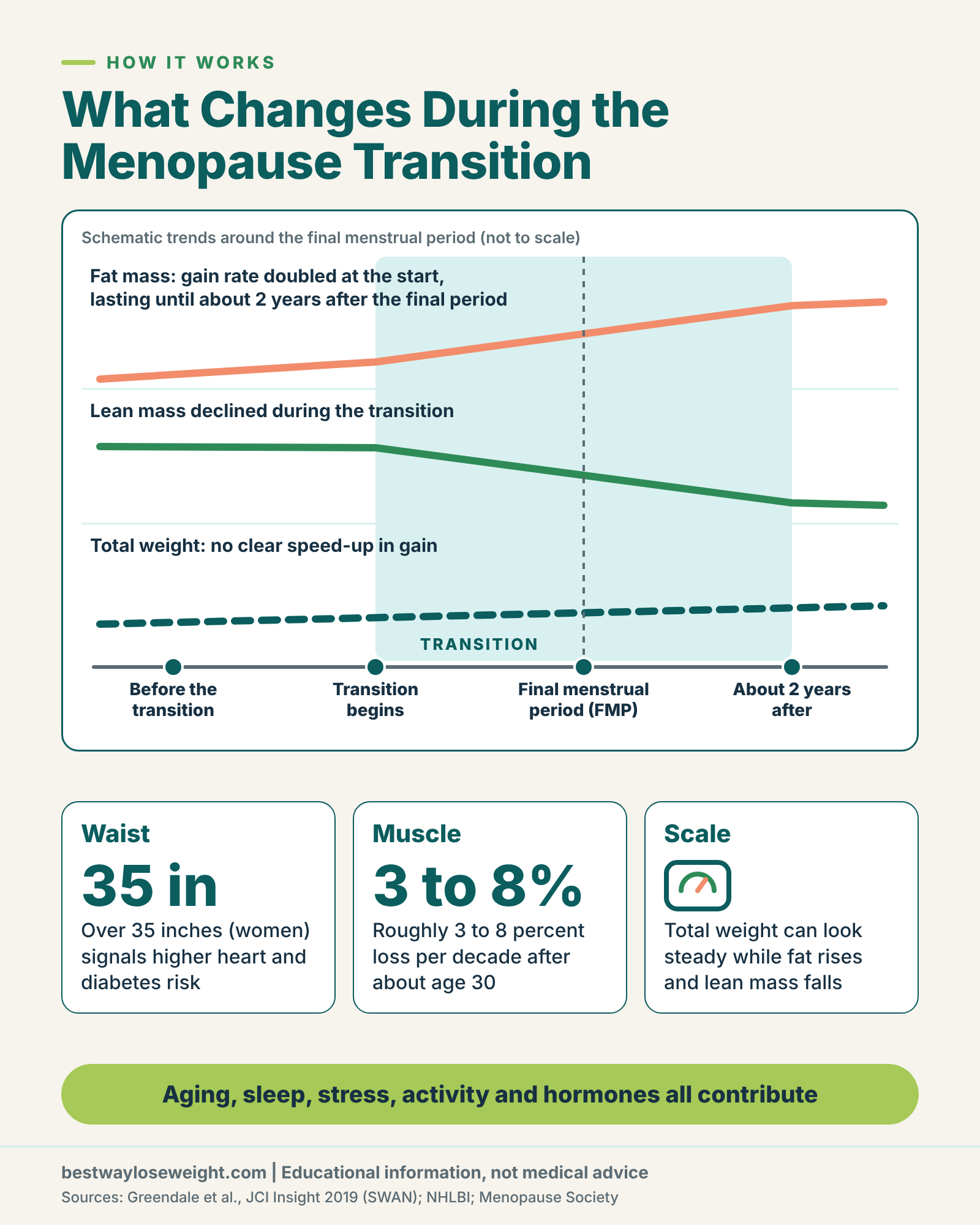
In the Study of Women’s Health Across the Nation (SWAN), a long-running U.S. cohort, researchers who measured body composition with dual-energy x-ray absorptiometry found that the rate of fat gain doubled at the start of the menopause transition and lean mass declined, with those shifts continuing until about two years after the final menstrual period. The same analysis found no discernible acceleration in total weight gain at that point (Greendale et al., 2019). The practical meaning: the scale can understate what is changing. Waist size, strength and how you feel in daily activity are worth tracking alongside weight.
Aging, hormones, sleep and habits all contribute
Experts do not fully agree on how much of midlife weight gain belongs to menopause versus aging. A Menopause Society consumer fact sheet states that aging is the primary driver of weight gain while menopause plays a critical role in redistributing fat (Menopause Society, Midlife Weight Gain). Muscle loss, less movement, poor sleep, stress, alcohol, some medications and medical conditions such as an underactive thyroid can all play a part.
What to do about it
The four habits that do most of the work
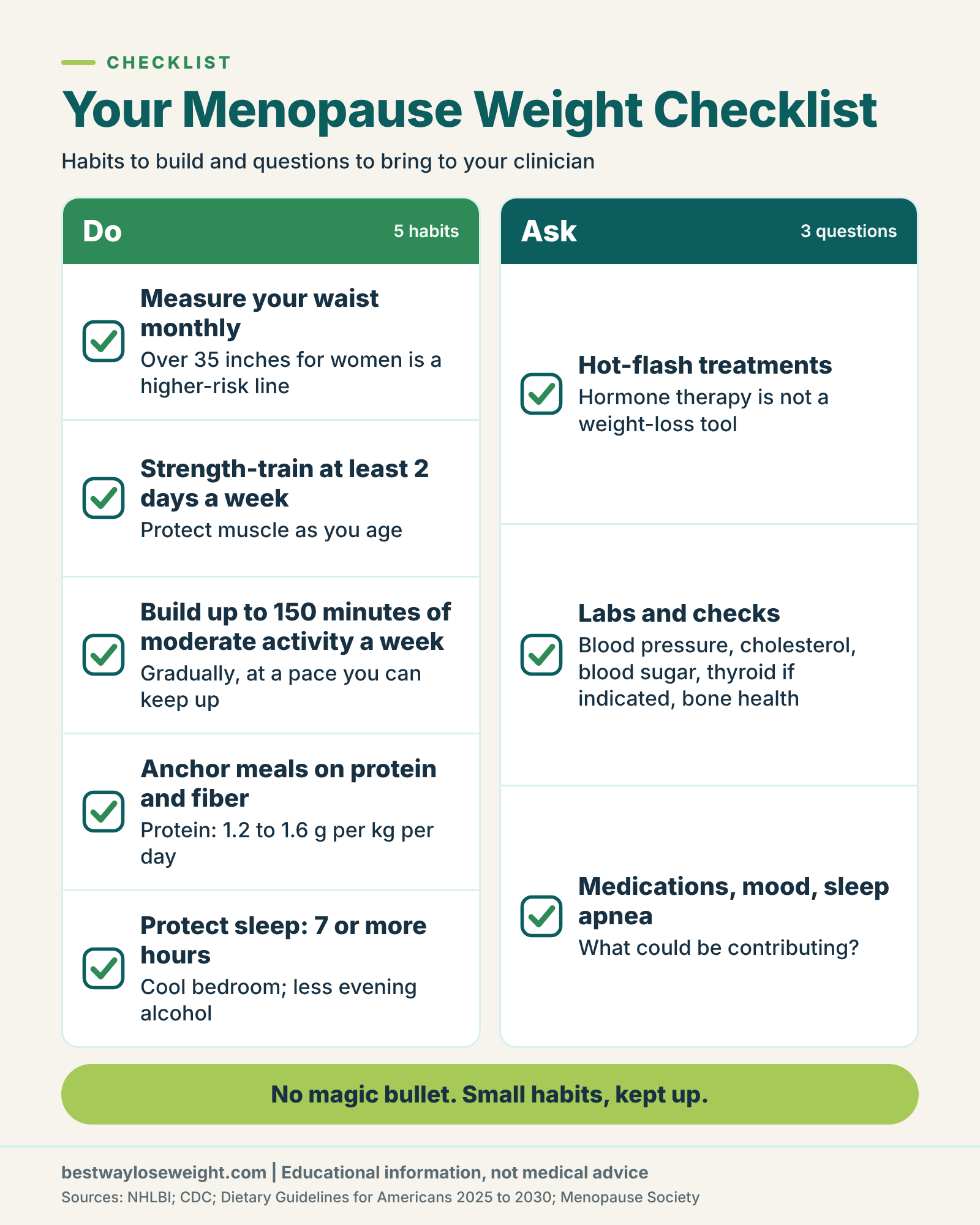
A modest, sustainable calorie gap if weight loss is appropriate for you; protein spread across the day (the 2025 to 2030 Dietary Guidelines for Americans give 1.2 to 1.6 grams per kilogram of body weight per day as the general range); muscle-strengthening on at least 2 days a week plus 150 minutes of moderate aerobic activity (the CDC adult guideline); and a protected sleep window. None of these is glamorous, and none is a magic bullet, but together they move the needle on body composition, energy and heart-disease risk factors.
Where a clinician fits in
Hormone therapy is approved for hot flashes, night sweats and vaginal symptoms, not for weight loss, and it carries its own benefit-risk decisions. Prescription weight-management medications are a separate, clinician-guided option for eligible adults. Check in with a clinician about unexplained weight change, heavy bleeding, bleeding after a full year without periods, new fatigue, low mood, loud snoring, or if you take medications or have a chronic condition. Never stop or change a prescription on your own.
What Drives Menopause Weight Gain in the First Place
Midlife weight change has several overlapping causes, which is why single-cause explanations (hormones, metabolism, willpower) tend to disappoint. Before getting practical, it helps to define the terms and look at what the best data actually measured.
Menopause, perimenopause and postmenopause in plain English
The stages and typical timing
Menopause is defined as one full year since your last period. The years leading up to it are called perimenopause (also “the menopausal transition”), when ovarian hormone levels, mainly estrogen (the main female sex hormone) and progesterone, rise and fall unpredictably and periods become irregular. Postmenopause is every year after that point. The U.S. Office on Women’s Health describes the average age of menopause in the United States as 52, within a typical range of 45 to 58, with perimenopause usually lasting two to eight years and averaging about four (Office on Women’s Health, Menopause basics). MedlinePlus describes the transition as usually beginning in your 40s and lasting several years (MedlinePlus, Menopause).
That timeline matters for weight because the stretch from the early 40s into the mid 50s also overlaps with other changes: careers and caregiving demands peak, sleep gets lighter for many people, and muscle mass begins its slow decline in most adults who don’t train it. Menopause doesn’t happen in a vacuum, and that is the main reason the “aging versus menopause” question below is hard to settle.
When timing is different: early menopause and primary ovarian insufficiency
Some women reach menopause earlier than average. The Office on Women’s Health notes that smoking can bring menopause on up to two years earlier, and that chemotherapy or surgery to remove both ovaries can trigger it (Office on Women’s Health). The NIH’s Eunice Kennedy Shriver National Institute of Child Health and Human Development describes primary ovarian insufficiency (POI) as ovaries that stop working normally before age 40, and notes that people with POI face higher risk of osteoporosis and other conditions linked to low hormone levels (NICHD, Primary Ovarian Insufficiency). If your periods stop or become very irregular in your 30s or early 40s, that is a reason to see a clinician rather than to manage it as a weight issue.
What the SWAN body-composition research found
Fat gain speeds up and lean mass falls
The most-cited body-composition study in this area comes from SWAN, which has followed women through midlife since the 1990s. In a 2019 analysis in JCI Insight, Greendale and colleagues used DXA scans (dual-energy x-ray absorptiometry, a low-dose x-ray technique that separates fat, lean tissue and bone) and modeled changes relative to each woman’s final menstrual period. Fat and lean mass both increased before the transition. Then, at the start of the transition, the rate of fat gain doubled and lean mass declined, and those changes continued until about two years after the final period, after which the trajectories flattened (Greendale et al., JCI Insight, 2019). A trade-press summary of the work describes about 1,246 women with an average starting age of 47.1 followed for roughly 18 years, and an average age at the final menstrual period of 52.2 (Contemporary OB/GYN).
The authors concluded that accelerated fat gain and lean-mass loss are menopause-related phenomena rather than simple aging. That is a notable statement, because it comes from a design that tracked the same women across the transition and measured composition directly instead of relying on the scale.
Why the scale can miss the change
The same paper found that weight itself rose roughly linearly through premenopause without a detectable speed-up at the start of the transition, and the weight trajectory flattened afterward (JCI Insight abstract). Put those two findings together and you get a pattern many women recognize: weight may look similar from one year to the next while body shape shifts, because fat is replacing some lean tissue. Fat takes up more space than the same weight of muscle, so the same number on the scale can come with a larger waist.
It’s worth being honest about limits. SWAN is an observational study, so it describes patterns and cannot prove that falling estrogen caused them. Results are averages across a diverse group of women; individuals vary widely. And the numbers describe typical trajectories, not a destiny.
Aging versus menopause: where the evidence agrees and where it doesn’t
What the aging-focused view points to
An NIA research summary of SWAN notes that changes in cardiovascular health were more influenced by the menopausal transition, whereas increases in high blood pressure and body mass index were more attributable to chronological aging (National Institute on Aging). Davis and colleagues, reviewing the literature in 2012, concluded that weight gain per se cannot be attributed to the menopause transition (Davis et al., Climacteric, 2012). Large measurements of energy expenditure also fit with aging and body composition rather than a metabolic “cliff”: the doubly labeled water analysis in Science found that expenditure adjusted for fat-free mass stays stable from about age 20 to 60 (Pontzer et al., 2021).
What the hormone-focused view points to
The same Davis review reported that hormonal changes of the transition are associated with an increase in total body fat and in abdominal fat. The Menopause Society fact sheet likewise attributes midlife weight gain to reduced physical activity, muscle loss and lower estrogen levels that shift where fat is stored. An American Heart Association scientific statement on the menopause transition and cardiovascular risk states that postmenopausal women have increased central or visceral fat and reduced lean muscle mass, even among those at a normal weight (AHA statement summary, 2020). Not every government page frames it the same way: one Office on Women’s Health page says many women gain about 5 pounds after menopause because of lower estrogen and a metabolic slowdown, while the energy-expenditure data above argue against a large drop in adjusted metabolism before about age 60 (Office on Women’s Health, Menopause and your health). Reasonable experts can hold both views because they are describing different measurements: total weight versus fat distribution versus energy use per kilogram of lean tissue.
What both views agree on
Nearly everyone agrees on three practical points. First, fat tends to shift toward the abdomen in the transition. Second, muscle is worth protecting because it supports strength, glucose handling and independence. Third, lifestyle habits remain the foundation of management whether the original trigger is aging, hormones, or both. The table below sums up how the pieces fit.
| Change | Linked more to aging | Linked more to the transition | Where habits matter |
|---|---|---|---|
| Total body weight | Yes: slow upward drift through midlife (SWAN; Davis 2012) | No clear speed-up in total weight at the transition (Greendale 2019) | Calorie intake, activity, sleep, alcohol |
| Fat mass | Rises gradually before the transition | Rate of gain doubled at the start of the transition, until about 2 years after the final period | Strength and aerobic training can reduce fat mass (see meta-analysis below) |
| Lean mass | Declines gradually with age (3 to 8 percent per decade after about 30 is commonly cited) | Declined during the transition in SWAN | Resistance training and adequate protein |
| Blood pressure and BMI | More attributable to aging in the NIA summary of SWAN | Less so | Diet quality, sodium, activity, sleep |
| Lipid and vascular changes | Partly | More attributable to the transition in the NIA summary | Diet, activity, not smoking, clinician-guided treatment |
| Metabolic rate per kg of lean mass | Stable from about 20 to 60 in the largest measurements (Pontzer 2021) | Not clearly altered in these data | Not directly adjustable, but muscle mass is |
How small is the daily gap behind midlife weight gain?
The arithmetic of 1.5 pounds a year
Mayo Clinic’s patient guide to menopause weight gain says weight gain often continues at about 1.5 pounds (0.7 kilograms) per year through the 50s (Mayo Clinic). Treat that as a rough average, not a rule. Still, the arithmetic is instructive. Using the common rule of thumb that a pound of body weight represents roughly 3,500 calories:
- 1.5 pounds per year x 3,500 calories per pound = 5,250 calories per year.
- 5,250 calories divided by 365 days = about 14 calories per day.
Fourteen calories is a bite or two of food, which is less than the day-to-day noise in any person’s intake or activity. This helps explain why midlife weight gain feels mysterious: no one eats dramatically more; the gap is tiny and steady. It also explains why a small, consistent change, such as a daily walk or an extra serving of protein that crowds out a snack, can matter on a multi-year horizon.
Why that framing helps, and where it breaks down
The 3,500-calorie rule is a simplification. Bodies adapt, and the energy content of lost or gained tissue depends on how much of it is fat versus lean mass, so the rule tends to overpredict long-term change. Also, a woman whose lean mass is falling can gain fat with no change in weight, which the arithmetic above can’t capture. Use the number as a way to appreciate scale, not as a forecast. For a deeper look at how the calorie gap works, see our guide to the calorie deficit and the practical walkthrough on how to calculate a calorie deficit.
Belly Fat, Muscle and Metabolic Risk: Why the Waistline Matters
The reason clinicians pay attention to menopause weight gain is less about appearance and more about where fat goes and what happens to muscle. Those two changes connect to cardiovascular and metabolic health in ways a bathroom scale can’t show.
Visceral fat and waist circumference
What visceral fat is and why it gets attention
Visceral fat is fat stored deep in the abdomen around organs such as the liver and intestines, as opposed to subcutaneous fat, the layer just under the skin. The National Heart, Lung, and Blood Institute puts the practical point simply: if most of your fat is around your waist rather than at your hips, you are at a higher risk for heart disease and type 2 diabetes (NHLBI, risk and waist circumference). The American Heart Association’s statement on the menopause transition says postmenopausal women have increased central or visceral fat and reduced lean muscle mass, associated with higher cardiovascular risk even at a normal weight (AHA statement summary).
That last phrase deserves emphasis. A woman can have a BMI in the “healthy” range and still carry more abdominal fat than is ideal, which is one reason waist circumference is a useful complement to BMI. It is not a diagnosis, only a screening signal worth discussing with your clinician.
How to measure your waist at home
NHLBI’s guidance is to stand, place a tape measure around your middle just above the hipbones, and read the number after breathing out normally. A waist of more than 35 inches (about 89 centimeters) for women is the threshold NHLBI gives for increased cardiovascular and metabolic risk. A few tips make the number more useful:
- Measure on bare skin or over thin clothing, with the tape level all the way around and snug but not digging in.
- Take it at the same time of day, such as first thing in the morning, because bloating can add an inch or more.
- Measure once a month, not daily. Waist changes are slow, and daily readings mostly record noise.
- Record it next to your weight so you can see when the two diverge.
Treat the 35-inch figure as a screening line, not a verdict. Bone structure, height and other factors affect how a given waist size should be interpreted, which is where a clinician’s judgment comes in.
Muscle loss and resting energy use
What “3 to 8 percent per decade” means in real life
The Menopause Society fact sheet cites muscle loss of 3 to 8 percent per decade after about age 30 as one reason calorie needs drift down in midlife (Menopause Society, Midlife Weight Gain). Over a single year that’s small. Over twenty years without resistance training it adds up to a meaningful difference in strength, balance and the ability to do ordinary tasks such as lifting a suitcase or getting up from a low chair. The SWAN analysis above suggests the loss may also be steeper around the transition itself.
Here’s the encouraging part: muscle responds to training at almost any age. The exercise section below covers how much and what kind, and cites a meta-analysis of 101 trials in postmenopausal women.
Why metabolism is only part of the muscle story
Muscle burns energy even at rest, so people sometimes conclude that losing it is the main reason the scale creeps up. The data are more nuanced. In the derivation sample for the widely used Mifflin-St Jeor equation (498 healthy adults), fat-free mass was the strongest single predictor of resting energy expenditure (Mifflin et al., 1990), so lean tissue does matter. But the large doubly labeled water analysis noted earlier found that energy expenditure adjusted for fat-free mass stays stable across adulthood until about 60 (Pontzer et al., 2021). Taken together, the sensible reading is that preserving muscle helps with strength, glucose handling and function, and modestly supports energy use, but “slow metabolism” by itself is not the best explanation for most midlife weight gain. If you want to see how your own estimate is built, our BMR calculator guide and TDEE guide walk through it.
Cholesterol, blood pressure and blood sugar
Lipid and vascular changes around the transition
The AHA statement notes that lipid changes, including increases in LDL cholesterol and apolipoprotein B, occur more in response to the changes of menopause, and the NIA’s summary of SWAN reports increased arterial stiffness within about a year after menopause beyond what aging alone would predict (NIA). The Office on Women’s Health adds that after menopause women’s heart disease risk approaches that of men of the same age (Office on Women’s Health). The takeaway isn’t alarm. It’s that midlife is a sensible time to make sure blood pressure and cholesterol are being checked on a regular schedule, because both are common, treatable and often silent.
Questions worth raising about blood sugar
Abdominal fat gain can nudge insulin resistance (when cells respond less well to insulin) in the wrong direction. You don’t need to guess: a clinician can order a fasting glucose or A1C test, and it’s reasonable to ask whether you are due, especially if you have a family history of diabetes, a history of gestational diabetes or polycystic ovary syndrome, or a larger waist. If you already have diabetes or prediabetes, changes to food or activity can interact with medications, so coordinate with your care team before making large changes.
Other Contributors Beyond Estrogen
Because the transition shows up alongside a busy life stage, it can be tempting to blame hormones for everything. A more useful approach is to look for the contributors you can actually change or treat.
Sleep and night sweats
How disrupted sleep can work against weight management
The Office on Women’s Health lists sleep trouble among the common transition symptoms and attributes it to low progesterone, hot flashes or night sweats, and urinary problems, recommending seven to nine hours of sleep (Office on Women’s Health, Symptoms and relief). The CDC says adults 18 to 60 need 7 or more hours, and that sufficient sleep supports a healthy weight, heart health and metabolism (CDC, About Sleep). Mayo Clinic’s guide adds the everyday mechanism many people recognize: when people don’t get enough sleep, they tend to snack more and consume more calories (Mayo Clinic). A short, broken night also tends to shrink the energy and motivation for exercise the next day. Our guides on sleep and weight loss and how much sleep you need go deeper.
When night sweats are the problem, not just the symptom
If night sweats are the main reason you wake, then sleep hygiene tips alone may not be enough, and treating the vasomotor symptoms (hot flashes and night sweats) becomes part of the weight plan. That is a clinician conversation and is covered in the treatment section below.
Stress, mood and eating
Mood changes during the transition
The Office on Women’s Health includes mood changes and depression or anxiety among the transition’s symptoms. Low mood, irritability and anxiety can change appetite in either direction, make planning meals feel impossible, and sap motivation to move. Eating more during a stressful stretch is a common human response, not a character flaw. Persistent low mood, loss of interest, or anxiety that interferes with daily life is worth raising with a clinician, who can discuss treatment options and check for other causes.
Practical ways to reduce stress-driven eating
Small structural changes tend to work better than pep talks. Plan two or three default meals you can assemble in ten minutes. Keep protein-forward snacks visible and easy. If evenings are when eating drifts, check whether you’ve eaten enough protein and fiber earlier in the day. Stress management that you’ll actually do, such as a short walk, stretching, journaling, or a call with a friend, beats an elaborate routine you drop after a week.
Movement and routines
The quiet drop in daily activity
Menopause Society and Mayo Clinic materials both name reduced physical activity as a contributor. In practice this often isn’t a decision. A desk job, a longer commute, a joint that aches on stairs, or a hot flash during an evening walk can all shave off movement a little at a time. Because daily activity (walking, chores, standing) can account for a meaningful share of the calories you burn, small declines can quietly compound.
Joint pain, pelvic floor and other practical barriers
Aches, stiffness and pelvic-floor symptoms such as leaking with impact are common reasons people stop exercising in midlife. They are also common reasons to get help. A physical therapist can adapt a strength plan around a sore knee or shoulder, and pelvic-floor physical therapy can address leakage so that you can keep training. These are solvable obstacles, not signs that you should give up on exercise.
Medical contributors to check
Thyroid, medications and sleep apnea
Several treatable conditions can contribute to weight change or fatigue at the same age that menopause arrives. An underactive thyroid can cause weight gain, tiredness and feeling cold. Several drug classes can affect appetite or weight in some people, including some antidepressants, corticosteroids and certain diabetes medicines; a prescriber or pharmacist can review your list. And sleep apnea, in which breathing repeatedly pauses during sleep, is more common with excess weight and with age. NHLBI notes that extra fat deposits in the neck can block the upper airway and that maintaining a healthy weight can help prevent or treat sleep apnea caused by obesity (NHLBI, Sleep apnea causes). Loud snoring, gasping at night and daytime sleepiness are reasons to ask about testing. Bring up any medication concerns, but don’t stop anything on your own.
Alcohol and other everyday contributors
Alcohol adds calories without much fullness, can disrupt sleep, and is listed by MedlinePlus among triggers some women find worsen hot flashes (MedlinePlus). The 2025 to 2030 Dietary Guidelines for Americans advise consuming less alcohol for better overall health (Dietary Guidelines for Americans, 2025 to 2030). If you drink regularly, a trial month of cutting back and noting what happens to your sleep, hot flashes and weight is a low-cost experiment. Smoking is another everyday factor: the Office on Women’s Health notes it can bring menopause on earlier.
Is It Menopause, Habits, or Something Else? A Decision Framework
Because so many things can contribute to weight change in midlife, a short screening routine helps you decide what to do first. This framework is not a diagnostic tool. It’s a way to organize what you notice so you can act on the parts you can change and bring the right questions to a clinician.
Match what you notice to what to bring up
How to use the table
Read down the left column for the pattern closest to your own, then look at the possible contributors and a reasonable next step. Several rows can apply at once. Menopause often overlaps with sleep problems, mood changes and lifestyle shifts, and any of them can be present alongside a thyroid or sleep disorder.
| What you notice | Possible contributors | Reasonable next step |
|---|---|---|
| Waist is larger and clothes fit tighter around the middle, but the scale is about the same | Fat shifting to the abdomen and lean mass declining during the transition | Measure your waist monthly, start or progress strength training, review protein, mention it at your next checkup |
| Irregular periods, hot flashes, night sweats and weight change together | Perimenopause plus sleep disruption | Describe your symptoms to a clinician and ask about treatment options, including hormonal and nonhormonal choices |
| Waking drenched, tired by afternoon, eating more to get through the day | Sleep loss from night sweats or other causes | Cool bedroom, consistent schedule, limit evening alcohol; ask about treating night sweats |
| Fatigue, feeling cold, constipation, weight gain without a change in habits | Possible underactive thyroid (among other causes) | Ask whether thyroid testing makes sense |
| Loud snoring, gasping at night, daytime sleepiness | Possible sleep apnea | Ask about a sleep evaluation |
| Low mood, loss of interest, appetite change, trouble concentrating | Depression or anxiety, which can overlap with menopause symptoms | Talk with a clinician; do not wait for weight to improve first |
| Weight started changing soon after starting a new medicine | Possible medication effect | Ask your prescriber or pharmacist to review; do not stop it on your own |
| Spotting or bleeding after a full year without periods, or very heavy bleeding | Needs evaluation; the Office on Women’s Health says bleeding after a year without periods could be caused by cancer or another serious problem | See a clinician promptly |
| Rapid unexplained gain or loss, new swelling, shortness of breath | Many possible medical causes | See a clinician promptly |
What the table cannot do
No table can tell you why your weight changed. It can point you toward questions, but only a clinician who knows your history can sort out causes, order tests and weigh treatments. If more than one row fits, that is useful information to bring to the visit.
A three-question screen before you change anything
Questions about timeline and symptoms
Start with timing. When did your periods start changing, when did the weight or waist change begin, and what else shifted around the same time: a new job, a new medication, a move, an injury, a loss? Then ask what symptoms you have: hot flashes, poor sleep, low mood, new aches. Write both answers down. Patterns often become obvious on paper that are fuzzy in memory.
A two-week baseline before you overhaul anything
Before changing your diet or exercise, spend two weeks simply recording: average sleep hours, steps or minutes of movement, how many days you ate protein at each meal, how often you drank alcohol, and your waist and weight once at the start and end. This baseline shows you the biggest opportunity and keeps you from fixing the wrong thing. It also gives your clinician concrete data rather than a general impression that “nothing works.”
Nutrition for Menopause Weight Gain: Calories, Protein and Food Quality
Nothing in the evidence points to a special “menopause diet” that outperforms sensible general nutrition. What helps is a calorie level that matches your goal, enough protein to protect muscle, plenty of fiber-rich plants, and a pattern you can keep up. The sections below turn that into numbers and a sample day. All figures are illustrations to adapt, not prescriptions.
Estimating calories with a worked example
Step 1: estimate resting energy needs
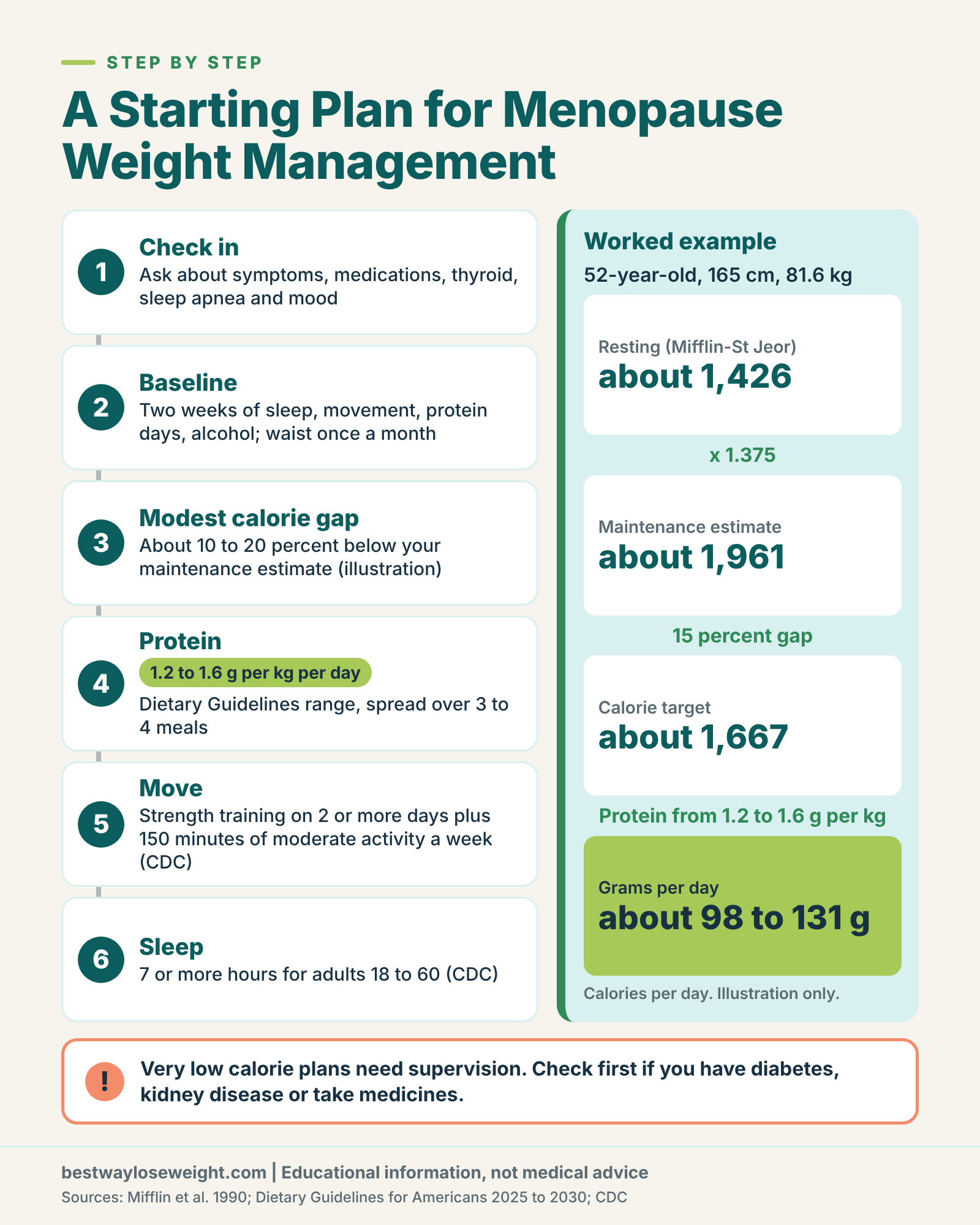
The Mifflin-St Jeor equation, published in 1990 from 498 healthy adults, estimates resting energy expenditure (the calories your body uses at rest) for women as: 10 x weight in kilograms + 6.25 x height in centimeters – 5 x age in years – 161 (Mifflin et al., 1990). Here is an example for a 52-year-old woman who is 5 feet 5 inches (165 cm) and weighs 180 pounds (81.6 kg). These are made-up assumptions chosen for illustration:
- 10 x 81.6 = 816
- 6.25 x 165 = 1,031
- 5 x 52 = 260
- 816 + 1,031 – 260 – 161 = about 1,426 calories per day at rest
The equation is an estimate with real person-to-person error, so treat the result as a starting point rather than a fact about your body.
Step 2: add activity, then set a modest gap
To turn resting energy into an estimate of total daily needs, people commonly multiply by an activity factor, often about 1.2 for very little exercise, 1.375 for light activity a few days a week, and 1.55 for moderate activity most days. These multipliers are conventions, not measurements. Using 1.375 for our example gives 1,426 x 1.375 = about 1,961 calories per day to maintain weight. A modest gap of 10 to 20 percent is a common starting range:
| Size of gap | Calories below maintenance per day | Approximate daily calories | Approximate weekly calorie gap |
|---|---|---|---|
| 10 percent | about 196 | about 1,765 | about 1,373 |
| 15 percent | about 294 | about 1,667 | about 2,058 |
| 20 percent | about 392 | about 1,569 | about 2,745 |
The weekly gap column shows arithmetic, not a forecast: bodies adapt, estimates are imperfect, and water shifts can hide fat loss for weeks. The best check is your own trend over 3 to 4 weeks. If your weight, waist and energy are moving in the direction you and your clinician want, keep going. If not, adjust by small steps rather than big cuts.
A few cautions apply. Many clinicians treat roughly 1,200 calories a day as a floor for women unless they are being supervised, and very-low-calorie approaches belong under medical supervision. Cutting too hard works against you in midlife because it can speed loss of muscle and bone. In a randomized trial of older adults with obesity, diet-induced weight loss of about 9 percent came with a 5 percent drop in lean mass in the aerobic-only group, versus about 2 to 3 percent in groups that included resistance training, and hip bone density fell about 3 percent in the aerobic-only group versus about 0.5 percent in groups with resistance training (Villareal et al., NEJM, 2017). That trial was in older adults rather than women at the transition, but the lesson transfers: if you are cutting calories, pair it with strength training. Our TDEE guide and calorie-gap walkthrough show the same method with other examples.
Protein: how much, and how to spread it out
The range and a worked example
The 2025 to 2030 Dietary Guidelines for Americans give a protein range of 1.2 to 1.6 grams per kilogram of body weight per day (Dietary Guidelines for Americans, 2025 to 2030), and the Menopause Society fact sheet suggests aiming for at least 1.2 grams per kilogram to help preserve muscle. For the 81.6-kilogram example:
- Low end: 81.6 x 1.2 = about 98 grams per day.
- High end: 81.6 x 1.6 = about 131 grams per day.
- Spread across three or four eating occasions, that is roughly 25 to 35 grams each.
For comparison, typical cooked servings supply roughly: 3 ounces of chicken breast or fish, 21 to 26 grams; 1 cup of plain Greek yogurt, about 20 to 23 grams; 2 eggs, about 12 grams; half a cup of cottage cheese, about 12 to 14 grams; three-quarters of a cup of cooked lentils, about 13 grams. These are approximate food-composition averages, so check labels. If you are also a larger body size, some clinicians and dietitians base protein on a goal or adjusted weight instead; ask a registered dietitian which approach fits you. For more on protein, see how much protein you need to lose weight and the high-protein diet guide.
Who should check before raising protein
Higher protein intake isn’t appropriate for everyone. People with kidney disease, and anyone told by a clinician to limit protein, should get individualized advice before changing intake. If you have diabetes or take medications that affect blood sugar or fluid balance, also check in first. Supplements such as powders are optional conveniences rather than requirements; food sources work, and they usually come with fiber and micronutrients.
Fiber, food quality and alcohol
Build meals around fiber, protein and plants
A practical plate for most meals is a protein source, a generous portion of vegetables or fruit, and a fiber-rich carbohydrate such as beans, lentils, oats, whole grains or potatoes with the skin. Fiber slows digestion, adds volume and supports steady appetite. The Dietary Guidelines for Americans 2025 to 2030 prioritize fiber-rich whole grains and set whole-grain serving goals of 2 to 4 per day, state that saturated fat should generally not exceed 10 percent of calories, and set a sodium limit under 2,300 milligrams per day for the general population (Dietary Guidelines for Americans, 2025 to 2030). Our guides to high-fiber foods and filling, nutritious foods have lists and swaps.
Bone health is part of food quality after menopause too. The NIH Office of Dietary Supplements lists the calcium recommended dietary allowance for women 51 and older at 1,200 milligrams per day, with an upper limit of 2,000 milligrams, and the vitamin D RDA at 600 IU (15 micrograms) through age 70 and 800 IU after that, with an upper limit of 4,000 IU (NIH ODS, Calcium; NIH ODS, Vitamin D). Those are population reference amounts, not personal prescriptions, and the ODS notes that evidence for supplements preventing fractures in community-dwelling postmenopausal women is mixed, with the U.S. Preventive Services Task Force finding insufficient evidence for routine supplementation. Food first is the usual starting point; ask your clinician whether you need a supplement or a bone-density test.
Meal patterns: what is and isn’t known
People often ask whether intermittent fasting, low-carb eating or a Mediterranean-style pattern works better in menopause. Based on the sources reviewed for this article, none has been shown to be clearly superior for women in the transition, so the best choice is the pattern you can sustain with enough protein and fiber. The Menopause Society has acknowledged that midlife women may have special considerations around macronutrients and exercise type, but the sources I could verify do not give specifics. If you’d like to compare approaches, see our guides to the Mediterranean diet, intermittent fasting and low-carb eating. Whichever you choose, skip patterns that leave you chronically exhausted, undernourished or preoccupied with food, and talk with a clinician first if you have diabetes, take glucose-lowering medicine, or have a history of disordered eating.
A sample day built around protein and fiber
One day at roughly 1,700 calories and 120-plus grams of protein
The sample below roughly matches the 15-percent example above. Values are approximate and rounded; real foods vary by brand and portion. Adjust portions up or down to fit your own estimate and your clinician’s guidance.
| Meal | What’s on the plate | Approx. calories | Approx. protein |
|---|---|---|---|
| Breakfast | 1 cup plain nonfat Greek yogurt, 3/4 cup blueberries, 1/4 cup dry rolled oats, 1 tablespoon chia seeds | about 340 | about 29 g |
| Lunch | Big salad: 2 cups mixed greens and vegetables, 4 oz cooked chicken breast, 1/2 cup chickpeas, 1 tablespoon olive oil with vinegar | about 480 | about 44 g |
| Snack | 1/2 cup cottage cheese with a medium apple | about 185 | about 13 g |
| Dinner | 5 oz baked salmon, 1 cup roasted broccoli with 1 teaspoon oil, 3/4 cup cooked brown rice | about 535 | about 38 g |
| Evening | 1 ounce almonds | about 165 | about 6 g |
| Day total | about 1,705 | about 130 g |
Notice that the day contains no forbidden foods and no “clean eating” rules. It is simply protein-forward, high in fiber, and built from ordinary groceries.
Budget, time and preference swaps
You can reach similar targets on a tight budget or schedule. Canned beans, lentils, eggs, frozen vegetables, plain yogurt, canned fish and store-brand oats are inexpensive, shelf-stable or quick. Vegetarian and vegan versions can swap in tofu, tempeh, lentils, edamame and soy or pea-based yogurts. If hot flashes follow certain foods or drinks, track them for a week; MedlinePlus lists alcohol and caffeine among common triggers, though triggers vary person to person. If you have a gluten, dairy or other allergy or intolerance, substitute accordingly, and consider a registered dietitian visit for a plan tailored to you.
Exercise for Menopause Weight Gain: Strength, Cardio and Bone Health
If nutrition sets the energy balance, exercise shapes what the scale is made of. For women in and after the menopause transition, the most important job of training is to protect or build muscle and bone while nudging fat down, with the heart and mood benefits as a bonus. No exercise targets belly fat on its own, so the goal is whole-body training done consistently.
What the trials show for postmenopausal women
A meta-analysis of 101 studies
A 2023 systematic review and meta-analysis in Frontiers in Endocrinology pooled 101 studies involving 5,697 postmenopausal women. On average, exercise training reduced body fat percentage by 1.86 percentage points, fat mass by 1.27 kilograms (about 2.8 pounds), and waist circumference by 1.45 centimeters (about 0.6 inch), and it increased fat-free mass by 0.66 kilograms (about 1.5 pounds) (Front Endocrinol, 2023). Aerobic and combined training had greater effects on fat-mass outcomes, while resistance and combined training had greater effects on muscle-mass outcomes. The authors concluded that combining aerobic and resistance training may be a viable strategy to improve body composition in postmenopausal women (DOAJ record of the abstract).
Keep the limits in mind. These are averages across many studies with different programs, durations and starting points, so your own result may be larger or smaller. The review covers postmenopausal women generally, not specifically women during the transition. And the changes are modest in absolute terms, which is a reminder that exercise alone rarely produces large fat loss; it works best alongside nutrition, sleep and time.
What “aerobic versus resistance” means for your plan
Aerobic exercise (walking, cycling, swimming, dancing) raises your heart rate for a sustained period and is especially good for heart health and calorie burn. Resistance exercise (free weights, machines, bands, bodyweight moves) loads your muscles so they adapt and keep their size and strength. The meta-analysis pattern is the practical guide: do both, and don’t let cardio crowd out strength work, since muscle is what tends to slip in the transition.
A strength plan you can start with
The structure: two full-body sessions a week
The CDC adult guideline calls for muscle-strengthening activity on at least 2 days a week that works all major muscle groups (legs, hips, back, abdomen, chest, shoulders and arms). A simple way to meet it is two full-body sessions of about 30 to 45 minutes, built on a few movement patterns:
- Squat or sit-to-stand (goblet squat, box squat, chair stand) for thighs and hips.
- Hip hinge (Romanian deadlift with dumbbells, hip bridge) for glutes and hamstrings.
- Push (wall, incline or floor push-up, dumbbell press) for chest and shoulders.
- Pull (band row, dumbbell row, lat pulldown) for the upper back.
- Carry or core (suitcase carry, dead bug, plank variations) for trunk stability.
A common beginner template is 2 to 3 sets of 8 to 12 repetitions of each movement, choosing a weight that makes the last two repetitions challenging while your form stays good, with a minute or two of rest between sets. When you can complete all sets and reps with good form, add a little weight or a repetition. That gradual increase is called progressive overload, and it’s the engine of muscle retention. If you are new to lifting, a session or two with a qualified trainer or physical therapist is a worthwhile investment, and anyone with heart disease, uncontrolled high blood pressure, osteoporosis, joint replacement or other chronic conditions should check with a clinician before starting. Our beginner’s guide to strength training and the explainer on losing fat while building muscle add programming detail.
A sample week that fits a busy schedule
| Day | Activity | Time | Notes |
|---|---|---|---|
| Monday | Full-body strength session A | 30 to 40 minutes | Squat pattern, push, pull, carry or core |
| Tuesday | Brisk walk | 20 to 30 minutes | Pace where you can talk but not sing |
| Wednesday | Rest or gentle mobility and stretching | 10 to 15 minutes | Active recovery counts |
| Thursday | Full-body strength session B | 30 to 40 minutes | Hinge pattern, push, pull, core |
| Friday | Brisk walk, bike or swim | 30 minutes | Cooler time of day if hot flashes are bothersome |
| Saturday | Longer easy activity (hike, dance, yard work) | 30 to 60 minutes | Something you enjoy |
| Sunday | Rest, short walk after a meal | 10 to 15 minutes | Protects sleep and recovery |
That week totals roughly 90 to 135 minutes of aerobic activity (counting the walks, ride or swim and weekend activity), with two strength sessions. It is a starting point, not a ceiling. As fitness improves, extend the walks or add intervals.
If this happens, try that
If your knees hurt during squats, reduce depth, use a box or chair, or try a hip bridge and leg press instead. If your wrists complain during push-ups, use dumbbells with a neutral grip or push from an incline. If you feel dizzy or overheated mid-workout from a hot flash, slow down, sip water, step into cooler air, and resume only if you feel well. If you finish a session wiped out for two days, you probably did too much too soon; trim a set and build up. If you are leaking urine with jumping or heavy lifts, skip impact moves for now and ask about pelvic-floor physical therapy.
Cardio and daily movement
How many minutes, and what counts
The CDC’s adult guideline is 150 minutes of moderate-intensity activity a week, or 75 minutes of vigorous activity, or an equivalent combination, and it notes that going beyond those amounts provides additional benefits. That can be 30 minutes a day on 5 days, or shorter chunks spread through the week. Mayo Clinic’s menopause weight-gain guide cites 150 to 300 minutes of moderate activity a week for the general adult population (Mayo Clinic). Walking is the most accessible way to get there; see our guides to walking for weight loss and how many steps a day.
Everyday movement and heat management
Formal workouts are only part of the picture. Standing, chores, taking stairs and short walks after meals add up, especially on days when you can’t get to a workout. If hot flashes are a barrier, exercise in the cooler part of the day, dress in layers you can shed, keep cold water nearby, and consider a fan or air-conditioned space. The Office on Women’s Health and MedlinePlus both list exercise among general lifestyle measures for the transition, though responses to exercise for hot flashes themselves vary.
Bone, joints and pelvic floor
Loading your bones
The NIH Office of Dietary Supplements notes that menopause leads to bone loss as lower estrogen reduces calcium absorption, with women typically losing about 1 percent of bone mineral density per year after menopause (NIH ODS, Calcium). The Office on Women’s Health recommends weight-bearing exercise twice a week alongside calcium and vitamin D. Strength training, brisk walking and, if your joints and bones allow, some impact activity all load the skeleton. In the older-adult trial mentioned earlier, hip bone loss during dieting was lower in the groups that included resistance training. If you have osteoporosis or a history of fractures, ask your clinician or a physical therapist which movements are safe for you before adding impact or heavy spinal loading.
Protecting joints and pelvic-floor function
Midlife joints appreciate a sensible warm-up, gradual progression and variety. If one activity routinely aggravates a joint, swap it for another that trains the same muscles with less irritation instead of quitting exercise. Pelvic-floor symptoms such as leaking with coughing, laughing or exercise are common and treatable; the Office on Women’s Health lists Kegel exercises as one option, and a pelvic-floor physical therapist can tailor an approach. Neither joint pain nor leaking is a reason to stop moving entirely.
Sleep, Stress and Hot Flashes: Habits That Support Weight Management
These topics are easy to skip because they don’t look like “weight loss,” yet they shape how hungry you feel, how much energy you have to move, and how consistent you can be. Treat them as part of the plan.
Building a sleep routine around night sweats
The basics the CDC recommends
The CDC’s sleep-hygiene suggestions include keeping consistent bedtimes and wake times, a quiet, cool and relaxing bedroom, putting away electronic devices at least 30 minutes before bed, avoiding large meals and alcohol before sleep, and skipping caffeine late in the day. They sound basic, and they are, but they work best when applied together and consistently for several weeks. A bedroom that is cool matters even more when night sweats are involved.
Practical tweaks when night sweats interrupt sleep
Layer bedding so you can peel it off, use breathable fabrics, keep water by the bed, and consider a fan. If you wake and can’t fall back asleep, get up and do something quiet in dim light instead of watching the clock. If you routinely sleep fewer than the 7 hours the CDC recommends for adults under 61 and can’t fix it with habits alone, mention it to a clinician. Treatments for hot flashes, covered below, can also improve sleep for some women. The Menopause Society MenoNote notes that hormone therapy is not a direct weight-loss tool but can relieve hot flashes and sleep disturbances, which may make it easier to stick with lifestyle changes.
Hot flashes and body weight
What the evidence says
The Office on Women’s Health notes that hot flashes may be worse in women who have overweight or obesity. A randomized trial from UCSF assigned 338 women with overweight or obesity and bothersome hot flashes to a six-month intensive behavioral weight-loss program (weekly group sessions, a reduced-calorie diet and a goal of at least 200 minutes of exercise a week) or to an education control. Among women bothered by hot flashes at baseline, those in the weight-loss group were twice as likely to report improvement, and reductions in weight, abdominal circumference and BMI were linked with improvement (UCSF news release on Huang et al., Archives of Internal Medicine, 2010). The Menopause Society’s 2023 nonhormone-therapy position statement lists weight loss among its recommended lifestyle approaches for vasomotor symptoms (summary of the 2023 position statement).
What it does not say
That trial enrolled women with overweight or obesity, lasted six months, and relied on women’s own reports, so it can’t tell you whether weight loss helps women at a lower body weight or whether the benefit lasts. It also doesn’t mean that gaining weight caused your hot flashes. Many women with a lower weight have severe symptoms, and many women with a higher weight have mild ones. Think of weight management as one possible lever for symptoms, not a cure, and don’t let it delay a conversation about treatments that directly address them.
Stress and the mind-body tools with evidence behind them
Cognitive behavioral therapy and related approaches
The Menopause Society’s 2023 position statement lists cognitive behavior therapy and clinical hypnosis among its recommended nonhormone options for vasomotor symptoms. Cognitive behavior therapy (CBT) is a structured, skills-based form of talk therapy. Some programs are delivered online or in groups, which can make it more accessible. The same statement does not recommend dietary supplements, cannabinoids, acupuncture or chiropractic manipulation for hot flashes, citing insufficient evidence.
A realistic budget for new habits
Midlife schedules are crowded, so the question isn’t whether a habit is helpful but whether you’ll still be doing it in a month. Choose one or two changes at a time. A 10-minute walk after dinner and a fixed wake-up time will usually do more than a perfect plan abandoned on day nine. Stack new habits onto existing routines, such as stretching while the coffee brews, and expect weeks, not days, for patterns to settle. If stress feels unmanageable, or you’re relying on food or alcohol to get through the day, a therapist or your primary care clinician is a good next step.
Hormone Therapy and Other Menopause Treatments: What They Do and Don’t Do for Weight
Treatment for menopause symptoms and treatment for weight are different goals, and it helps to keep them separate. This section summarizes what official sources and guidelines say as of October 7, 2026. Regulatory details in this area have changed quickly, so confirm current labeling with your clinician or pharmacist. Nothing here is a recommendation to start, stop or change any medicine.
Menopausal hormone therapy and weight
What it is approved to treat
Menopausal hormone therapy (MHT, also called hormone replacement therapy or HRT) replaces some of the hormones the ovaries stop making. The FDA’s consumer update describes approved hormone therapies as helping relieve hot flashes, night sweats, vaginal dryness and pain with sexual activity, and says they may reduce the chances of getting osteoporosis (FDA consumer update, February 2026). Weight loss is not an approved use. The Menopause Society fact sheet says the same in plain terms: hormone therapy is not a direct weight-loss tool, though relieving hot flashes and sleep disruption may make it easier to follow lifestyle changes.
The Menopause Society’s 2022 position statement, as summarized by trade press, says that for most healthy, symptomatic women under 60 and within 10 years of menopause onset the benefits of hormone therapy outweigh the risks, and that it is effective for vasomotor symptoms and genitourinary symptoms and for bone loss and fracture prevention (summary of the 2022 statement). Whether it is right for you depends on your age, time since menopause, symptoms, personal and family history, and preferences.
What the evidence says about weight and body fat
Two questions get mixed up: does hormone therapy cause weight gain, and can it prevent or reverse it? On the first question, a Cochrane review of 28 randomized trials with 28,559 women found no evidence of an effect of estrogen alone or estrogen plus progestogen on body weight or on the BMI increase normally seen around menopause; the differences between users and non-users were about 0.03 and 0.04 kilograms (Cochrane review, Kongnyuy et al., 2000). That also means the review did not find that hormone therapy prevents weight gain. The review noted that there were insufficient data to analyze waist-to-hip ratio, fat mass or skinfold thickness, and it is more than two decades old, so it predates many current formulations.
On body composition, the Davis review reported evidence of a reduction in overall fat mass with estrogen and estrogen-progestogen therapy, improved insulin sensitivity and a lower rate of type 2 diabetes, and concluded that estrogen therapy may partly prevent the menopause-related shift in body composition (Davis et al., 2012). The honest summary is that hormone therapy does not appear to make the scale go up, may modestly influence fat distribution, and has not been established as a weight-loss treatment. If you and your clinician choose it for symptoms, think of any body-composition effect as a possible side benefit rather than a goal.
The 2025 and 2026 FDA labeling changes
What changed and what stayed
On November 10, 2025, the FDA announced it was requesting labeling changes for menopausal hormone therapy products, following an expert panel in July 2025, literature review and public input. According to the FDA’s drug-safety page (content updated February 12, 2026) the requested changes include removing boxed-warning language on cardiovascular disease, breast cancer and probable dementia; removing the recommendation to use the lowest effective dose for the shortest time from the boxed warnings; and adding consideration of starting hormone therapy for moderate to severe vasomotor symptoms in women younger than 60 or less than 10 years since menopause. The boxed warning linking systemic estrogen-alone products to endometrial cancer is being maintained (FDA drug alert page). On February 12, 2026 the FDA announced it had approved the first six sets of labeling changes, covering systemic combination therapy, systemic estrogen-alone, systemic progestogen-alone and topical vaginal estrogen, with 29 companies having submitted proposed changes (FDA press announcement).
Two details are easy to miss. First, the FDA’s consumer update clarifies that cardiovascular disease and breast cancer are not being removed from the Warnings and Precautions section, only from the boxed warning, and that the agency continues to warn about endometrial cancer risk for estrogen-alone products. Second, because labels are being updated product by product, the wording on the package insert you receive may differ depending on the product and the date. A 2026 commentary in Obstetrics and Gynecology describes the change as moving toward product-specific labeling and individualized benefit-risk decisions (Sriprasert et al., 2026).
What the label change does not decide for you
Changes to a boxed warning don’t make hormone therapy right or wrong for any one person. Clinicians still weigh your age, time since menopause, whether you have a uterus (estrogen is generally paired with a progestogen to protect the uterine lining, which is the reason the endometrial cancer warning applies to estrogen-alone products), your personal and family history of conditions such as blood clots, stroke, heart disease and certain cancers, and how much your symptoms affect your life. If you are interested, ask about route and formulation, how you would monitor benefit and side effects, when to reassess, and what would make you stop. Those are questions for a clinician; this article can’t answer them for you.
Nonhormone options and what they mean for weight
What the Menopause Society 2023 statement recommends
For people who can’t or don’t want hormone therapy, the Menopause Society’s 2023 nonhormone-therapy position statement lists cognitive behavior therapy, clinical hypnosis, certain antidepressants (SSRIs and SNRIs), gabapentin, oxybutynin, fezolinetant and, in selected cases, stellate ganglion block among recommended options for vasomotor symptoms, along with weight loss as a lifestyle measure. It states that hormone therapy remains the most effective treatment for these symptoms and describes SSRIs/SNRIs and gabapentin as giving mild to moderate improvement. It does not recommend dietary supplements or cannabinoids, acupuncture or chiropractic manipulation, citing insufficient evidence (summary of the 2023 position statement). Some of these medicines can affect sleepiness, appetite or weight in some people, so ask about side effects as well as benefits.
Newer prescription options and their safety notes
Fezolinetant (brand name Veozah) blocks a brain signaling pathway involved in hot flashes. In December 2024 the FDA added a boxed warning for rare but serious liver injury, with liver blood tests before and during early treatment, and advice to stop and contact a clinician for symptoms such as fatigue, nausea, itching, yellowing of the eyes or skin, light-colored stool or dark urine (FDA drug safety communication; details of the monitoring schedule were confirmed via a trade-press report). Elinzanetant (brand name Lynkuet), a dual neurokinin receptor antagonist, was approved by the FDA on October 24, 2025 for moderate to severe hot flashes due to menopause; in the 52-week OASIS-3 trial hot-flash frequency fell by 73.8 percent with elinzanetant versus 47 percent with placebo at week 12 (Contemporary OB/GYN). Neither product is approved to treat weight, and the sources I reviewed don’t report a weight benefit from them. Your clinician can explain current label details, who should avoid them, and how they fit with other medicines you take.
| Option | Main purpose per sources | What is known about weight | Points to discuss with a clinician |
|---|---|---|---|
| Systemic hormone therapy | Hot flashes, night sweats, vaginal symptoms; may reduce osteoporosis risk (FDA) | No effect on weight in a Cochrane review of 28 trials; possible effect on fat distribution (Davis 2012); not a weight-loss treatment | Age and time since menopause, personal and family history, uterus status, route, how to reassess |
| Cognitive behavior therapy and clinical hypnosis | Vasomotor symptoms (Menopause Society 2023) | Not a weight treatment | Access, cost, online or group formats |
| SSRIs and SNRIs | Mild to moderate improvement in vasomotor symptoms (Menopause Society 2023) | Varies by medicine and person; ask about appetite and weight effects | Other medicines you take, mood history, side effects |
| Gabapentin | Mild to moderate improvement in vasomotor symptoms (Menopause Society 2023) | Ask about sleepiness and weight effects | Other medicines, side effects |
| Fezolinetant | Moderate to severe hot flashes; boxed liver warning (FDA, Dec 2024) | Not approved for weight; no weight benefit identified in sources reviewed | Liver testing, symptoms to report, medicine interactions |
| Elinzanetant | Moderate to severe hot flashes (FDA approval, Oct 2025) | Not approved for weight; no weight benefit identified in sources reviewed | Current label, side effects, who should avoid it |
| Lifestyle weight loss | Listed as a lifestyle measure for vasomotor symptoms (Menopause Society 2023) | Reduces weight by design; improved hot flashes in one 338-woman trial of women with overweight or obesity | Safe pace, muscle and bone protection, who should be supervised |
Weight-Loss Medications and Menopause: Questions to Ask
Some women find that lifestyle changes help but don’t go far enough, especially when other health conditions are present. Prescription weight-management medicines are a separate decision from menopause treatment and are guided by a clinician. This section covers the general framework only, and our patient-friendly guide to GLP-1 medications goes into the drug class in detail.
Who may qualify and what the basics are
Eligibility and the medicines on the list
According to the NIDDK, adults may qualify for prescription weight-management medicine if they have a body mass index (BMI) of 30 or higher, or 27 or higher with a weight-related health condition such as high blood pressure or type 2 diabetes. NIDDK lists six medicines approved for long-term use: orlistat, phentermine-topiramate, naltrexone-bupropion, liraglutide, semaglutide and tirzepatide (NIDDK, Prescription Medications to Treat Overweight and Obesity, last reviewed June 2024). That page may not reflect newer approvals, so ask your clinician which options are currently available. The Menopause Society fact sheet notes that anti-obesity medications, bariatric surgery and endoscopic procedures can be options for more severe cases, alongside lifestyle care.
Pregnancy, breastfeeding and lifestyle context
NIDDK states that weight-management medicines should never be taken during pregnancy or when planning a pregnancy, are not recommended during breastfeeding, and work best combined with a lifestyle program. If you are in perimenopause and there is any chance of pregnancy, bring that up before starting any medicine. Medicines don’t replace eating well and staying active; they are meant to be used alongside them.
Muscle, nutrition and menopause-specific questions
Protecting muscle and bone while losing weight
Any weight loss, whether from diet alone or with medicine, can include some loss of lean mass and bone density, which is the same concern raised by SWAN for the transition itself. The older-adult trial discussed earlier showed that pairing weight loss with resistance training preserved more lean mass and hip bone density than aerobic exercise alone. The practical response is the same whatever route you take: keep protein in the range your clinician or dietitian recommends, do strength training at least 2 days a week, get enough calcium and vitamin D from food and, if advised, supplements, and avoid cutting calories more than your care team suggests. I could not verify menopause-specific outcome data for these medicines from the sources reviewed here, so don’t assume results will match those in general trials.
A question list for your visit
- Do I meet the BMI and health-condition criteria, and are there reasons I should not use these medicines?
- How does this fit with my menopause symptoms, other medicines and any hormone therapy I take or am considering?
- What side effects are common, which are serious, and whom should I call if they happen?
- How will we monitor muscle, bone, nutrition and mood while I’m on treatment?
- Who will help me with protein, strength training and meal planning?
- What is the plan if I stop, and how long are we planning to treat?
- If there is any chance of pregnancy, what contraception or timing do we need to discuss?
Setting Realistic Goals: Tracking, Plateaus and a 12-Week Plan
Good plans fail when the goal is wrong or the feedback is misleading. In the menopause transition, both problems are common: weight can be a noisy measure, and a goal borrowed from someone else’s body may not fit yours. The sections below help you choose goals, track what matters and stage the work.
Choosing goals that fit the biology
Start with process and function, not a number
Goals you fully control tend to work better than outcomes you only influence. Examples: two strength sessions a week, protein at every meal on five days, a consistent wake time, a 10-minute walk after dinner, and one alcohol-free week to see what happens to your sleep. Pair those with function goals such as climbing stairs more easily, carrying groceries without strain, or a stronger push-up from an incline. These are within reach, they improve body composition, and they keep paying off even when the scale is slow.
Outcome goals, with your clinician’s input
If weight loss is appropriate for you, ask your clinician what size and pace make sense for your health, medications and history. Many people and clinicians set an initial target as a modest percentage of starting weight rather than a specific number, then reassess. Avoid goals pegged to a past weight or a former body. The research on the transition suggests your body composition and health risks now differ from those of your 30s, so the best target is the best version of health at the stage you’re in. If you’ve struggled with disordered eating, work with a clinician or therapist experienced in it, and skip rigid tracking.
What to track and how to read it
A small, sustainable tracking set
Track few things, consistently:
- Weight: weigh two or three mornings a week and use the weekly average, rather than reacting to single readings.
- Waist: once a month, using the method described earlier.
- Strength: a simple log of exercises, weights and repetitions, which shows progress even when body weight is flat.
- Sleep and symptoms: hours slept, night sweats and hot flashes on a quick 0-to-3 scale, to see whether habits or treatments move them.
- Protein and movement: a tally of protein-forward meals and minutes of activity, not necessarily a full food diary.
How to read the trend without overreacting
Body weight can swing by a few pounds from salt, hydration, digestion and, during perimenopause, the unpredictable cycles that can shift fluid retention. Judge progress over 3 to 4 weeks, not days. If weight is flat but your waist is smaller and your strength is up, that is meaningful progress consistent with the body-composition changes described in the research. If everything is flat for 4 or more weeks despite consistent habits, check the basics before cutting calories: sleep, protein, step count, portion creep, alcohol, and whether your calorie estimate was too generous. Our guide to the weight loss plateau walks through that process.
A 12-week starting plan
Weeks 1 to 4: build the base
The first month is for installing habits and gathering data, not for pushing hard. Do the two-week baseline, then add one change per week: week 1, a consistent sleep and wake schedule; week 2, protein at breakfast and lunch; week 3, two short strength sessions; week 4, a daily walk after one meal. Keep calories near your maintenance estimate or apply a small gap of about 10 percent if your clinician agrees that weight loss suits you.
Weeks 5 to 12: progress and review
From week 5, progress your strength weights gradually, extend walking time, and decide with your clinician whether the calorie gap stays or changes. At week 8, review waist, strength, sleep and symptoms. At week 12, schedule a check-in with your clinician to review labs, symptoms, and whether treatments (for symptoms, or for weight) are worth discussing. If weight loss isn’t the goal, the same structure works for building strength and energy while holding weight steady.
| Weeks | Focus | Weekly targets | Check-in |
|---|---|---|---|
| 1 to 2 | Baseline and sleep schedule | Record sleep, movement, protein days, alcohol; fixed wake time | Waist and weight at start and end of week 2 |
| 3 to 4 | Protein and first strength sessions | Protein at 3 meals on 5 days; two short full-body sessions; walks after one meal | Are sessions repeatable without pain? |
| 5 to 8 | Progression and food quality | Add weight or reps; add fiber-rich foods; aerobic minutes toward 150 a week | Week 8: waist, strength log, sleep and hot-flash notes |
| 9 to 12 | Consolidate and review | Keep what works; adjust calories only if the trend calls for it | Week 12: clinician visit for symptoms, labs and options |
If progress stalls
Check the basics first
Before you assume your metabolism is broken, ask: Are you sleeping enough? Are you eating protein at each meal? Has your step count slipped? Have weekend meals or drinks crept up? Are the portions in your estimate still accurate? Is your calorie target based on an older weight? Fixing these usually costs less than cutting more food. If you’ve been dieting for months, a planned maintenance break at your estimated needs can help you recover energy and training quality.
When to adjust and when to ask for help
If the basics are solid and the trend is flat for a month, adjust one variable by a small amount, such as 100 calories, 2,000 more steps, or an extra strength set, then wait 2 to 3 weeks. If you’re feeling fatigued, cold, unusually hungry, dizzy or losing hair, or if your periods or mood change unexpectedly, that’s a cue to see a clinician rather than to cut further. Needing help isn’t failure; it’s often the most efficient next step.
When to Talk With a Clinician (and What to Ask)
The Office on Women’s Health advises talking with a provider if symptoms bother you or if you have spotting or bleeding after a year without periods. Beyond those, a few situations call for a prompt or individualized plan.
Reasons to book a visit
Symptoms that should not wait
- Bleeding or spotting after 12 months without a period, or very heavy or prolonged bleeding.
- Rapid unexplained weight gain or loss, new swelling of the legs or face, or persistent fatigue.
- Chest pain, shortness of breath or fainting: seek urgent care.
- Persistent low mood, hopelessness or anxiety that interferes with daily life. If you are having thoughts of harming yourself, call or text 988 (the Suicide and Crisis Lifeline) in the U.S. or go to the nearest emergency department.
- Periods that stop or become very irregular before about age 40 (see the POI discussion earlier).
Situations that deserve a tailored plan
Check in before major diet or exercise changes if you take prescription medicines (especially for diabetes or blood pressure), have kidney, liver or heart disease, osteoporosis, a history of disordered eating, or are pregnant, trying to conceive or breastfeeding. Perimenopause does not guarantee that pregnancy is impossible, so raise contraception and any pregnancy plans with your clinician before starting new medicines. A registered dietitian and a physical therapist or qualified trainer are useful allies in addition to your physician.
A checklist of questions to bring
About symptoms and treatment
- Based on my symptoms and history, am I in perimenopause or postmenopause, and do any tests make sense?
- Which of my symptoms might be related to something else, such as thyroid, sleep apnea, depression or a medication?
- Would I be a candidate for hormone therapy or a nonhormone treatment, and what are the benefits, risks and side effects for me?
- Given the recent FDA labeling updates, how do the current labels apply to the product you might prescribe?
- How will we decide whether a treatment is working and when to reassess it?
About weight, labs and nutrition
- Is a weight-loss goal appropriate for me right now, and what pace is safe?
- Which labs should I have (for example blood pressure, cholesterol, blood sugar or A1C, and thyroid if indicated), and how often?
- Do I need a bone-density test, and how should I get calcium and vitamin D?
- How much protein is right for me, given my kidneys and other conditions?
- Can you refer me to a registered dietitian, a physical therapist or a program that supports strength training?
- Would I qualify for a prescription weight-management medicine, and what would the plan be if I stopped?
Frequently Asked Questions About Menopause Weight Gain
Causes and timing
Can perimenopause cause weight gain before my periods stop?
It can. In the SWAN analysis, the rate of fat gain doubled at the start of the menopause transition, which begins while periods are still occurring, though irregular. That does not mean everyone gains weight in perimenopause; total weight did not accelerate on average. If you are still having periods but notice a thicker waist, strength slipping or sleep changes, you may be seeing early body-composition shifts, which is a good time to start strength training.
Is menopause weight gain inevitable?
No. The average trend is a gradual upward drift, with Mayo Clinic citing about 1.5 pounds a year through the 50s, but averages hide wide individual variation. A Menopause Society release describes midlife weight gain as common but preventable and emphasizes comprehensive lifestyle approaches (Menopause Society press release). Preventable doesn’t mean effortless, and some contributors, such as hormones and genetics, aren’t fully in your control. The realistic aim is to shape the trend, protect muscle and keep health markers in a good range.
How long does the body-composition shift last?
In SWAN, fat gain and lean-mass loss continued until about two years after the final menstrual period, and then the trajectories flattened. That pattern describes a group average, and it doesn’t mean fat gain will stop on its own at a set date; later aging brings its own muscle loss, and habits still drive the outcome. Think of the first years around the final period as a window when strength training and sleep deserve extra attention.
Is it harder to lose weight after menopause?
The sources I reviewed do not show that the same diet works differently before and after menopause, and the best energy-expenditure data suggest adjusted metabolism is stable until about 60. What often makes it feel harder is the surrounding context: less muscle, poorer sleep, more stress, fewer free hours and a thicker middle. These are modifiable. If progress stalls despite solid habits, bring it to a clinician to look for other contributors.
Treatments, tests and supplements
Will treating hot flashes help me lose weight?
Not directly. None of the hot-flash treatments described above is approved for weight loss. Indirectly, better sleep and fewer disruptions may make it easier to keep up exercise and regular meals, as the Menopause Society fact sheet suggests for hormone therapy. Think of symptom treatment as removing an obstacle, not as a weight-loss intervention.
If I take hormone therapy, do I still need to train and watch nutrition?
Yes. Hormone therapy is approved for symptoms and bone protection, not for body composition, and the research on fat distribution is limited. Muscle and bone still respond to resistance training, protein and calcium and vitamin D. The Menopause Society calls comprehensive lifestyle changes the backbone of midlife weight management.
Do supplements marketed for menopause weight gain work?
I did not find reliable evidence in the sources reviewed that any supplement reverses menopause weight gain. The Menopause Society’s 2023 position statement does not recommend dietary supplements or cannabinoids for hot flashes, citing insufficient evidence. Supplements can interact with medicines and aren’t reviewed by the FDA for effectiveness before sale, so check with a pharmacist or clinician before taking one, and be wary of products that promise fast fat loss.
Which tests might be worth asking about?
It depends on your history. Common conversation starters are blood pressure, cholesterol, blood sugar or A1C, and thyroid function if you have symptoms such as fatigue, cold intolerance or unexplained weight change, plus bone-density screening when your clinician advises it. The Office on Women’s Health recommends regular blood pressure and cholesterol screening after menopause. Your clinician decides which tests apply to you.
Food, exercise and daily life
Can walking alone shrink menopause belly fat?
Walking helps heart health, mood and calorie burn, and in the meta-analysis aerobic training lowered fat mass, with the combined approach also improving muscle outcomes. But no exercise targets fat from one region only, and walking alone does little to protect muscle. Add two strength sessions a week and attend to protein, and keep expectations modest: the average waist change in the meta-analysis was about 1.45 centimeters.
Should I lift heavy weights after menopause?
Many women do well with progressive resistance training, but “heavy” is relative to your experience. Start with weights that let you finish 8 to 12 repetitions with good form and increase gradually. If you have osteoporosis, a joint replacement, heart disease or uncontrolled high blood pressure, ask your clinician or a physical therapist about safe loading and any movements to avoid.
How much alcohol is okay during menopause?
The 2025 to 2030 Dietary Guidelines advise consuming less alcohol for better overall health, and I did not verify a specific number for menopause. Alcohol adds calories, can disrupt sleep and is a trigger some women notice for hot flashes. If you drink, notice how it affects your sleep and symptoms and consider cutting back; a clinician can advise you if you take medicines or have health conditions that interact with alcohol.
What should I do on days when poor sleep or hot flashes derail my plan?
Aim for the minimum effective day instead of abandoning the plan. Eat a protein-forward breakfast, take a short walk, do one set of each strength movement if you feel up to it, and go to bed on time. Skipping meals and then overeating at night tends to make things worse. One rough day doesn’t undo weeks of progress; two or three in a row is a signal to look at sleep and symptoms more closely.
Bottom Line: Menopause Weight Gain Is Manageable, Not Mysterious
What to remember
What changes
During the menopause transition, fat gain tends to speed up, lean mass tends to fall, and fat shifts toward the abdomen, even when the scale barely moves. Aging, sleep, stress, activity, alcohol, medications and medical conditions all contribute alongside hormones, and experts disagree about how to divide the credit. The underlying daily gap is small, which is both why the gain sneaks up and why small, consistent habits matter.
What helps
The best-supported moves are not exotic: strength training at least 2 days a week plus regular aerobic activity, enough protein spread across the day, a fiber-rich, mostly minimally processed way of eating at a calorie level that suits your goal, protected sleep, and less alcohol. Hormone therapy and other treatments address symptoms and are not weight-loss treatments. Prescription weight-management medicines are a separate clinician-guided option for eligible adults. If you take only one step this week, book a baseline: measure your waist, note your sleep and protein, and write down the three questions you most want a clinician to answer.
Editorial and medical-review note
Scope and sourcing
This article is educational and is not medical advice, a diagnosis or a treatment plan. It was fact-checked against the sources listed below as of October 7, 2026, and it is flagged for qualified clinical review before publication. No reviewer name or credentials are stated here because none have been assigned. Individual medical decisions, including hormone therapy, nonhormone treatments and weight-management medicines, belong with a clinician who knows your history.
What may change after publication
Menopause care is moving quickly. The FDA’s hormone-therapy labeling changes were still being rolled out product by product as of early 2026, newer nonhormone treatments are being added, and weight-management drug approvals continue to change. Some pages were summarized from secondary reports or abstracts, as noted in the source list. Check current FDA labeling and professional-society guidance for any medicine before relying on the details here.
Sources
Sources were accessed on or around October 7, 2026. Where a source was read through a summary, abstract or secondary report instead of the full text, the list says so.
Primary sources (government and clinical guidelines)
U.S. government health agencies
- U.S. Food and Drug Administration. FDA Approves Labeling Changes to Menopausal Hormone Therapy Products. February 12, 2026.
- U.S. Food and Drug Administration. FDA Requests Labeling Changes Related to Safety Information to Clarify the Benefit/Risk Considerations for Menopausal Hormone Therapies. Announced November 10, 2025; content updated February 12, 2026.
- U.S. Food and Drug Administration. Hormone Replacement Therapies Can Help Women with Bothersome Menopausal Symptoms. February 2026.
- U.S. Food and Drug Administration. FDA adds Boxed Warning about rare occurrence of serious liver injury with use of Veozah (fezolinetant). December 2024 (page located in search results; the direct fetch was rate-limited, so details were read from a trade-press report).
- Office on Women’s Health, HHS. Menopause basics; Menopause and your health; Menopause symptoms and relief.
- National Institute on Aging. Research explores the impact of menopause on women’s health and aging (the NIA “What Is Menopause?” page could not be retrieved).
- Eunice Kennedy Shriver National Institute of Child Health and Human Development. Primary Ovarian Insufficiency (POI).
- MedlinePlus, National Library of Medicine. Menopause.
- National Institute of Diabetes and Digestive and Kidney Diseases. Prescription Medications to Treat Overweight and Obesity. Last reviewed June 2024.
- National Heart, Lung, and Blood Institute. Risk factors: waist circumference and BMI; Sleep apnea causes.
- Centers for Disease Control and Prevention. Adult Physical Activity Guidelines; About Sleep.
- NIH Office of Dietary Supplements. Calcium: Health Professional Fact Sheet; Vitamin D: Health Professional Fact Sheet.
Professional societies and clinical guidance
- U.S. Department of Health and Human Services and U.S. Department of Agriculture. Dietary Guidelines for Americans, 2025 to 2030. 2026 (read through a fetch summary of the PDF).
- The Menopause Society. MenoNote: Midlife Weight Gain. Copyright 2025 (read through a fetch summary of the PDF).
- The Menopause Society. Weight management in midlife (press release). Undated (read through a fetch summary).
- The Menopause Society. The 2022 hormone therapy position statement. Menopause. 2022. Read through the OB/GYN.net summary because the statement PDF and PubMed record could not be retrieved.
- The Menopause Society. The 2023 nonhormone therapy position statement. Menopause. 2023. Read through the OBG Project summary.
- El Khoudary SR, Aggarwal B, Beckie TM, et al. Menopause transition and CVD risk: AHA scientific statement. Circulation. 2020. Read through the ACC “Ten Points to Remember” summary.
- Mayo Clinic. The reality of menopause weight gain.
Research and supporting literature
Body composition, aging and menopause
- Greendale GA, Sternfeld B, Huang M, et al. Changes in body composition and weight during the menopause transition. JCI Insight. 2019;4(5). JCI Insight record (abstract level; full text figures not retrieved). Cohort details from Contemporary OB/GYN.
- Davis SR, et al. Understanding weight gain at menopause. Climacteric. 2012. Abstract record.
- Pontzer H, et al. Daily energy expenditure through the human life course. Science. 2021. Abstract (LJMU repository).
- Mifflin MD, et al. A new predictive equation for resting energy expenditure in healthy individuals. Am J Clin Nutr. 1990. PubMed 2305711.
Exercise, nutrition and treatment evidence
- The effects of exercise training on body composition in postmenopausal women: a systematic review and meta-analysis. Front Endocrinol. 2023;14:1183765. Frontiers PDF; DOAJ record.
- Villareal DT, et al. Aerobic or resistance exercise, or both, in dieting obese older adults. N Engl J Med. 2017. PubMed 28514618.
- Huang AJ, et al. An intensive behavioral weight loss intervention and hot flushes in women. Arch Intern Med. 2010. Read through the UCSF news release.
- Kongnyuy EJ, Norman RJ, Flight IHK, Rees MC. Hormone replacement therapy and body weight (Cochrane review CD001018; summary titled “Hormone replacement therapy has no effect on body weight and cannot prevent weight gain at menopause”). Cochrane Database Syst Rev. 2000. Cochrane summary.
- Sriprasert I, et al. Elimination of the black box warning on menopausal hormone therapy. Obstet Gynecol. 2026. PubMed 41687116.
- Elinzanetant (Lynkuet) FDA approval and OASIS-3 results. Contemporary OB/GYN, October 24, 2025 (trade-press report; confirm against the FDA label).
- Fezolinetant boxed-warning details. Patient Care Online, December 2024 (trade-press report).

