
Most adults should aim for at least 7 hours of sleep a night. That’s the guidance from the CDC and from the American Academy of Sleep Medicine and the Sleep Research Society, and plenty of adults land somewhere between 7 and 9 hours. If you’re thinking about sleep for weight loss, though, the hour count is only part of the story. When you sleep, how regular your schedule is, how well you sleep and whether a condition such as sleep apnea is getting in the way all matter too.
This guide walks through what the research does and doesn’t show, how to work out a realistic sleep target for your own schedule, and how to fit more sleep into a full life without turning it into one more thing to fail at. There’s no magic bullet here. Better sleep won’t melt weight off on its own, but it can make the eating and movement habits you’re already working on easier to stick with.
Key Takeaways
The short answer
The number most adults should aim for
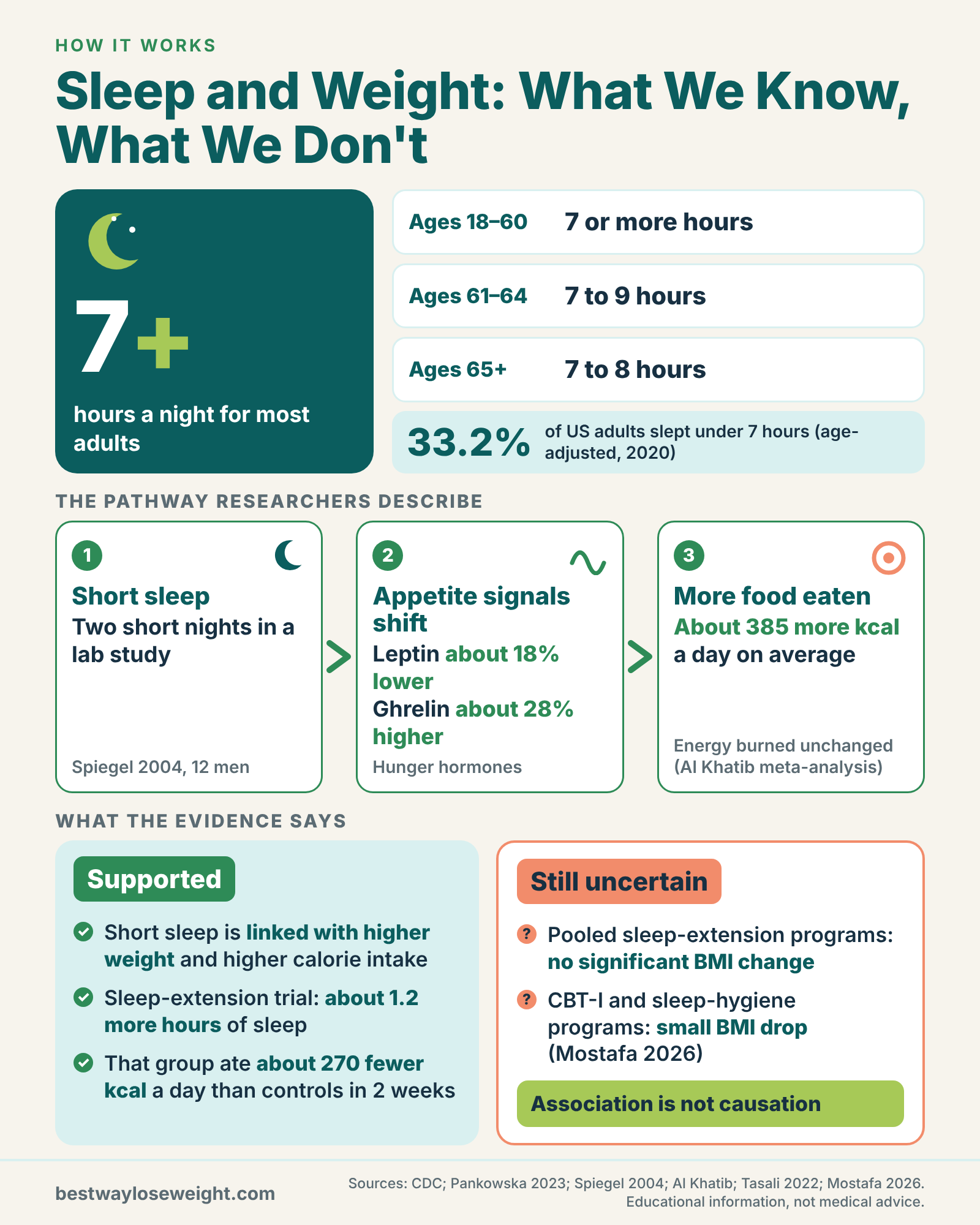
The CDC lists 7 or more hours for adults aged 18 to 60, 7 to 9 hours for ages 61 to 64 and 7 to 8 hours for adults 65 and older. The National Heart, Lung, and Blood Institute (NHLBI) describes a range of 7 to 9 hours for adults. Regularly getting 6 hours or fewer is considered inadequate by the AASM and Sleep Research Society consensus panel. Your own need within that range depends on genetics, health, age and circumstances.
What sleep can and cannot do for weight
- Short sleep is linked with higher body weight in large population studies, but those studies can’t prove that short sleep caused the weight.
- In a two-week trial, adults with overweight who slept about 1.2 hours more ate roughly 270 fewer calories a day than a comparison group. That trial was short and small, so treat it as a promising signal, not a forecast for your results.
- A 2026 pooled analysis of behavioral sleep programs found a small drop in body mass index (BMI) for programs aimed at insomnia and sleep habits, but not for programs that only tried to lengthen sleep. The evidence is mixed.
What to do first
Fix duration and consistency before gadgets
- Pick a fixed wake time you can keep seven days a week, or close to it.
- Count backward to a bedtime that leaves 7 to 8 hours of actual sleep, not just time in bed.
- Protect the 30 to 60 minutes before bed from work, bright screens and big meals.
- Keep this up for two weeks and note how you feel and what your appetite does before you change anything else.
When to involve a clinician
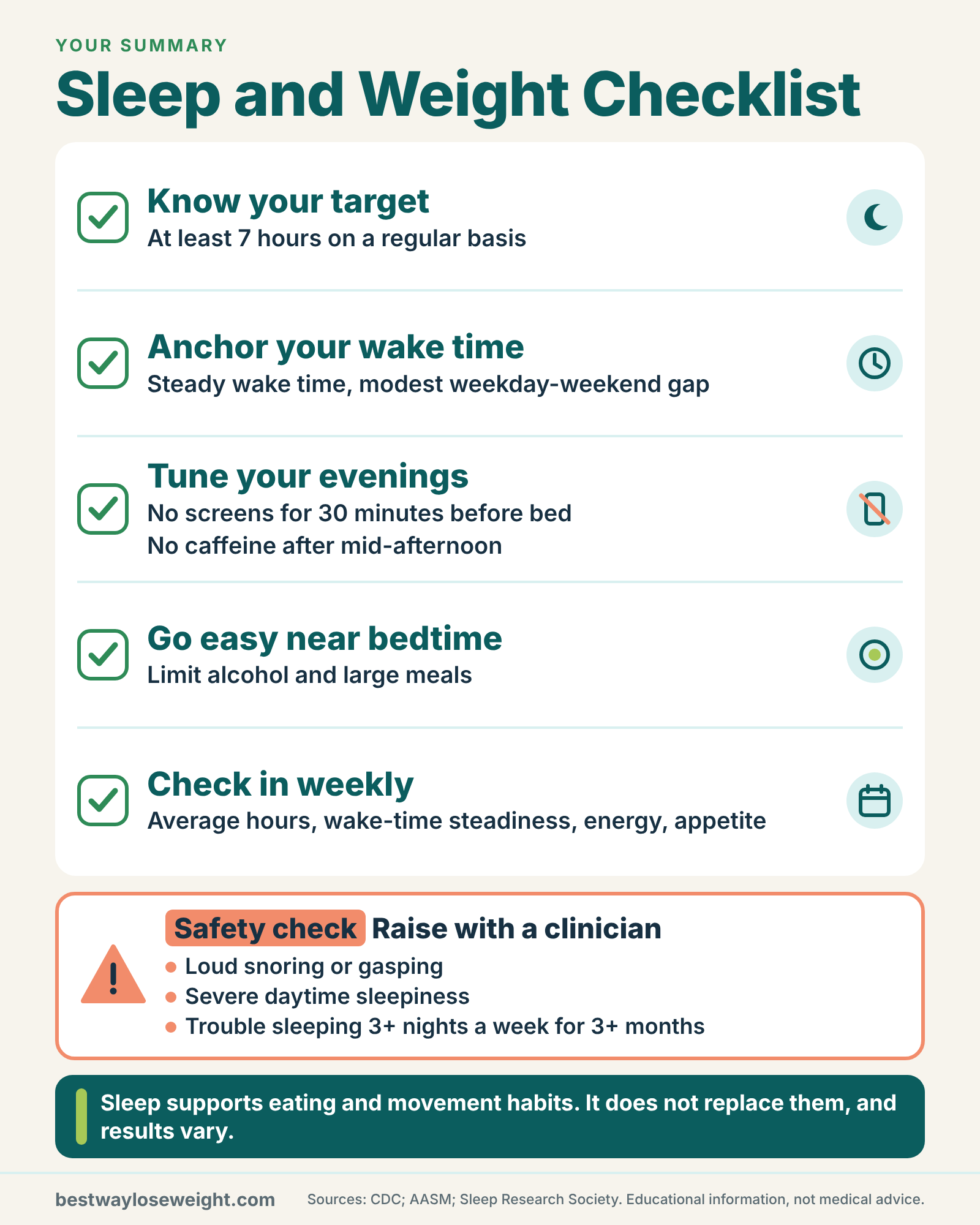
Loud snoring, gasping or breathing pauses, severe daytime sleepiness, trouble sleeping three or more nights a week for months, or sleep problems during pregnancy, with diabetes or while on medication all deserve a conversation with a health professional. Those situations call for individual advice, and an article can’t replace it.
Sleep for Weight Loss: What the Evidence Shows and Where It Stops
Sleep for weight loss is one of those topics where the headlines run well ahead of the data. The research is real, and it’s worth taking seriously. It’s also more mixed than the confident claims you’ll see on social media. Here’s a plain-English tour of the main pieces, starting with population studies and moving to trials.
Why short sleep and higher body weight show up together
What large population studies found
A 2008 meta-analysis (a study that pools results from many earlier studies) by Cappuccio and colleagues looked at short sleep and obesity. Of 696 studies identified, 45 met the inclusion criteria and 30 were pooled, covering 634,511 participants from around the world. Among adults, short sleepers had pooled odds of obesity of 1.55 (95% confidence interval 1.43 to 1.68) compared with people sleeping longer. Among children, the figure was 1.89. In adults, each additional hour of sleep corresponded to a BMI that was about 0.35 units lower.
The Wisconsin Sleep Cohort, reported by Taheri and colleagues in 2004, followed a similar thread in 1,024 participants who had an overnight sleep study. People who slept 5 hours had about 15.5% lower leptin and about 14.9% higher ghrelin than people who slept 8 hours. (Leptin is a hormone linked with feeling full, and ghrelin is linked with hunger.) Average BMI rose from 31.3 to 32.4 as sleep fell from 8 hours to 5, and the lowest average BMI appeared at about 7.7 hours of sleep.
Why a link is not the same as a cause
Neither of those studies shows that short sleep caused the extra weight. The Cappuccio authors themselves noted that causal inference is difficult because of limited control for important confounders and inconsistent evidence about which came first. Plenty of things can push sleep down and weight up at the same time: shift work, stress, depression, pain, caregiving, low income, and untreated sleep apnea. Weight can also affect sleep. The NHLBI lists excess weight as a risk factor for obstructive sleep apnea, which fragments sleep, so the arrow can point both ways.
How common short sleep is in the United States
Short sleep is common enough that this is a mainstream problem and not a niche one. A CDC analysis of 2020 data (Pankowska and colleagues, Preventing Chronic Disease, 2023) found that an age-adjusted 33.2% of US adults reported sleeping fewer than 7 hours a day. The rate peaked at 36.4% among adults aged 25 to 44, and it varied by income, marital status, race and ethnicity, and geography. If sleep feels hard to come by, you’re in very large company, and the barriers are often structural rather than a matter of discipline.
What randomized trials add to the observational picture
The sleep-extension trial in adults with overweight
The most-cited trial is Tasali and colleagues, published in JAMA Internal Medicine in 2022. It enrolled adults aged 21 to 40 with a BMI of 25.0 to 29.9 who habitually slept under 6.5 hours a night (80 analyzed, 40 per group). The intervention group got individualized sleep-hygiene counseling aimed at an 8.5-hour bedtime window for two weeks, and the control group kept their usual habits. By wrist-sensor measurement, the intervention group gained about 1.2 hours of sleep per night (95% CI 1.0 to 1.4). Their estimated energy intake fell by 270.4 kcal a day relative to controls (95% CI -393.4 to -147.4), and their body weight was 0.87 kg (about 1.9 lb) lower relative to the control group (95% CI -1.39 to -0.35). Measured energy expenditure didn’t differ significantly.
The calorie-restriction crossover trial
Nedeltcheva and colleagues (Annals of Internal Medicine, 2010) tested what sleep does when people are already eating less. Ten adults with overweight (mean age 41, mean BMI 27.4) completed two 14-day periods of moderate calorie restriction, one with an 8.5-hour sleep opportunity and one with 5.5 hours. Fat loss was 1.4 kg (about 3.1 lb) with the longer sleep window and 0.6 kg (about 1.3 lb) with the shorter one, and fat-free mass loss rose from 1.5 kg (3.3 lb) to 2.4 kg (5.3 lb). The authors concluded that lack of sufficient sleep may compromise the efficacy of typical dietary interventions. With only ten participants and two weeks, this is a mechanism study and not a guarantee.
Newer pooled evidence is more mixed
A 2026 systematic review and meta-analysis in Obesity Reviews (Mostafa and colleagues) pulled together behavioral sleep interventions in adults with poor sleep health: 27 studies reviewed, 25 in the meta-analyses. Programs using cognitive behavioral therapy for insomnia (CBT-I, a structured, non-drug program) or sleep-hygiene education (8 studies, 1,384 participants) lowered BMI by about 0.64 kg/m². Sleep-extension programs (5 studies, 138 participants) did not produce a statistically significant BMI change. The authors concluded that sleep interventions have potential to be integrated into obesity management alongside current lifestyle strategies. Read that as encouraging, with a lot of uncertainty about who benefits most and for how long.
How big could the effect realistically be?
Average results are not promises
Every number above is a group average from a specific population, usually young or middle-aged adults studied for days or weeks in settings where researchers were watching. Individual results vary, and nothing here supports promising a specific amount or speed of weight loss from sleep. A better question than “how many pounds will this take off?” is “does sleeping enough make my eating and activity plan easier to follow?” That’s a question you can test on yourself.
Reading the 270-calorie result with some care
The 270-kcal figure is a difference between groups. In the Tasali trial the extension group’s intake fell, and the control group’s intake actually rose by about 115 kcal a day, so part of the gap came from the comparison group drifting up. Two weeks is also short, the people studied had overweight but not obesity, and the weight difference was measured over just 14 days. It would be a mistake to multiply 270 kcal by 365 and announce an annual weight loss. Real bodies adapt, appetite changes, and life interrupts. The honest takeaway is narrower: in the short run, more sleep appeared to lower the amount people ate without being asked to diet.
Evidence at a glance
| Study | Design and size | Main finding | Main limitation |
|---|---|---|---|
| Cappuccio et al., 2008 (Sleep) | Meta-analysis of observational studies; 634,511 participants | Short sleep linked with higher odds of obesity in adults and children | Cross-sectional data; hard to separate cause from effect |
| Taheri et al., 2004 (PLoS Medicine) | Wisconsin Sleep Cohort; 1,024 participants | Shorter sleep linked with lower leptin, higher ghrelin and higher BMI; lowest BMI near 7.7 hours | Single morning blood sample; observational |
| Nedeltcheva et al., 2010 (Ann Intern Med) | Randomized crossover; 10 adults; 14 days per condition | With calorie restriction, 5.5 hours of sleep opportunity meant less fat lost and more lean mass lost than 8.5 hours | Very small; lab-controlled; short |
| Tasali et al., 2022 (JAMA Intern Med) | Randomized trial; 80 adults with overweight who slept under 6.5 hours; 2 weeks | About 1.2 more hours of sleep; about 270 fewer kcal per day eaten than controls | Short; limited population; long-term effect unknown |
| Mostafa et al., 2026 (Obesity Reviews) | Systematic review and meta-analysis; 25 studies in meta-analyses | Small BMI reduction with CBT-I or sleep-hygiene programs; no significant change with sleep extension alone | Small studies; mixed designs and populations |
How Many Hours of Sleep Do Adults Need?
Official guidance is fairly consistent, and it comes with an important footnote: these are population recommendations, not a prescription for your particular body. Here’s what the main sources say, why they use ranges, and what to make of the “too much sleep” question.
Official guidance by age
Adults 18 to 60: 7 or more hours
The CDC lists 7 or more hours for adults aged 18 to 60. A joint consensus statement from the American Academy of Sleep Medicine and the Sleep Research Society (Watson and colleagues, Journal of Clinical Sleep Medicine, 2015) says adults should sleep 7 or more hours per night on a regular basis to promote optimal health. A 15-member expert panel reached that conclusion using a modified RAND Appropriateness Method (a structured way of rating evidence and reaching agreement) after reviewing thousands of scientific articles across nine health categories. The statement noted that sleeping less than the recommended amount is associated with weight gain and obesity, among other adverse outcomes. It did not set an upper limit.
Teens, older adults and the 7-to-9 framing
The CDC lists 8 to 10 hours for teens aged 13 to 17, 7 to 9 hours for adults 61 to 64 and 7 to 8 hours for adults 65 and older. The NHLBI describes adults as needing between 7 and 9 hours a night. These aren’t competing numbers. The 7-or-more and 7-to-9 framings overlap, and both put the floor at 7. Teens and children need more, and the table below shows where each age group falls. If you’re parenting a teen who’s trying to manage weight, sleep is a conversation to have with their pediatrician rather than a place for calorie rules or pressure.
Recommended sleep by age
| Age group | Age range | Recommended sleep per day |
|---|---|---|
| Newborn | 0 to 3 months | 14 to 17 hours |
| Infant | 4 to 12 months | 12 to 16 hours, including naps |
| Toddler | 1 to 2 years | 11 to 14 hours, including naps |
| Preschool | 3 to 5 years | 10 to 13 hours, including naps |
| School age | 6 to 12 years | 9 to 12 hours |
| Teen | 13 to 17 years | 8 to 10 hours |
| Adult | 18 to 60 years | 7 or more hours |
| Adult | 61 to 64 years | 7 to 9 hours |
| Adult | 65 years and older | 7 to 8 hours |
Why one number is not enough
Individual need varies
The AASM and Sleep Research Society statement acknowledges that individual variability in sleep need is influenced by genetic, behavioral, medical and environmental factors, and that the mechanisms still need more research. In practice that means some people feel solid at 7 hours and others need closer to 8 or 9. The point of the guideline isn’t to assign you a number. It’s to say that if you’re regularly under 7, you’re more likely to be short of what your body needs.
Time in bed versus time asleep
Guidelines refer to sleep, not time in bed. Lying in bed for 8 hours but sleeping for 6 doesn’t deliver 8 hours of sleep. A simple way to see the gap is sleep efficiency: hours asleep divided by hours in bed, times 100. Six hours asleep out of 8 hours in bed is 6 divided by 8, or 75%. If your efficiency is low, adding even more time in bed may not add sleep, and the fix might be about timing, light, worry or a sleep disorder instead. The troubleshooting section later in this guide covers those cases.
Quality, timing and the absence of sleep disorders
The AASM said adequate sleep requires appropriate timing, daily regularity, good sleep quality and the absence of sleep disorders. That’s a useful checklist. Someone sleeping 8 hours with untreated sleep apnea, or sleeping 8 hours at times that clash with their body clock, may feel worse than someone sleeping 7 hours on a steady schedule. For weight management, this is why “sleep more” is incomplete advice.
Can you sleep too much?
What the federal and professional sources say
The NHLBI says sleeping more than 9 hours a night is not necessarily harmful and may be helpful for young adults, people recovering from sleep deprivation and people who are sick. The AASM consensus panel likewise agreed that sleeping more than 9 hours may be appropriate for young adults, people recovering from sleep debt and people with illnesses. In other words, long sleep isn’t automatically a problem. It can be your body repaying a debt.
The U-shaped pattern in large studies
In a 2010 meta-analysis of 16 studies (27 cohort samples, 1,382,999 participants, 112,566 deaths), Cappuccio and colleagues found a relative risk of death of 1.12 for short sleepers and 1.30 for long sleepers compared with people in the middle. The Taheri study above showed a similar U shape for BMI. Researchers often suspect that long sleep is partly a marker of underlying illness, depression or sleep disorders, which again is association and not cause. The practical message: if you consistently need well over 9 hours and still feel unrested, or your sleep need changed suddenly, mention it to a clinician. Don’t try to cut your sleep to a smaller number on your own.
How to Find Your Own Sleep Number: Logs, Bedtime Math and Sleep Debt
Guidelines give you a range. A short experiment gives you your range. The steps below take about two weeks and need nothing more than a notes app or a piece of paper.
Keep a two-week sleep log
What to record each day
Clinicians use sleep diaries when evaluating sleep problems, and the NHLBI mentions this in its insomnia guidance, so you’re borrowing a standard tool. Each morning, jot down:
- The time you got into bed and the time you tried to fall asleep
- Roughly how long it took to fall asleep and how many times you woke up
- The time you woke for good and the time you got out of bed
- Caffeine (when your last cup was), alcohol, and when you finished your last meal
- A 1-to-5 energy rating and a 1-to-5 appetite rating for the day
Estimates are fine. You’re looking for patterns, not lab precision.
How to read the log
After 14 days, calculate your average sleep on workdays and on free days separately. If free-day sleep is regularly an hour or more longer than workday sleep, that gap is a hint that you may be running short during the week. (This is a rule of thumb, not a diagnostic test.) Then look at your 1-to-5 ratings. Days after 7 or more hours of sleep might show higher energy or steadier appetite. If you see no relationship at all, that’s useful too, and it may mean that duration isn’t your main issue.
Work backward from your wake time
The bedtime formula
Most people choose a bedtime and hope for the best. Working backward is more reliable, because your wake time is usually the fixed point. The formula:
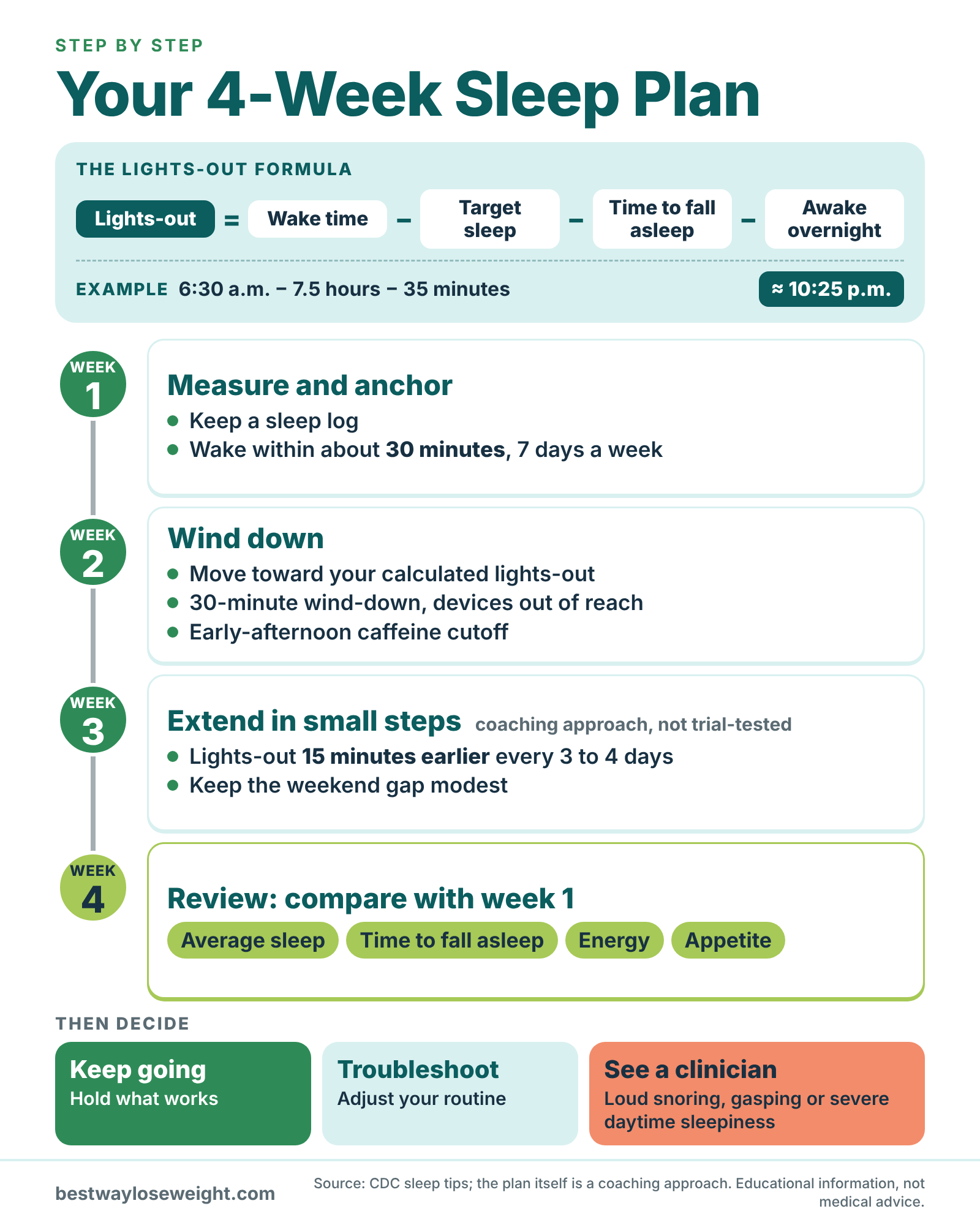
Lights-out time = wake time, minus target sleep, minus the time it usually takes you to fall asleep, minus typical time awake during the night.
Worked example, with assumptions stated: you wake at 6:30 a.m., you’re aiming for 7.5 hours of sleep, it takes you about 20 minutes to fall asleep and you’re usually awake about 15 minutes in total overnight. Start at 6:30 a.m. and subtract 7 hours 30 minutes, which gives 11:00 p.m. Subtract another 35 minutes (20 plus 15) and lights-out lands at about 10:25 p.m. If you want a 30-minute wind-down, it starts around 9:55 p.m. That’s earlier than most people expect, and it’s why a “reasonable” 11:30 p.m. bedtime often turns into 6 hours of sleep.
Three example schedules
| Situation | Wake time | Sleep target | Assumed time to fall asleep plus night awakenings | Lights-out | Wind-down starts |
|---|---|---|---|---|---|
| Early commuter | 5:30 a.m. | 7 hours | 15 minutes | 10:15 p.m. | 9:45 p.m. |
| Parent of school-age kids | 6:15 a.m. | 7.5 hours | 30 minutes | 10:15 p.m. | 9:45 p.m. |
| Evening shift (home by midnight) | 9:00 a.m. | 7.5 hours | 20 minutes | 1:10 a.m. | 12:40 a.m. |
Notice what the table makes visible: for the first two, a 10:15 p.m. lights-out leaves little room for a long evening. Your schedule decides where sleep can come from, which is why the later planning sections look at trade-offs instead of assuming everyone can simply go to bed earlier.
Sleep debt arithmetic
A worked weekly example
Sleep debt is the gap between the sleep you needed and the sleep you got. Suppose your target is 7.5 hours. You sleep 6 hours Monday through Friday, then 8.5 hours on both Saturday and Sunday. Weekly sleep is 5 × 6 + 2 × 8.5, which equals 30 + 17, or 47 hours. The target for the week is 7 × 7.5, or 52.5 hours. You’re 5.5 hours short, which averages out to about 6.7 hours a night even though two nights looked generous. Seeing the weekly total is often more motivating than judging any single night.
Why weekend catch-up only goes so far
A 2019 laboratory study in Current Biology (Depner and colleagues, 36 healthy adults over two weeks) compared a control group sleeping up to 9 hours, a group limited to 5 hours, and a group limited to 5 hours on weekdays with unrestricted weekend sleep. The weekend-recovery group slept only about 3 extra hours across the two weekend nights, gained about 3 pounds, like the chronic-restriction group, and saw insulin sensitivity fall in both restricted groups. (Insulin sensitivity is how well your body responds to the hormone that moves sugar out of the blood.) The NIH summary of the findings reports a 27% drop in the weekend-recovery group, notably in liver and muscle, compared with 13% in the group that never recovered. The authors concluded that weekend recovery did not appear to be an effective countermeasure. This was a small study in healthy young adults in a lab, so don’t over-read it. The practical takeaway is gentler: if you can, spread extra sleep across weeknights, even 15 to 30 minutes at a time, instead of relying on Saturday to fix the week.
How Short Sleep Can Change Eating, in Plain English
This section gives the short version of the mechanisms, because it explains why a sleep target can matter to a weight plan. For a deeper look at hunger hormones and habits, see our companion guide on sleep and weight loss: how sleep affects hunger and habits.
Appetite signals and food reward
Hunger and fullness hormones
In a classic experiment (Spiegel and colleagues, Annals of Internal Medicine, 2004), 12 healthy young men spent two nights with 4 hours in bed (about 3 hours 53 minutes of sleep on average) and two nights with 10 hours in bed (about 9 hours 8 minutes of sleep). After the short nights, leptin was about 18% lower, ghrelin was about 28% higher and overall appetite was about 24% higher. Participants also wanted sweet, salty and starchy foods more, while their interest in fruit, vegetables and dairy increased much less. The sample was small, all male and young, and the restriction lasted only two nights.
How the brain weighs food after a bad night
Greer and colleagues (Nature Communications, 2013) scanned 23 healthy young adults after a normal night (about 8.2 hours) and after a night of total sleep deprivation. After deprivation, activity fell in brain regions involved in evaluating food choices while the amygdala, a region tied to emotional reactions, became more reactive. Participants also rated more high-calorie items as “wanted,” and on average they wanted about 600 additional calories’ worth of those foods. A full night without sleep is more extreme than usual short sleep, and the study measured desire for food, not what people actually ate. Think of it as a plausible mechanism, not a measure of your next snack.
What happens to intake and to energy expenditure
The pooled evidence on calories eaten
A systematic review and meta-analysis (Al Khatib and colleagues, European Journal of Clinical Nutrition) covered 17 studies (496 participants) of partial sleep deprivation, with 11 studies (172 participants) in the pooled analysis. Energy intake rose by about 385 kcal on average (95% CI 252 to 517). Total energy expenditure and resting metabolic rate did not change significantly. Intake shifted toward more fat and less protein, with no clear effect on carbohydrate. That fits with Tasali’s 270-kcal difference, though the studies differ in design, so they shouldn’t be treated as one precise number.
Late-night snacking and tired decision-making
In the Depner weekend-recovery study, the sleep-restricted groups ate more late at night, according to the NIH summary. It’s plausible that being tired also makes convenient foods more appealing and planning harder, though the trials above don’t test that directly, so it remains a reasonable hypothesis and not a finding. If late-evening eating is your pressure point, it helps to decide ahead of time what an evening snack looks like. For people exploring meal timing more generally, our guide to intermittent fasting for weight loss covers what the evidence says.
What this means for a calorie plan
A worked example of intake drift
This example is an illustration, using numbers inside the range the trials reported. It isn’t a prediction for you. Say your estimated maintenance is 2,300 kcal a day and you plan to eat about 1,800, a 500-kcal planned deficit. If a stretch of poor sleep nudges your actual intake up by 250 kcal a day without you noticing, your real deficit shrinks to 250 kcal, which is half of what you planned. Across a week, that’s a planned 3,500 kcal deficit turning into 1,750. Nothing about your effort changed. What changed was your body’s appetite signals and the shape of your day. If you’re not sure how to estimate your own maintenance number, see our TDEE calculator guide.
Sleep supports the plan but does not replace it
Because the trials found intake changing and energy expenditure not changing, sleep appears to work mainly by influencing how much you eat, not by burning more. That means a calorie deficit is still the mechanism of fat loss, and sleep is one of the things that can make it easier or harder to maintain one. For the mechanics, see how a calorie deficit works for weight loss. Treat adequate sleep as a way to protect your plan from drifting, not as a substitute for having one.
Sleeping Enough During Active Weight Loss
The question changes a bit once you’re actually in a calorie deficit. Now you’re asking whether sleep affects what you lose, how you feel and whether you keep going. Here’s what the research offers.
Protecting lean mass while eating less
Why the fat-free mass result matters
In the Nedeltcheva crossover trial, the proportion of lost weight that came from fat was lower when sleep was cut to 5.5 hours. Fat-free mass is everything in your body that isn’t fat, including muscle, organs, bone and water, and some of that loss in a short trial can reflect water shifts as well as muscle. The authors’ conclusion was that insufficient sleep may compromise dietary efforts. Because it’s ten people over 14 days, it can’t tell us how this plays out over six months. What it does is give a reason, alongside the appetite findings, to treat sleep as part of the plan.
Pairing sleep with protein and resistance training
The most evidence-based ways to hold on to muscle while you lose weight are eating enough protein and doing resistance exercise, not any sleep trick. Sleep supports your ability to train and recover, but it doesn’t replace either. Our guides on how much protein you need to lose weight and strength training for weight loss cover the specifics. Think of the three as a trio: sleep, protein and lifting each cover a different gap.
Sleep quality and sticking with a program
What a six-month behavioral program found
Thomson and colleagues (Obesity, 2012) analyzed 245 women with overweight or obesity (mean age 45.5, mean BMI 33.9) in a weight-loss intervention trial; 198 completed the 24-month weight assessment. At baseline, 52.7% reported clinically significant sleep problems. Women who reported better subjective sleep quality, and women who slept 7 or more hours, were more likely to reach weight-loss success in the six-month program (the quality finding was a 33% higher likelihood). Worse sleep quality at six months was associated with a 28% lower likelihood of sustained weight loss at 18 months. This is observational data within a trial, so it can’t show that improving sleep would change outcomes. Sleep problems might also be a marker for stress or other barriers.
A 2025 digital coaching study
A 2025 analysis in Obesity Medicine followed 1,883 participants (82.6% women, median age 52, median BMI 39.1) in a 12-month digital lifestyle program with self-reported measures. Sleep apnea, tiredness and an evening chronotype (being a “night owl,” meaning a body clock that runs later) were each linked with less weight loss, while improving daytime alertness over the program was linked with better results. These are associations in a self-reported dataset. One useful reading is that how alert you feel during the day may be a more practical thing to track than a precise number of hours.
Energy for movement and the 24-hour picture
Sleep, activity and sitting as one day
Canada’s 24-Hour Movement Guidelines for Adults (18 to 64) treat the whole day as a unit. They recommend 7 to 9 hours of good-quality sleep on a regular basis with consistent bed and wake-up times, at least 150 minutes a week of moderate-to-vigorous aerobic activity, muscle-strengthening activities at least twice a week, and several hours of light activity including standing. The value of that framing is that you aren’t trading sleep against exercise as if they were rivals. If you’re building up your walking, our guide to walking for weight loss shows how to scale it.
What to do on a very short-sleep day
No trial tells you the exact cutoff at which a workout should be swapped for rest, so this is judgment, not a rule. If you slept far less than usual and a hard session feels like a stretch, an easy walk or a lighter session keeps the habit alive without piling on strain. Then protect the next night. If it keeps happening, that’s a signal about your schedule or about a possible sleep problem, and not a reason to push harder.
Consistency, Light and the Sleep Environment
Duration gets the attention, but a few studies suggest that regularity and the room you sleep in also matter. Most of this evidence is observational, so the framing here is “reasonable to try” and not “proven.”
Regular timing: bedtime consistency and social jet lag
The NoHoW analysis of weight regain
Larsen and colleagues (PLoS Medicine, 2020) tracked 967 adults from Britain, Denmark and Portugal who had lost at least 5% of their weight in the prior year and had a BMI of 25 or higher, using Fitbit Charge 2 devices for 12 months. Average sleep duration and average sleep timing weren’t associated with weight regain or body-fat change. But greater variability in sleep onset (how much bedtime moved around) was associated with regain of about 0.55 kg (1.2 lb) per hour of variability (95% CI 0.10 to 0.99) and with higher body fat percentage. It’s an observational study, so consistent bedtimes could simply be a marker of a more structured life. Still, bedtime regularity is free to try.
Social jet lag and body weight
Social jet lag is the mismatch between your body clock and your social schedule, often seen as sleeping later on free days than on workdays. A 2024 systematic review and meta-analysis in Obesity Reviews (Arab and colleagues) pooled 43 studies and 231,648 participants. Social jet lag was positively associated with BMI (correlation 0.12), fat mass (0.10), waist circumference (0.15) and the odds of overweight or obesity (odds ratio 1.20). Those are small associations, between-study differences were very large, and the authors said causality still needs testing. So the finding supports keeping the weekday-weekend gap modest, but it doesn’t prove that closing it will change your weight.
Light, screens and the room itself
Light while sleeping
In the Sister Study (Park and colleagues, JAMA Internal Medicine, 2019), more than 43,000 women who slept with a television or other artificial light on were more likely to be overweight or obese at the start and more likely to gain weight or become obese during follow-up. According to the NIH summary, differences in sleep quality and duration, calorie intake and physical activity did not explain the connection. It’s an association and it can’t prove causation, and the people who sleep with lights on may differ in ways the study can’t capture. Cheap fixes such as turning off the TV, using blackout curtains or covering small standby lights cost little to try.
Screens before bed
A small 2015 experiment in PNAS (Chang and colleagues) compared reading a light-emitting e-reader with reading a printed book before bed. With the light-emitting device, participants took longer to fall asleep and had reduced evening sleepiness, reduced melatonin secretion, later circadian timing and lower next-morning alertness. (Melatonin is a hormone that rises in the evening and helps signal nighttime.) The CDC’s practical advice is to put electronic devices away at least 30 minutes before bed. If your phone use is as much about stress as about light, a different wind-down activity may do more than a filter.
A cool, quiet room
The CDC also recommends a quiet, relaxing and cool sleeping environment, along with the same bedtime and wake time every day. A fan or white noise, a lighter blanket and keeping pets or devices off the bed are common-sense versions. Whether any one of these changes your sleep length is individual, so it’s worth changing one thing at a time and checking your log, instead of rebuilding the whole bedroom at once.
What each environment change is backed by
| Change | What the sources say | Strength of support for weight |
|---|---|---|
| Consistent bed and wake times | Recommended by the CDC and Canadian 24-hour guidelines; bedtime variability linked with regain in one observational study | Reasonable to try; not proven to change weight |
| Smaller weekday-weekend gap | Social jet lag linked with higher BMI in pooled observational studies | Association only |
| No screens for 30 minutes before bed | CDC tip; small experiment showed delayed sleep onset and circadian timing with a light-emitting device | Supports sleep; effect on weight not tested |
| No TV or artificial light on while sleeping | Linked with weight gain in a large cohort of women | Association only |
| Quiet, cool, comfortable room | CDC sleep tip | Supports sleep; effect on weight not tested |
Evening Habits That Shorten or Fragment Sleep
Once you know your target, the next question is what stands between you and it. A handful of evening habits come up again and again in federal guidance and sleep research. You don’t have to change all of them. Pick the one that your log suggests is costing you the most.
Caffeine and alcohol
Caffeine timing
The CDC’s sleep tips include skipping caffeine after mid-afternoon. Coffee is the obvious source, but caffeine also hides in tea, cola, energy drinks, pre-workout powders and some chocolate and pain relievers. Sensitivity varies a lot from person to person, so a fixed rule can be too strict for some and too loose for others. A simple self-test: for one week, stop caffeine by early afternoon, and compare how long it takes you to fall asleep with your baseline log. If you’re using caffeine to push through sleep debt, the better long-term move is to repay the debt.
Alcohol and sleep
A 2013 review of studies on alcohol and sleep (Ebrahim and colleagues, Alcoholism: Clinical and Experimental Research) found that at all dosages, alcohol reduced the time it took to fall asleep, made the first half of the night more consolidated and increased sleep disruption in the second half. REM sleep (the stage most associated with vivid dreaming) was reduced at moderate and high doses, and the first REM period was delayed at all doses. In plain terms, a nightcap may help you drop off but can leave the second half of the night choppy. The CDC also advises avoiding alcohol before bed. Alcohol contributes calories as well, which matters if you’re tracking intake, but the sleep effect is a separate reason to look at your evening routine.
Evening meals and snacks
Big late meals
The CDC suggests avoiding substantial meals before sleep. Many people find that going to bed uncomfortably full, or eating a very large dinner late, makes it harder to settle. There isn’t a single trial-tested cutoff, so a practical approach is to notice your own pattern: does a late heavy meal show up in your log on nights when it takes longer to fall asleep? If so, shifting the biggest meal earlier or making it lighter is a low-cost experiment. For a fuller look at when you eat, not just what, see our guide on intermittent fasting and meal timing.
Hunger at night on a calorie plan
If you’re in a deficit and you’re hungry at bedtime, plan for it rather than white-knuckling it. A small snack built from protein and fiber, such as Greek yogurt with berries or an apple with a little peanut butter, fits into most plans and takes the edge off. If you’re regularly kept awake by hunger, your deficit may be larger than is comfortable for you. A moderate deficit is usually easier to live with, and very-low-calorie approaches belong under clinician supervision. Our calorie deficit guide explains how to size one sensibly.
The wind-down routine
A 30-minute buffer
The CDC’s advice to put electronic devices away at least 30 minutes before bed is a good anchor for a short buffer between “doing” and “sleeping.” A simple routine might be: set out tomorrow’s clothes and lunch, turn the lights low, wash up, then read a printed book or listen to something quiet. The routine matters more than any specific step. Repeating the same sequence tells your body what’s coming.
Handling a busy mind
If your mind starts running through tomorrow’s to-do list the moment you lie down, a common behavioral tactic is a short “brain dump”: write tomorrow’s tasks and worries on paper earlier in the evening so you can tell yourself they’re already handled. This is a widely used sleep-coaching technique, though the research behind it is limited, so treat it as an experiment. If racing thoughts are persistent, that’s worth raising with a clinician, because anxiety and sleep problems often travel together.
Evening habits at a glance
| Habit | What the sources say | First experiment to try |
|---|---|---|
| Caffeine in the afternoon or evening | CDC advises skipping caffeine after mid-afternoon; individual sensitivity varies | One week with an early-afternoon cutoff; compare time to fall asleep |
| Alcohol near bedtime | Review found easier sleep onset but more disruption in the second half of the night | Move any drink earlier in the evening, or skip it on nights you need good sleep |
| Large late meal | CDC advises avoiding substantial meals before sleep | Make dinner earlier or lighter on three nights and compare notes |
| Bright screens in bed | CDC tip: no devices for 30 minutes before bed; small experiment showed delayed sleep onset | Charge the phone outside the bedroom for one week |
| Racing thoughts at lights-out | Brain-dump technique is common in sleep coaching; research is limited | Ten minutes of writing earlier in the evening |
A Four-Week Plan to Add Sleep Without Rebuilding Your Life
This plan is a practical structure, not a clinical protocol. The steps combine federal sleep tips and the findings above with common behavioral coaching practice. The 15-minute stepping approach in week 3, in particular, is a coaching heuristic and hasn’t been tested in the trials cited in this article. Adjust the pace to your life, and skip anything that doesn’t suit you.
Weeks 1 and 2: Measure and anchor
Week 1: log and fix your wake time
Don’t try to change bedtime yet. Start the sleep log, and pick a wake time you can keep within about 30 minutes on all seven days. Set one alarm. Use the bedtime formula from earlier to calculate where your lights-out time should land, but only note it down for now. The goal this week is baseline data and a steady anchor, because a steady wake time tends to make everything else easier to adjust.
Week 2: set lights-out and start a wind-down
Move to the lights-out time you calculated, or as close as your evening allows. Add the 30-minute wind-down and charge devices outside the bedroom, or at least out of reach. Try the early-afternoon caffeine cutoff for one week. Keep logging. If you can’t reach your calculated bedtime on workdays, don’t force it, because the next step is designed to close the gap gradually.
Weeks 3 and 4: Extend and protect
Week 3: step toward your target
If your average sleep is still below your target, move lights-out about 15 minutes earlier every three or four days until you get there. Small steps are easier to defend against a busy evening than one big jump. Keep the weekend gap modest: try to keep free-day wake times within an hour of workday wake times, because large weekday-weekend swings are linked with higher BMI in observational research.
Week 4: review and decide
Compare your week 4 log with week 1. Look at average sleep, how long you took to fall asleep, your 1-to-5 energy ratings and your 1-to-5 appetite ratings. There are three possible conclusions. If you’re sleeping about as long as your target and feeling better, keep going and fold the routine into your weekly plan. If you’re in bed long enough but not sleeping, move to the troubleshooting section. If you snore loudly, wake unrefreshed or have persistent daytime sleepiness, talk to a clinician instead of tweaking further.
The four weeks in one table
| Week | Focus | Actions | What to check |
|---|---|---|---|
| 1 | Baseline and anchor | Start the log; fix wake time within about 30 minutes; calculate lights-out | Average sleep; workday versus free-day gap |
| 2 | Wind-down and cutoffs | Move toward calculated lights-out; 30-minute wind-down; devices out of reach; early caffeine cutoff | Time to fall asleep; evening hunger |
| 3 | Extend | Step lights-out about 15 minutes earlier every three or four days; keep weekend gap modest | Average sleep versus target; energy rating |
| 4 | Review | Compare to week 1; decide to keep, adjust or seek advice | Appetite rating; daytime alertness; any red flags |
Finding the time when your day is already full
Where sleep time can come from
Time for sleep usually has to come from somewhere, and it helps to name the source ahead of time. The usual candidates are late-evening scrolling or television, chores that can move to the morning or weekend, a second round of email after dinner, and the half hour of “one more episode.” Batch-cooking on a weekend can shorten weeknight dinners. If your wake time is fixed by work or kids, bedtime is the only lever, which is why the bedtime formula starts from the wake time.
What to protect and what to trade
Be careful about what you trade. Cutting meal prep may push you toward convenience foods, and dropping every workout to gain 30 minutes of sleep may lower your weekly activity. The 24-hour guidelines treat sleep, activity and sitting as parts of the same day. A reasonable trade is low-value time such as aimless scrolling. A poor trade is the one thing that keeps your eating or movement on track. When the day simply won’t stretch, even a modest gain of 20 to 30 minutes on most nights is a legitimate win.
Troubleshooting: In Bed Long Enough but Still Not Sleeping Enough
Sometimes the hours are available and sleep still doesn’t come. That’s a different problem from a crowded schedule, and the solution isn’t simply an earlier bedtime. The patterns below are common, and each has a sensible first step.
If-then guide for common patterns
If falling asleep takes a long time
If you regularly lie awake for 30 minutes or more, check the usual suspects first: caffeine timing, bright light and screens, a heavy late meal, and a mind that hasn’t wound down. Then look at the timing itself. Going to bed well before you feel sleepy can lengthen the time you lie awake. A widely used behavioral approach, taught in CBT-I programs, is to get up if you’ve been awake for a long stretch, keep the lights low, do something quiet, and go back when you feel sleepy. This is general behavioral guidance and not a prescription for you, so a clinician or CBT-I provider can tailor it.
If you wake in the night or too early
Waking in the night can come from alcohol (which tends to disrupt the second half of the night, as covered above), a warm room, needing the bathroom, hunger, stress, pain or a breathing problem such as sleep apnea. Hot flashes and night sweats can also fragment sleep around perimenopause and menopause, and our guide to menopause and weight gain covers that stage of life. Early waking that comes with low mood or loss of interest deserves a conversation with a clinician, because sleep changes can be an early sign of depression.
If you sleep enough hours but wake unrefreshed
Hours alone don’t guarantee rest. Persistent tiredness despite 7 or more hours, especially with loud snoring, gasping, morning headaches or sleepiness while driving or working, is a reason to ask about a sleep study. A clinician may also look at medications, mood, thyroid function and other conditions. Don’t try to diagnose this yourself, and don’t assume the answer is more caffeine.
A quick if-then table
| If this is happening | Contributors to check | First step | Talk to a clinician if |
|---|---|---|---|
| Takes 30 minutes or more to fall asleep | Late caffeine, screens, late meal, worry, bedtime earlier than your body is ready for | Wind-down routine; caffeine cutoff; brain dump | It happens three or more nights a week for months |
| Wake during the night | Alcohol, warm room, bathroom trips, hunger, stress, hot flashes | Adjust room and evening drinks; plan an evening snack | Loud snoring, gasping or breathing pauses are noticed by a partner |
| Wake too early and can’t get back to sleep | Morning light, stress, mood, alcohol | Darker room; consistent wake time; limit evening alcohol | Low mood, loss of interest or hopelessness accompany it |
| Enough hours but still exhausted | Sleep apnea, medications, other conditions, irregular timing | Keep the log; check timing consistency | Daytime sleepiness affects driving, work or safety |
| Sleep is fine on weekends only | Weekday schedule too short; social jet lag | Move weeknight lights-out earlier in small steps | You need long weekend sleep and still feel unrested |
Insomnia and cognitive behavioral therapy for insomnia
What the guidelines say
The NHLBI describes chronic insomnia as trouble falling or staying asleep that occurs three or more nights a week, lasts more than three months and can’t be explained by another health condition. The American College of Physicians’ guideline (Qaseem and colleagues, Annals of Internal Medicine, 2016) gives a strong recommendation, based on moderate-quality evidence, that all adults receive cognitive behavioral therapy for insomnia (CBT-I) as the initial treatment for chronic insomnia. The guideline says medications should ideally be reserved for short-term use. As always, decisions about any sleep medicine belong to you and your clinician.
Why “just spend more time in bed” can backfire
If you have insomnia, extending time in bed can reinforce lying awake and associating the bed with frustration. CBT-I programs commonly address this with carefully guided limits on time in bed. That’s a clinician-led technique, and it’s one reason the four-week plan above is for people whose main barrier is time and habits. If you suspect insomnia, the pooled analysis mentioned earlier is relevant: programs built around CBT-I and sleep hygiene showed a small BMI reduction, while plain sleep extension did not show a significant effect. Getting the right kind of help seems to matter more than simply trying to sleep longer.
Shift Work, Parenting, Travel and Other Real-Life Constraints
Advice about sleep often assumes a 9-to-5 job, no kids and a quiet bedroom. Plenty of readers live differently. The goal in this section is to adapt, not to judge.
Shift work and irregular schedules
What occupational health sources say
The CDC’s National Institute for Occupational Safety and Health (NIOSH), on a page reviewed in July 2026, says nonstandard schedules that disrupt or shorten sleep, including night work and long hours, are a common source of fatigue. Fatigue can slow reaction time, reduce focus, limit short-term memory and impair decision-making. The sources reviewed for this article didn’t give a reliable estimate of how much shift work changes weight, and long-term trial data on weight outcomes in shift workers are limited. So the practical question is how to protect sleep within the schedule you actually have.
Practical tactics that fit a shifting schedule
These are general coaching suggestions, not trial-tested prescriptions. Treat your main sleep block as non-negotiable and keep it at roughly the same time on as many days as possible. Use blackout curtains or a sleep mask for daytime sleep, and tell your household when you’re asleep. Pack meals and snacks for the shift so you’re not relying on vending machines at 3 a.m. Keep caffeine to the first part of the shift. On days off, shift your sleep toward your normal schedule gradually and don’t flip it all at once if you can avoid it. If you’re often drowsy at work or while driving, take that seriously and tell a clinician.
Parents, caregivers and students
Broken sleep with babies and young children
If your sleep is chopped up by a baby or a sick child, a 7-hour target may be unrealistic for a season. Aim to protect your longest possible sleep block, trade night duties with a partner if you can, and take a short rest when the child naps if it helps. During this phase, it’s usually wiser to keep weight goals modest and food simple than to run an aggressive deficit on top of sleep loss. If you’re pregnant, recently postpartum or breastfeeding, check with your clinician before changing how you eat to lose weight. Weight management in those stages needs individual advice.
Students and young adults
The CDC analysis noted that short sleep was most common among adults aged 25 to 44, and late schedules are common among students and young adults. All-night study sessions and weekend sleep-ins create the large weekday-weekend gap linked with higher BMI in the social jet lag research. The most useful single habit is a consistent wake time, including on weekends, as far as your class schedule allows. Energy drinks can add both caffeine and sugar, so check labels if you rely on them.
Travel, life stages and health conditions
Time zones and travel
Sleep after crossing time zones is a short-term disruption and not a lasting setback. A common approach is to move your wake time and meal times toward local time as soon as you can and to get daylight earlier in the day at your destination. Don’t judge your sleep or your weight by the first few days of a trip. The evidence on travel and weight specifically is thin, so keep expectations flexible.
Adolescents, pregnancy, menopause and chronic conditions
Several groups need individual guidance rather than general rules. Adolescents have higher sleep needs and shouldn’t be put on adult-style diets or sleep restrictions. Pregnancy and breastfeeding change both sleep and nutrition needs. People with diabetes, heart disease, a history of disordered eating or those taking prescription medicines should check with their clinician before changing eating or sleep routines in a major way. If you have a history of an eating disorder, an intense focus on tracking sleep and weight can sometimes be unhelpful, and a clinician can help you decide how much tracking is right for you.
When Poor Sleep Needs a Clinician: Sleep Apnea, Insomnia and Medications
Everything above assumes that your sleep problem is mostly about time and habits. Some problems aren’t, and weight and sleep apnea in particular are closely connected. This section is educational and isn’t a substitute for an evaluation.
Sleep apnea and weight
What sleep apnea is and what it looks like
The NHLBI describes sleep apnea as a common condition in which breathing stops and restarts many times during sleep. Obstructive sleep apnea (the more common type) happens when the upper airway becomes blocked. Warning signs include snoring or gasping during sleep and excessive daytime sleepiness. Risk factors include obesity, enlarged tonsils and hormonal changes that can narrow the airway. The NHLBI notes that untreated sleep apnea can impair concentration, memory and decision-making and increases the risk of stroke, heart attack and other serious problems. If you suspect it, ask your clinician about a sleep study. The NHLBI page was last updated in January 2025.
What weight loss can do for apnea
The relationship runs both ways, and weight loss can help. In the Sleep AHEAD study (Kuna and colleagues, Sleep, 2013), 264 adults with obesity, type 2 diabetes and obstructive sleep apnea were randomized to an intensive lifestyle program or to diabetes support and education. At year 1 the lifestyle group had lost an average of 10.7 kg (about 24 lb) compared with under 1 kg (about 2 lb), and apnea severity (measured by the apnea-hypopnea index, or breathing disruptions per hour) was lower by 9.7 events per hour relative to controls. At year 4, remission of sleep apnea was five times more common with the lifestyle program (20.7% versus 3.6%). Weight loss isn’t a substitute for diagnosis and treatment, though. If you have sleep apnea, ask your clinician how weight loss fits with other treatments such as a CPAP machine (a device that keeps the airway open with air pressure).
Prescription options and what to ask
As of October 2026, one fact is worth knowing about because it affects conversations with clinicians. According to the manufacturer’s announcement, the FDA approved tirzepatide (Zepbound) on December 20, 2024 for adults with moderate-to-severe obstructive sleep apnea and obesity, to be used with a reduced-calorie diet and increased physical activity. That statement comes from the company’s press release, and the FDA label and Drugs@FDA entry are the places to confirm the exact indication and safety information before relying on it. Whether any prescription option is right for you is a decision for you and your clinician. Our complete guide to losing weight safely and our GLP-1 guide put medication in context.
Red flags and questions for your clinician
When to book an appointment
Consider making an appointment if any of these apply:
- Loud snoring, gasping, choking or witnessed breathing pauses during sleep
- Sleepiness during the day that affects driving, work or safety, even after enough hours in bed
- Trouble falling or staying asleep three or more nights a week for more than three months
- Morning headaches, or waking unrefreshed on most days
- Sudden change in how much you need to sleep, or sleep problems alongside low mood, anxiety or hopelessness
- Sleep problems during pregnancy, breastfeeding or with a chronic condition such as diabetes
Questions to ask
- Could any of my medicines or supplements be affecting my sleep or appetite?
- Should I be screened for sleep apnea, and what would a sleep study involve?
- Is CBT-I available to me, in person or online?
- How should I approach weight loss while I’m sleeping poorly or being treated for a sleep disorder?
- Do my other conditions change how much sleep or what kind of schedule I should aim for?
Putting Sleep Together With Eating, Movement and Tracking
A sleep plan works best when it sits alongside the other pieces of weight management instead of competing with them. Here’s a way to sequence the work and a simple way to track it.
Where sleep fits in a weekly plan
A priority stack you can use
This is a decision framework for organizing effort, not a ranking of scientific evidence. Work down the list and stop where your biggest gap is.
- Safety first. If you have red flags for sleep apnea, insomnia or a medical condition, start with a clinician.
- Duration and wake-time anchor. Aim for at least 7 hours of sleep on a regular basis, with a steady wake time.
- Eating pattern. Build meals around protein, fiber and foods you’ll actually eat, with a moderate and sustainable deficit if weight loss is the goal.
- Movement. Add walking and two strength sessions a week as your schedule permits.
- Refinements. Light, caffeine timing, alcohol, evening snacks and the sleep environment.
Which problem to start with
| Your main barrier | Start here | Pair it with |
|---|---|---|
| Not enough time in bed | Bedtime formula and a fixed wake time; trade low-value evening time | A planned evening snack and simple dinners |
| Enough time in bed, poor sleep | Troubleshooting steps; consider CBT-I; check for apnea | Daytime light and regular activity; consistent meal times |
| Irregular schedule | Anchor one sleep block and keep the weekend gap modest | Packed meals and a caffeine cutoff |
| Possible sleep disorder | Clinician visit first | Weight-loss plan agreed with your clinician |
| Short on sleep during a calorie deficit | Protect sleep before tightening the deficit further | Protein and resistance training to preserve lean mass |
Tracking without obsessing
A paper log works fine, and wearables can add convenience. The NoHoW study used a consumer wearable and found patterns in bedtime variability, but consumer devices only estimate sleep, and accuracy varies by device and by person. If tracking raises your anxiety about sleep, that can backfire, and a weekly average of hours and a daytime-energy rating will do. For the scale, weekly averages beat daily readings, because daily weight bounces with water and food volume. If you hit a stall despite good habits, sleep is one of several things to review, along with the usual suspects in our plateau guidance.
Realistic expectations
What improvement can and can’t mean
The most defensible expectation is modest: better sleep may make appetite steadier, workouts easier to complete and habits easier to keep. It doesn’t promise a particular number on the scale, and the trial data are short-term. If you feel better and your adherence improves, that’s a real result even before the scale moves. If your sleep improves and your weight doesn’t change, the energy balance, medication effects or other factors may be involved, and that’s information, not failure.
A five-question weekly check-in
- What was my average sleep this week, and how does it compare with my target?
- How steady were my wake time and bedtime?
- How were my energy and appetite on short-sleep days versus well-rested days?
- Did sleep change what I ate or whether I exercised?
- Is there a red flag I should bring to a clinician?
Ten minutes on a Sunday is enough. The point is to see patterns early and make one small change at a time. For help estimating how much to eat while you do this, the TDEE calculator guide and the complete guide to losing weight safely are good next steps.
FAQ
Questions about hours, naps and schedules
Is 6 hours enough if I feel fine?
The AASM and Sleep Research Society panel said 6 or fewer hours per night is inadequate to sustain health and safety in adults, but individual need does vary. Feeling fine is a reasonable clue, though not a perfect one, because people tend to adapt to being a little short. A fair test is to try 7.5 hours of sleep for two weeks and compare your energy and appetite ratings with your baseline log. If nothing changes, you’ve learned something. If you feel noticeably better, you’ve learned something more useful.
Do naps count toward my sleep total?
For infants and toddlers, the CDC’s totals include naps. For adults, the sources reviewed for this article don’t give a firm rule on how naps should be counted. A short nap can help alertness on a short-sleep day, and many people find a long or late nap makes it harder to fall asleep at night, so check your own log. If you need naps daily despite sleeping long nights, that’s worth mentioning to a clinician.
Should I go to bed earlier or wake up later to add sleep?
Either can work, but a steady wake time is the better anchor for most people, because it keeps your body clock predictable. If your job or children set your wake time, earlier lights-out is the lever. If you have a flexible schedule and you’re naturally a night owl, shifting both bedtime and wake time later and keeping them consistent may suit you better than forcing an early bedtime. Consistency matters more than the particular clock time.
Can I make up for a bad night by eating less the next day?
It’s better not to. Short sleep tends to raise hunger and the appeal of high-calorie food, so a tight restriction after a bad night can set up a rebound. A steadier approach is to eat your planned meals, include protein and fiber at breakfast and lunch, keep an easy snack ready for the evening, and get to bed on time. One short night doesn’t undo your progress, and there’s nothing to punish yourself for.
Questions about weight loss, appetite and body fat
Will sleeping more make me lose weight on its own?
Probably not by itself. In the Tasali trial, people who slept more ate fewer calories and had a small weight difference over two weeks, but they were also receiving sleep counseling and being studied. The 2026 pooled analysis found no significant BMI change from sleep extension alone. Most people will need the usual building blocks, including a moderate calorie deficit, protein, movement and consistency, with sleep helping them stay on track.
Why am I so hungry after a bad night, and what helps?
Short-sleep experiments found higher ghrelin, lower leptin, stronger desire for high-calorie foods and more intake. In practical terms, tired days are when your plan is most likely to be tested. Decide meals in advance, keep protein-rich options visible and drink water or tea at the times you’d normally reach for a snack out of habit. If the hunger is intense and persistent, look at how much you’re eating overall as well as how much you’re sleeping.
Does sleep affect belly fat specifically?
The sources reviewed here don’t show that sleep targets belly fat. The Nedeltcheva trial measured total fat and fat-free mass, and the social jet lag review reported associations with waist circumference as one of several body measures. The body doesn’t let you choose where fat comes off, and sleep isn’t a spot-reduction tool. What the evidence supports is a connection between sleep and overall appetite and body weight.
Should I take melatonin or another sleep supplement?
This article can’t recommend or discourage a supplement, and the sources reviewed here don’t evaluate them. Supplements aren’t risk-free, and they can interact with other medicines, so it makes sense to ask a clinician or pharmacist before you start, especially if you’re pregnant, breastfeeding, on prescription medication or have a medical condition. If you need help regularly to fall asleep, that’s a sign to talk about your sleep, not just buy something.
Questions about habits and what to expect
Does the time of day I exercise affect my sleep?
The CDC lists regular exercise among habits that support sleep, but the sources reviewed here don’t settle whether evening workouts help or hurt for any given person. Some people sleep well after an evening session and others feel wired. Your sleep log can answer this: compare nights after morning, afternoon and evening workouts. Whatever the timing, a consistent routine is more important than the clock.
Are there foods that help me sleep?
The CDC’s guidance focuses on what to avoid, namely large meals, alcohol and late caffeine, and on regular nutritious eating in general. The sources reviewed for this article don’t support a specific food or “sleep snack” as a reliable fix. If you’re hungry at bedtime on a calorie plan, a small snack with protein and fiber is a sensible choice, not a sleep treatment.
How long before I notice a difference?
There isn’t a trial-based answer for how fast everyday benefits show up. Tasali measured outcomes after two weeks, and the coaching plan in this article uses four weeks as a review window. Look at energy, mood, how you handle evening hunger and how consistently you complete workouts, not only the scale. If nothing improves after a month of steady effort, that’s a cue to look at the troubleshooting section or talk to a clinician.
Is it okay to use a sleep medication to get to 7 hours?
That’s a decision for you and your prescriber. The ACP guideline recommends CBT-I as the first treatment for chronic insomnia and says medications should ideally be used only for the short term. Over-the-counter products can have side effects, and some cause next-day drowsiness. If sleep is a persistent struggle, ask about CBT-I and a sleep evaluation, so that you’re treating the cause and not just the symptom.
Bottom Line
What to remember
The numbers and the nuance
Most adults should aim for at least 7 hours of sleep a night, with timing, regularity and sleep quality all counting. Short sleep is linked with higher body weight and, in short trials, with higher calorie intake, but the evidence is mixed on how much deliberately lengthening sleep changes weight in the real world. Sleep supports a weight plan; it doesn’t replace eating and movement.
The caveats that matter
No amount or speed of weight loss can be promised from sleep changes. If you snore loudly, stop breathing in your sleep, are always sleepy, or have had insomnia for months, a clinician can help with causes that habits alone won’t fix.
Your next step
This week
Choose a wake time you can keep, work backward to a lights-out time with the formula, start a simple sleep log and set up a 30-minute wind-down. That’s enough for the first week.
If you do only one thing
Pick the single change your log says is costing you the most sleep, whether that’s late caffeine, a late screen habit or an inconsistent wake time, and fix that first. One steady change beats five that don’t last.
Sources
All sources were accessed on October 7, 2026. Study details come from the abstracts, summaries or manuscripts linked below; check the original publication before quoting figures.
Primary sources (government and clinical guidelines)
Federal and public health sources
- Centers for Disease Control and Prevention. About Sleep (page reviewed November 2023): recommended sleep by age and sleep tips.
- National Heart, Lung, and Blood Institute (NHLBI). How Much Sleep Is Enough? (updated March 2022).
- NHLBI. Sleep Apnea (updated January 2025).
- NHLBI. Insomnia (updated March 2022).
- CDC, National Institute for Occupational Safety and Health. Work Schedules: Shift Work and Long Hours (reviewed July 2026).
- Pankowska MM, et al. Prevalence and Geographic Patterns of Self-Reported Short Sleep Duration Among US Adults, 2020. Preventing Chronic Disease, 2023.
- National Institutes of Health. Weekend catch-up can’t counter chronic sleep deprivation. NIH Research Matters, 2019.
- National Institutes of Health. Getting sufficient sleep reduces calorie intake, 2022 (summary of the Tasali trial).
Professional guidelines and consensus statements
- Watson NF, et al. Recommended amount of sleep for a healthy adult: a joint consensus statement of the American Academy of Sleep Medicine and Sleep Research Society. Journal of Clinical Sleep Medicine, 2015;11(6):591-592.
- American Academy of Sleep Medicine. Seven or more hours of sleep per night: a health necessity for adults (press release, 2015; updated 2024).
- Qaseem A, et al. Management of chronic insomnia disorder in adults: a clinical practice guideline from the American College of Physicians. Annals of Internal Medicine, 2016;165:125-133.
- Canadian Society for Exercise Physiology. Canadian 24-Hour Movement Guidelines for Adults 18 to 64.
- Eli Lilly and Company. FDA approves Zepbound (tirzepatide) as the first and only prescription medicine for moderate-to-severe obstructive sleep apnea in adults with obesity (manufacturer press release, December 20, 2024). Confirm indication and safety information in the FDA label.
Research and supporting literature
Trials and experiments
- Tasali E, et al. Effect of sleep extension on objectively assessed energy intake among adults with overweight in real-life settings: a randomized clinical trial. JAMA Internal Medicine, 2022;182(4):365-374. Author manuscript.
- Nedeltcheva AV, et al. Insufficient sleep undermines dietary efforts to reduce adiposity. Annals of Internal Medicine, 2010;153(7):435-441.
- Spiegel K, et al. Brief communication: sleep curtailment in healthy young men is associated with decreased leptin levels, elevated ghrelin levels, and increased hunger and appetite. Annals of Internal Medicine, 2004.
- Greer SM, Goldstein AN, Walker MP. The impact of sleep deprivation on food desire in the human brain. Nature Communications, 2013;4:2259.
- Depner CM, et al. Ad libitum weekend recovery sleep fails to prevent metabolic dysregulation during a repeating pattern of insufficient sleep and weekend recovery sleep. Current Biology, 2019 (as summarized by NIH, above).
- Chang AM, et al. Evening use of light-emitting eReaders negatively affects sleep, circadian timing, and next-morning alertness. PNAS, 2015;112(4):1232-1237.
- Kuna ST, et al. Long-term effect of weight loss on obstructive sleep apnea severity in obese patients with type 2 diabetes. Sleep, 2013;36(5):641-649.
- Ebrahim IO, et al. Alcohol and sleep I: effects on normal sleep. Alcoholism: Clinical and Experimental Research, 2013;37(4):539-549.
Observational studies, reviews and pooled analyses
- Cappuccio FP, et al. Meta-analysis of short sleep duration and obesity in children and adults. Sleep, 2008;31(5):619-626.
- Cappuccio FP, et al. Sleep duration and all-cause mortality: a systematic review and meta-analysis of prospective studies. Sleep, 2010;33(5):585-592.
- Taheri S, et al. Short sleep duration is associated with reduced leptin, elevated ghrelin, and increased body mass index. PLoS Medicine, 2004;1(3):e62.
- Al Khatib HK, et al. The effects of partial sleep deprivation on energy balance: a systematic review and meta-analysis. European Journal of Clinical Nutrition, 71(5):614-624 (summary page).
- Mostafa SA, et al. The effect of behavioral sleep interventions on measures of obesity, dietary intake and physical activity in adults with poor sleep health: a systematic review, meta-analysis and meta-regression analysis. Obesity Reviews, 2026;e70139.
- Arab A, et al. Social jetlag and obesity: a systematic review and meta-analysis. Obesity Reviews, 2024;25(3):e13664 (summary page).
- Larsen SC, et al. Consistent sleep onset and maintenance of body weight after weight loss: an analysis of data from the NoHoW trial. PLoS Medicine, 2020;17(7):e1003168.
- Thomson CA, et al. Relationship between sleep quality and quantity and weight loss in women participating in a weight-loss intervention trial. Obesity, 2012;20(7):1419-1425.
- Association between sleep and weight loss in a 12-month digital lifestyle intervention. Obesity Medicine, 2025;58:100653.
- Park YM, et al. Association of exposure to artificial light at night while sleeping with risk of obesity in women. JAMA Internal Medicine, 2019;179(8):1061-1071 (NIH summary).

